
HaIchud B'chidud - English — Nitzavim Vayelech (2026-08-31)
בס"ד
Shiurim of the Ichud B’chidud are available פרשת נצבים~וילך תשפ"ו
on Torah Anytime by R’ Yitzchok Aryeh Epstein
This week’s Shiurim can be accessed at
7:05 הדלקת נרות
https://www.torahanytime.com/#/lectures?v=475963 9:42~9:06 סזק"ש
https://www.torahanytime.com/#/lectures?v=475981 זמניםare for Lakewood, NJ
718-298-2077 press 9 475963# or 9 475981#.
Volume 28 Issue 1
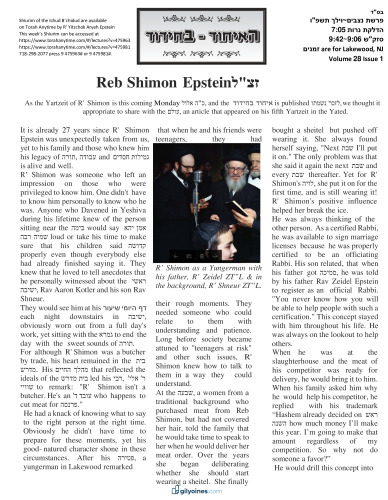
Reb Shimon Epsteinזצ"ל
As the Yartzeit of R' Shimon is this coming Monday כ"ה אלול, and the איחוד בחידודis published לזכר נשמתו, we thought it
appropriate to share with the עולם, an article that appeared on his fifth Yartzeit in the Yated.
It is already 27 years since R' Shimon that when he and his friends were bought a sheitel but pushed off
Epstein was unexpectedly taken from us, teenagers, they had wearing it. She always found
yet to his family and those who knew him herself saying, "Next שבתI'll put
his legacy of תורה, עבודהand גמילות חסדים it on." The only problem was that
is alive and well. she said it again the next שבתand
R' Shimon was someone who left an every שבתthereafter. Yet for R'
impression on those who were Shimon's לויה, she put it on for the
privileged to know him. One didn't have first time, and is still wearing it!
to know him personally to know who he R' Shimon's positive influence
was. Anyone who Davened in Yeshiva helped her break the ice.
during his lifetime knew of the person He was always thinking of the
sitting near the בימהwould say אמן יהא other person. As a certified Rabbi,
שמיה רבהloud or take his time to make he was available to sign marriage
sure that his children said קדושה licenses because he was properly
properly even though everybody else certified to be an officiating
had already finished saying it. They Rabbi. His son related, that when
R’ Shimon as a Yungerman with
knew that he loved to tell anecdotes that his father got סמיכה, he was told
his father, R’ Zeidel ZT”L & in
he personally witnessed about the ראשי by his father Rav Zeidel Epstein
the background, R’ Shneur ZT”L.
ישיבה, Rav Aaron Kotler and his son Rav to register as an official Rabbi.
Shneur. "You never know how you will
their rough moments. They
They would see him at his דף היומי שיעור be able to help people with such a
needed someone who could
each night downstairs in ישיבה, certification." This concept stayed
relate to them with
obviously worn out from a full day's with him throughout his life. He
understanding and patience.
work, yet sitting with the גמראto end the was always on the lookout to help
Long before society became
day with the sweet sounds of תורה. others.
attuned to ''teenagers at risk"
For although R' Shimon was a butcher When he was at the
by trade, his heart remained in the בית and other such issues, R'
slaughterhouse and the meat of
מדרש. His מהלך החייםthat reflected the Shimon knew how to talk to
his competitor was ready for
ideals of the בית מדרשled his רבי, 'ר' אלי them in a way they could
delivery, he would bring it to him.
שווייto remark: "R' Shimon isn't a understand.
When his family asked him why
butcher. He's an ' עובד דwho happens to At the שבעה, a women from a
he would help his competitor, he
cut meat for פרנסה." traditional background who
replied with his trademark
purchased meat from Reb
He had a knack of knowing what to say “Hashem already decided on ראש
to the right person at the right time. Shimon, but had not covered השנהhow much money I’ll make
Obviously he didn't have time to her hair, told the family that
this year. I’m going to make that
prepare for these moments, yet his he would take time to speak to amount regardless of my
good- natured character shone in these her when he would deliver her
competition. So why not do
circumstances. After his פטירה, a meat order. Over the years someone a favor?”
yungerman in Lakewood remarked she began deliberating
He would drill this concept into
whether she should start
wearing a sheitel. She finally
his children’s upbringing that there running in the house, he nearly double the amount of meat.
technically is no such thing as always left the lights on This continued for years. This
competition! Just do what Hashem outside to assist those who person subsequently moved to
wants you to do and let Him take walked through Hashem’s New York. When he ordered $100
care of the rest. yard. As a הכרת הטוב, he would meat at a local butcher, he
He lent thousands of dollars over invite the person who taught expected to receive the same
the years, never asking for him שחיטה, R’ Hertz amount that R’ Shimon
payment. He would say, obviously Kantarovitz who had no customarily gave him. Imagine
the person can’t pay back, when he family of his own to go to, to his surprise when the butcher gave
has the means to do so, he will. spend the two months around him half the amount! He angrily
R’ Shimon would offer drinks to פסחand סוכותin his house. told the butcher he normally got
those who would mow the lawn and Although he had a large more than this from his old
offered the mailman a cup of family, especially when his butcher. The butcher insisted that
coffee. His worker inspired by this own married children would he’s giving him $100 worth of
noble gesture, continued this after move in for יום טוב, he was still meat and showed him that’s what
his passing. an invited guest, for he taught he gave him. It then dawned on
His house operated with an “open him the ropes of the business. him the tremendous חסדhe
door policy.” His attitude was, “It’s Rav Hertz would doze off at received over the years from R’
not my house, it’s Hashem’s the end of the סעודהbefore Shimon.
house,” and lived his life Bentching, sometimes lasting He had trying moments in his life.
accordingly. Of course he had the a half hour or longer. The His business suffered and he had a
help of his esteemed Rebbitzen, children would get impatient, host of ailments and other issues
who ably assisted him in his any yet he would quietly motion but never despaired. His steadfast
endeavors, as she continues to do them to wait. Only after R’ בטחוןkept him going amid all the
till this very day. No one hesitated Hertz would wake up would troubles he faced on a daily basis.
at all to knock on their door. they sing שיר המעלותand He longed for ’משיחs arrival. At
Relatives stayed with their families Bentch. the time of the first Gulf War, he
for months at a time when they had started a מנהגin his home where he
no place to live for various reasons, He combined his אהבת חסד would sing at שלש סעודות, אני
until they could find suitable with הצנע לכתas the פסוקin מאמין. With tears flowing down his
quarters. When a child asked if he מיכהstates. Many חסדיםhe did face, his heartfelt rendering of
would have to give up his bed for a on the quiet. One person these ageless words reflected a
guest again, he answered “give him related that his mother would deep yearning for the days of “ מתי
a bed? It’s not your bed. It’s always receive her meat with תמלוך בציון.”
Hashem’s bed. We just live here!” an envelope. To an outsider it Although he was not privileged to
When his children teased each other looked like a bill; to the family witness ’משיחs arrival, his
“get out of my room”, he would tell it contained much-needed beautiful legacy lives on through
them, “It’s not your room- it’s money. To others he his wonderful family and all those
Hashem’s room.” concealed his חסדיםas regular who knew him who will hopefully
Living down the block from the business. One customer merit heralding משיחby following
Yeshiva, his backyard was used as approached him before יום טוב the example he set for them.
a shortcut by those going to with $100. He said that this is
Yeshiva. While other neighbors all he has. “Please give me as ה.ב.צ.נ.ת
fenced in their yards, he insisted on much as $100 will buy.”
leaving his open. “If it helps Realizing this person’s
Yeshivaliet get to סדרquicker, why wobbly financial situation, R’
not let them?” And although he Shimon told him no problem
made sure no extra lights were and proceeded to give him
Riddles of the Week
Every year, we begin our Riddle of the Week series with the following הקדמה.
Is it מותרfor someone who is asked a riddle to try to find out the answer from someone else when he, himself, doesn't know the answer?
In ' שופטים פרק ידwe are told the story of שמשון הגבורmarrying a Philis�ne woman. At the wedding, שמשוןasks the thirty assembled
guests a riddle. He tells them that if they get the answer to the riddle within seven days, he will give them thirty sheets and thirty suits of clothing.
If they don't get the answer, however, they must give him thirty sheets and thirty suits. Not knowing the answer, they threaten 'שמשוןs new wife
and tell her that if she doesn't get the answer out of שמשוןand tell it to them, they will burn her and her father's house. Without telling שמשוןwhy
she wanted to know the answer, she pleads and cries for seven days un�l שמשוןtells her the solu�on. She then tells the informa�on to the thirty
men who repeat it to שמשוןdemanding their prize. שמשוןpays, but only by killing thirty פלישתיmen, taking their suits and giving the suits to the
wedding guests.
However, he had promised them sheets and suits. Why did he only give them suits? The אברבנאל, as quoted by the מלבי"ם, says that
שמשוןwas not sure of the answer to our ques�on and was, therefore, unsure if he owed them the prize. A�er all, they really didn't know the
answer themselves. They had to resort to threats to get the answer. On the other hand, they did come up with the right answer. Not knowing
whether they could be considered legi�mate riddle solvers he decided to only pay half the bet according to the rule of ממון המוטל בספק חולקין-
when money is in doubt each side gets half.
Yet on the other hand, in מדרש איכה, where it describes the smart children of ירושלים, we find the following story.
One �me, a man from Atoona came to ירושליםand entered a school where the children were learning without their teacher. He started
to ask the students ques�ons and they answered. They then said to the guest, "Let's make a deal. We'll each take turns asking each other riddles.
The first side not to know the answer to the other's riddle will have to give his clothes to the other side." They then said that since he was older, it
was befi�ng for him to answer first. When the man agreed, they asked him a riddle which he didn't know, and they took his clothes.
He, thereupon, went to their rebbe, ר' יוחנן, with the complaint that the people of ירושליםwelcome their guests by taking their clothing.
Rav Yochanan, seeing what had happened, asked if they had asked him a riddle that he couldn't answer. When he admited that that's exactly what
had happened, ר' יוחנןtold him the answer which he took back to the ישיבהand retrieved his clothes.
It seems from this that ר' יוחנןfelt it was permited to tell the man the answer so that he could get back his clothing which he, had he not
found the answer, would have lost "fair and square"?
The בן איש חי, in his תשובות רב פעלים, however, is unsure about this point. It is possible that either 1) ר' יוחנןfelt, as we said, that he was
permited to tell the man the answer or 2) that the boys behaved improperly with their ques�ons and although they, technically, had won the bet,
he wanted the students to return the clothing anyway to soothe the guest's feelings. Even though they didn't have to, because the answer was
goten illegally, Rav Yochanan felt sure that his תלמידיםwould cooperate.
(This was all heard on a tape of a שיעורgiven many years ago by Hagaon Rav Yitzchok Zilberstein שליט"אof Bnei Brak. In a subsequent
tape, a�er men�oning the above once again, he added the following.)
Rav Yehuda Tzadkah זצ"ל, the ראש ישיבהof ישיבת פורת יוסף, told the following story. When he was a young boy growing up in ירושליםthe
Gerer Rebbe, the אמרי אמת זצ"ל, came to visit ירושליםfor the first �me. All the ישיבה בחוריםcame to see the great רביand he asked all the litle
boys some ques�ons. When it was Rav Tzadkah's turn, he was asked by the רביwhat he was learning and he answered משניות שבת. To which he
was asked by the רבי, "How many פרקיםare there in "?מסכת שבתand he answered, "Twenty-four". Asked the רבי, "And why are there twenty-
four?". Rav Tzadkah didn't know. He ran across the streets of ירושליםto where the כף החיים זצ"לwas learning. The כף החייםtold him that שבתis
called a כלהand just like a כלהhas – כ"ד קישוטיןtwenty-four ornaments, so, too, does מסכת שבת. Rav Tzadkah ran back to the Gerrer Rebbe and
told him the answer. The רביthen gave Rav Tzadkah two גרושas a prize. The גרושcoin at that �me was a coin with a hole in the middle. When Rav
Tzadkah brought the coins home to his mother, she �ed a string through one of them thereby making a necklace which she placed around her son's
neck. From then on, said Rav Tzadkah, he had much, much more הצלחהin his learning.
From this story, says Rav Zilberstein, we see that when a riddle or ques�on is asked, the understanding is that the ques�oner wants the
one asked to work on the answer and as long as an effort is made to get the answer even from another source, the reward is his.
But there is yet another purpose to asking a riddle and that is, to facilitate learning and remembering what one has learned. To prove this,
Rav Zilberstein asks the following riddle from a גמרא מפורשת.
Riddle:
When is a person required to sell his father?
Answer:
The : גמ' יבמות צ"טquotes a ברייתאthat tells of a case where someone can sell and must sell his father. This can happen if a person buys
an עבדand a – שפחהa slave and slavewoman - who have a son from before, but the son was not included in the sale. If the purchaser of the slaves,
the אדון, frees the שפחהand then marries her, he is required to give her a כתובהwhich requires payment to her in case he dies or divorces her. If
the אדוןthen writes a will to the son, who is not related to him in any way, which gives the son all his property upon his death and then the אדון
dies, the son inherits all the property which includes the slave, his own father. When the woman requests the payment of the כתובהand there is
no other way to pay the debt, the son sells his father to pay for the כתובהto his mother.
The גמראthen asks ?מאי קמשמע לןWhat does this ברייתאteach us? And it answers that this ברייתאholds that an עבדis considered
– מטלטליןa movable item – and that it holds like רבי מאירwho says that מטלטליןis pledged to a כתובהand must be sold in order to pay for the
כתובה. Or, says the גמרא, the ברייתאholds that an עבדis like land which according to everybody is pledged to the כתובה. (The הלכהis like neither,
an עבדis considered מטלטליןand is not משועבדto the כתובה.)
Asks Rav Zilberstein שליט"א, if the ברייתאwanted to teach us that מטלטליןis pledged to the כתובה, why didn’t it just say so? Why the
convoluted (but very interes�ng) case of a son selling his father? We see from this, says Rav Zilberstein, that the גמראwishes to say things in a
mind-teasing or riddle-like manner so that what is being learned will remain in one’s memory.
A�er that הקדמה, we would like to state that the purpose of our Riddle of the Week is to trigger some thought-provoking discussions at the
Shabbos table or any other place. As such, we will accept any legi�mate answer (some�mes a sole opinion and o�en�mes not )להלכהbrought
to our aten�on no mater the source of the informa�on. And we hope that what is discussed will, indeed, be remembered by all those who
par�cipate in these discussions להגדיל תורה ולהאדירה.
דבר תורה
ָת ָתּה לַ אֲ ָמ ְת� ז ֶַרע
ַ ֹאמר ד' צְ בָ אוֹת ִאם ָראֹ ה ִת ְראֶ ה בׇּ ﬠֳ נִ י אֲ ָמ ֶת� וּזְ כ ְַר ַתּנִ י וְל ֹא ִת ְשׁכַּח אֶ ת אֲ ָמ ֶת� ְונ
ַ ו ִַתּדֹּר נ ֶֶדר וַתּ
ֹאמר ִתּ ְמצָ א ִשׁ ְפ ָח ְת� ֵחן
ֶ וַתּ...ִתּן אֶ ת ֵשׁלָ ֵת� אֲ ֶשׁר ָשׁאַ ְל ְתּ ֵמ ִﬠמּו ֵ ִשׂ ָראֵ ל יְ ֹאמר ְלכִ י ְל ָשׁלוֹם וֵא�הֵ י י
ֶ ַויַּﬠַ ן ﬠֵ ִלי וַיּ...אֲ נ ִָשׁים
'הפטרת ר"ה יום א....( )פרש"י פנים של זעם.ְבּﬠֵ ינֶי� ו ֵַתּלֶ � הָ ִא ָשּׁה ְל ַד ְרכָּהּ וַתּ ֹאכַל וּפָ נֶיהָ ל ֹא הָ יוּ לָ הּ עוֹד
פשטות, חנהwas agitated and very broken by the way פנינהtreated her and by the fact that she was childless.
However, a�er she received ’עליs ברכה, she calmed down and no longer had a face of anger. There are many words used
here that seem to have a much deeper explana�on. Here is the !מהלך החתם סופר
The גמראtells us that when a person is מעביר על מדותיו, they are מוותרon עוולותthat were done to them, מעבירין
(.לו על כל פשעיו )ר"ה י"ז. They are זוכהto !מתנות מן השמיםThey are trea�ng others, with more than they deserve; שמים
too, will deal with them, more than they deserve!
There are occasions when one does not have to be מעביר על מדותיו, and maybe they shouldn’t be מעביר על מדותיו,
for example the person is a רשעand is deliberately causing them pain! We see from the פסוקof יחי ְוכַﬠְ ִסי ִדּבַּ ְר ִתּי
ִ כִּ י מֵ רֹב ִשׂ
ﬠַ ד הֵ נָּה, that חנהfelt that פנינהwas a רשעand was deliberately causing her pain and therefore, פנינהwas not deserved of
ge�ng a pass of מעביר על מדותיו. חנהdid not know that ’פנינהs inten�ons were !לשם שמיםBut חנהrealized that even
though she was en�tled to not let it go, she wouldn’t be זוכהto get a מתנהof זרע של קיימאas she was not being !מוותר
Therefore, when she asked ' דfor a child, she said ד' צבאותwhich the גמ' ברכותteaches us, that חנהwas מחדשa new טענה,
that since ' דhas so many צבאות, it would be befi�ng for ' דto give her a child! This טענה, says the חתם סופר, is a type of
טענהsaid in בית דין, which means, that חנהfelt that she should get the child through מדת הדין, without רחמנות. Not as a
מתנה, as she isn’t being !מעביר על מדותיהBut she felt that in her case, she should NOT be !מעביר על מדותיה
ויען עלי ויאמר, and עליtold her, I think you’re going about this the wrong way! !לכי לשלוםGo back to your family,
and start a new הנהגהwith פנינה, even though she is mistrea�ng you! The reason is because פנינהis really being מתכווין
!!לשם שמיםTherefore, you should be מעביר על מידתך, and then, ואלקי ישראל יתן את שלתך אשר שאלת מעמו. Instead of
coming with a טענהthat you should get a child מן הדין, it will be much easier if you are מעביר על מידתךand get the child
as a !מתנה
She accepted the מוסרof עלי, !ופניה לא היו לה עודThe פנים של זעם, was now gone as she was being מעביר על מדותיו
and she was זוכהto !הריון
רבינו יונהsays, that being מעביר על מדותיוis a shortcut to get !רחמי שמיםWe can get so much more, even more
than we deserve, all by being מוחל, by being מוותרfrom the people that hurt us! We should all be זוכהto a כתיבה וחתימה
!טובה
RIDDLE OF THE WEEK
When should we be concerned about the last time the חזןin our Shul took a haircut?
PARSHA MYSTERY
???מה הטעם 'מצוות הקהל' היא דוקא במוצאי שמיטה בחג הסוכות
ANSWER
'מה שקבעה תורה מצות הקהל בסוכות במוצאי שמיטה י"ל משום דסוכות נקרא 'חג האסיף-וז"ל טעמא דקרא )ל"א י'( במועד שנת השמיטה בחג הסוכות
אמנם התורה הבטיחה שבשנה הקודמת תעשה התבואה לב' שנים ולזה מזכירין בסוכות,שאוספין את התבואה ובשמיטה שלא זרעו אין מה לאסוף
!בהקהל בזה שקוראין בסוכות שנתקיים מה שהבטיחה התורה שהתבואה מוכנה משנה שעברכה וא"צ לאסוף אם מקיימין את התורה
If you have any comments or answers to the riddles or the דבר תורה, please fax them to 732-363-4947 or email me at ichudbchidud@gmail.com.
If you would like the English איחוד בחידודemailed to you at no charge, please send us a request at ichudbchidud@gmail.com !!
Riddles of the week & the answers are written by R’ Michoel Levi of Bais Yaakov D’Rav Meir