
The Maharsham Project - English — Nitzavim Vayelech (2026-08-31)
W E E K LY T E S H U VA H I N S I G H T S F R O M T H E M A H A R S H A M O F B R E Z H A N
THE
MAHARSHAM שו״ת מהרש״ם
P R O J E C T
Issue No. 27 · Two Teshuvos of the Maharsham
לעילוי נשמת
הרה״ק רבי ישכר בער מסאטמאר
בן הרה״ק רבי מרדכי מנדבורנא זצללה״ה
Two teshuvos this issue instead of one, because both are unusually short. They come from far corners of
the Maharsham's world: a shidduch made sight unseen that came apart, and a young man's new glass eye.
Different worlds, and, as it turns out, one habit of mind.
ONE · TESHUVOS MAHARSHAM, CHELEK I, SIMAN 195
He Had Never Seen the Kallah
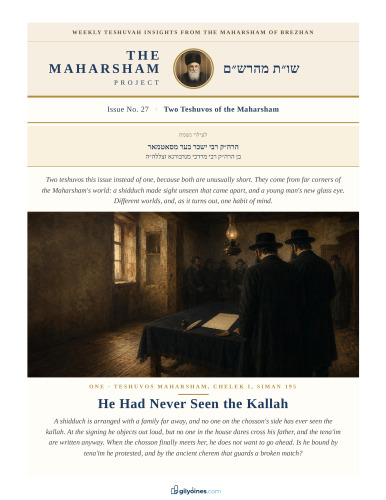
A shidduch is arranged with a family far away, and no one on the chosson's side has ever seen the
kallah. At the signing he objects out loud, but no one in the house dares cross his father, and the tena'im
are written anyway. When the chosson finally meets her, he does not want to go ahead. Is he bound by
tena'im he protested, and by the ancient cherem that guards a broken match?
1
THE CASE
The match was made with a family from a far village, and no one on the chosson's side had ever seen the kallah, not the
chosson, not even his parents. When they sat to write the tena'im, the chosson protested out loud, in front of several
people, that they still had not seen her, and he said the same to his mother. But no one in the house dared cross his father,
so the objection never reached him, and the tena'im were written anyway. Only afterward did the chosson meet the
kallah, and he did not find her pleasing. His father then sent the tena'im back to the kallah's father, who answered that he
accepted their return and would not drag them to beis din, but that he did not forgive them. The question reached the
Maharsham from Rav Nesa Yaakov Edelstein, av beis din of Chernelitza: with the match broken, does the cherem
hakadmonim, the old cherem on one who walks away from a shidduch, now fall on the chosson's side?
T H E M A H A R S H A M ' S A N A LY S I S
Two separate questions sit inside this, and the Maharsham keeps them apart. First, is there money anyone can actually
collect, the penalty written into the tena'im? Second, and only after that clears, does the ancient cherem still bind?
The money he answers quickly. The questioner had raised the Chasam Sofer, who held that even when a chosson's
refusal counts as ones, so that his father escapes the penalty written into the tena'im, the father still should not hand his
son a dowry. The Pnei Yitzchak argued the other way, that the father owes nothing beyond trying, in words, to bring his
son round. The Maharsham does not need to settle that argument. Here the chosson protested as the tena'im were being
written, and on that fact every opinion agrees that no dowry can be demanded of his father. He adds that the earlier
poskim run against the Chasam Sofer in any case. The kallah's father had already said he would not sue. So no beis din
is collecting here.
That leaves only the cherem, and a cherem is not a matter of proof. The kallah's father is not asking for money; he is
withholding his forgiveness and invoking the old ban. Whether it binds turns on one thing alone: is the chosson's reason
genuine, or a pretext dressed up to escape the match? And that is kelapei shemaya galya, a truth open to Heaven even
where no court can test it.
What was the reason? Only that, once he saw her, the chosson did not find her attractive; she was very short, he said,
and not beautiful in his eyes. The Maharsham refuses to call this a grave flaw. He even notes that in Shir HaShirim a
woman's stature is counted among her praises. Yet he rules that if the chosson honestly declines for this reason and no
other, with no cunning behind it, the cherem does not attach. Everything rests on whether, in his own heart, that is truly
why.
THE P'SAK
The money claim fails. Because the chosson protested as the tena'im were being written, no penalty and no
dowry can be collected from his father, and the kallah's father does not sue in any case. The cherem binds only a
pretext. Since the kallah's father asks not for money but for the ancient cherem, it holds only if the refusal is a
cover story. If the chosson knows in his own heart that he truly declines for the reason he gives, free of any
trickery, no cherem falls on him. That last question is between him and Heaven.
TWO · TESHUVOS MAHARSHAM, CHELEK II, SIMAN 5
The Glass Eye on Shabbos
A young man blind in one eye is fitted with a glass eye so lifelike that no one notices, set firmly in the
socket. May he walk out into the street with it on Shabbos?
2
THE CASE
A young man blind in one eye was fitted by doctors in Warsaw with a polished glass eye, so like a real one that a passing
glance would never catch it. They worked up to it in stages. First a small eye, until the socket settled and grew used to it;
then a larger one, so lifelike that only a long, deliberate look reveals it is not real. In time, they told him, they would
replace the glass with a refined metal eye that would not shatter if it ever fell. The question came from Rav Aryeh
Shlomo Naumiast, a dayan in Kamarove near Tomashov: may the young man go out with it into a reshus harabim on
Shabbos?
T H E M A H A R S H A M ' S A N A LY S I S
The Gemara had faced a cousin of this question, a woman's false tooth. The Mishnah and Gemara treat a gold tooth and
a silver one differently, and the Shulchan Aruch rules the same: on Shabbos a woman may go out with a plain tooth, but
not with a gold one. Why the gold? Because it stands out. People notice it and smirk, she grows embarrassed and slips it
out to spare herself, and now she is carrying it four amos in the public domain. The silver draws no eye, so none of that
ever begins. The Maharsham's question is which of the two a glass eye resembles.
He gives four reasons it is the silver, and they stack. First, it sits fixed firmly in the socket, so the fear that it falls does
not arise. Second, it is so natural that no one mocks or even stares, so there is no embarrassment to make him take it out.
Third, and here he reaches for a rule from an unexpected corner: a kohen with a blemish or a blind eye may not lift his
hands to bentch the people, lest they stare at him, yet once he is dash b'iro, familiar in his own town for thirty days, the
worry lapses and he does. So here too, once the townsfolk know the young man's face, no one is studying his eye. And
fourth, one does not originate a new gezeirah for a case that is barely met with. Put together, the very worry behind the
gold-tooth decree simply never appears.
THE P'SAK
He may go out with it on Shabbos, glass or metal alike. Fixed firmly, unremarkable to the eye, and made familiar
once his town knows his face, the glass eye never raises the concern the gold-tooth decree was built to stop, and
the coming metal eye stands on the same ground. There is no cause to extend an old gezeirah to so rare a case.
W H AT Y O U N O W K N O W
One dispute can hold more than one claim. A beis din that cannot collect money has not thereby settled a
cherem or an obligation before Heaven; weigh each on its own. And where a psak rests on a person's true
motive, halacha can leave that final step kelapei shemaya, to the honesty of the heart.
Resemblance alone does not forbid. Before an old gezeirah is stretched over a new thing, find the exact worry
the Sages were guarding against, then ask whether this case truly raises it. A glass eye looks like the forbidden
gold tooth, but the fear behind that decree, that it comes off and gets carried, never arises.
3
✦ ◦ ✦
KEY TERMS
Cherem hakadmonim · ( )חרם הקדמוניםA ban of the early Dash b'iro · (" )דש בעירוFamiliar in his town." A visible
authorities against unjustifiably breaking a formal shidduch; a irregularity that might draw stares stops doing so once the
communal sanction, separate from any penalty in the tena'im. community grows used to the person, after thirty days.
Kelapei shemaya galya · (" )כלפי שמיא גליאIt is revealed to Reshus harabim · ( )רשות הרביםA halachic public domain, where
Heaven." The true motive is known Above even when a beis din carrying an object or moving it four amos is forbidden on Shabbos.
cannot verify it, so the ruling rests on honest intent.
THE TWO QUESTIONERS
The first case reached the Maharsham from Rav Nesa Yaakov Edelstein, av beis din of Chernelitza. The second came from
Rav Aryeh Shlomo Naumiast, a dayan in Kamarove, near Tomashov. Two towns and two very different questions, a broken
shidduch and a young man's new glass eye, brought to the same posek in the same season.
COMING NEXT WEEK
For thirty years he took out the Sefer Torah, an honor he never bought.
Then he traveled, his sons took his place, and his brother objected.
Had thirty years made the honor his to hand down?
W H O WA S T H E M A H A R S H A M ?
Rabbi Shalom Mordechai HaKohen Schwadron, ben HaRav Moshe (1835–1911), served as the Rav of Brezhan in Galicia
for over 40 years. He is best known for his seven-volume Shut Maharsham, containing thousands of teshuvos on every
area of halachah, and his Da'as Torah commentary on Shulchan Aruch. Regarded as one of the foremost poskim of his
generation, his rulings are cited in halachic works to this day.
P R I N C I PA L S O U R C E S
Case One: Chasam Sofer; Pnei Yitzchak, Even HaEzer 17; Mabit, Chelek I, Siman 85; Shach, Yoreh De'ah 236:7; Darchei Noam; and further poskim cited within.
Source: Teshuvos Maharsham, Chelek I, Siman 195 (verified against Sefaria).
Case Two: Mishnah and Gemara, Shabbos 64b–65a (the gold and silver tooth); Shulchan Aruch, Orach Chaim 303:12; Rashi and Meiri, Rashba, Ran, and the
Yerushalmi ad loc.; Rambam; Rosh Yosef to Shabbos 65; the kohen who is dash b'iro, Shulchan Aruch Orach Chaim 128 (from Megillah); Sha'ar HaMelech, Hilchos
Shofar; Tzlach, Pesachim 65. Source: Teshuvos Maharsham, Chelek II, Siman 5 (verified against Sefaria).
R E C E I V E T H E M A H A R S H A M P R O J E C T E V E RY W E E K
Scan the QR code or visit kechnia.org/maharsham to subscribe. Free weekly delivery to your inbox.
This translation is presented for Torah study and enrichment purposes only. It is not intended as halachah l'maaseh. The translator has made every effort to render the Maharsham's
words faithfully, but this English adaptation may contain errors or imprecisions. For any practical halachic question, consult your own Rav.
The Maharsham Project · kechnia.org/maharsham · · לעילוי נשמת הגה״ק רבי שלום מרדכי בן רבי משה הכהן זצללה״הinfo@kechnia.org
4