
Living Appreciation — Ki Savoi (2026-08-24)
בס"ד
Dedicated in the zechus for a פרשת כי תבא
refuah shleimah for Shoshana Issue 235
Emuna Bas Penina Devora
and everyone else who needs.
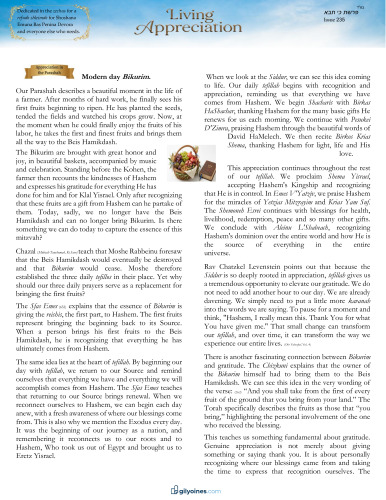
Modern day Bikurim. When we look at the Siddur, we can see this idea coming
to life. Our daily tefillah begins with recognition and
Our Parashah describes a beautiful moment in the life of appreciation, reminding us that everything we have
a farmer. After months of hard work, he finally sees his comes from Hashem. We begin Shacharis with Birkas
first fruits beginning to ripen. He has planted the seeds, HaShachar, thanking Hashem for the many basic gifts He
tended the fields and watched his crops grow. Now, at renews for us each morning. We continue with Pesukei
the moment when he could finally enjoy the fruits of his D'Zimra, praising Hashem through the beautiful words of
labor, he takes the first and finest fruits and brings them David HaMelech. We then recite Birkos Krias
all the way to the Beis Hamikdash. Shema, thanking Hashem for light, life and His
The Bikurim are brought with great honor and love.
joy, in beautiful baskets, accompanied by music
and celebration. Standing before the Kohen, the This appreciation continues throughout the rest
farmer then recounts the kindnesses of Hashem of our tefillah. We proclaim Shema Yisrael,
and expresses his gratitude for everything He has accepting Hashem's Kingship and recognizing
done for him and for Klal Yisrael. Only after recognizing that He is in control. In Emes V'Yatziv, we praise Hashem
that these fruits are a gift from Hashem can he partake of for the miracles of Yetzias Mitzrayim and Krias Yam Suf.
them. Today, sadly, we no longer have the Beis The Shemoneh Esrei continues with blessings for health,
Hamikdash and can no longer bring Bikurim. Is there livelihood, redemption, peace and so many other gifts.
something we can do today to capture the essence of this We conclude with Aleinu L'Shabeach, recognizing
mitzvah? Hashem's dominion over the entire world and how He is
the source of everything in the entire
Chazal (Midrash Tanchumah, Ki Savo) teach that Moshe Rabbeinu foresaw universe.
that the Beis Hamikdash would eventually be destroyed
and that Bikurim would cease. Moshe therefore Rav Chatzkel Levenstein points out that because the
established the three daily tefillos in their place. Yet why Siddur is so deeply rooted in appreciation, tefillah gives us
should our three daily prayers serve as a replacement for a tremendous opportunity to elevate our gratitude. We do
bringing the first fruits? not need to add another hour to our day. We are already
davening. We simply need to put a little more kavanah
The Sfas Emes (632) explains that the essence of Bikurim is into the words we are saying. To pause for a moment and
giving the reishis, the first part, to Hashem. The first fruits think, "Hashem, I really mean this. Thank You for what
represent bringing the beginning back to its Source. You have given me." That small change can transform
When a person brings his first fruits to the Beis our tefillah, and over time, it can transform the way we
Hamikdash, he is recognizing that everything he has experience our entire lives. (Ohr Yechezkel, Vol. 4)
ultimately comes from Hashem.
There is another fascinating connection between Bikurim
The same idea lies at the heart of tefillah. By beginning our and gratitude. The Chizkuni explains that the owner of
day with tefillah, we return to our Source and remind the Bikurim himself had to bring them to the Beis
ourselves that everything we have and everything we will Hamikdash. We can see this idea in the very wording of
accomplish comes from Hashem. The Sfas Emes teaches the verse: (26:2) “And you shall take from the first of every
that returning to our Source brings renewal. When we fruit of the ground that you bring from your land.” The
reconnect ourselves to Hashem, we can begin each day Torah specifically describes the fruits as those that “you
anew, with a fresh awareness of where our blessings come bring,” highlighting the personal involvement of the one
from. This is also why we mention the Exodus every day. who received the blessing.
It was the beginning of our journey as a nation, and
remembering it reconnects us to our roots and to This teaches us something fundamental about gratitude.
Hashem, Who took us out of Egypt and brought us to Genuine appreciation is not merely about giving
Eretz Yisrael. something or saying thank you. It is about personally
recognizing where our blessings came from and taking
the time to express that recognition ourselves. The
farmer could not simply send his fruits with someone
else. He had to make the journey himself, stand before
the Kohen and personally acknowledge all that Hashem
had done for him.
Our Parashah teaches us the mitzvah of Bikurim — bringing
We see this idea in a fascinating halachic detail. Modim
the first fruits to Yerushalayim. The Torah refers to these fruits as
D'Rabanan, the expression of gratitude that we say during
reishis, "the first," the very same word used at the creation of the
the repetition of Shemoneh Esrei, is unique: it is the only
world. Chazal explain that Bereishis can be read as bishvil reishis
berachah in which the shaliach tzibbur and the congregation — that the world was created "because of the first," referring to
express their thanks together. Why? The shaliach tzibbur bikurim. What is so fundamental about this mitzvah? The Alshich
can represent us in the public prayer, but when it comes explains that the whole essence of bikurim is gratitude to Hashem
to expressing our personal gratitude to Hashem, he for giving us produce. Gratitude is so fundamental that is the
cannot say it on our behalf. Each person must express his reason for the creation of the world! (Alshich, Ki Savo 26:2)
own thanks. Gratitude must come personally from the
one who received the kindness. (Abudramah on the Siddur, Modim)
Chazal teach that Bikkurim has no minimum measurement;
Just as gratitude cannot be expressed through a even one single grain of wheat can fulfill the mitzvah. Yet for that
messenger, we also cannot appoint a messenger to daven tiny gift, the Torah gives us an entire passage of Mikra Bikkurim in
for us. At the heart of tefillah is our personal connection which we recount and recognize all the kindness Hashem has
to Hashem, and our gratitude for all that He does for us.. done for us. Rav Yerucham Levovitz, points out a beautiful idea.
Imagine giving someone a small coin, and instead of simply
We need to stand before Hashem ourselves, open our
accepting it, he responds by recognizing your kindness and
hearts and express our own thanks generosity. Who has received more from the exchange? The
personally. recipient received the coin, but the giver received something
During the final years of Rav Elyashiv's life, he required a serious much greater—the recognition of his goodness. This is the idea of
operation, and a top surgeon was flown in from America to perform Bikkurim: Hashem gives us a small gift, and through it, He gives us
the opportunity to recognize His tremendous kindness. The same
it. After the surgery, Rav Elyashiv asked those around him how to
is true of all mitzvos. We may feel that we are giving something to
say "thank you" in English. They were surprised and offered to Hashem, but in reality, Hashem is giving us the opportunity to give
thank the doctor for him. Rav Elyashiv insisted, "No. I need to back and, most importantly, to recognize how much He has given
thank him personally." He practiced saying "thank you" in us. We are not merely giving Hashem a gift; He is giving us the gift
English until he could say it himself. Then he personally thanked of having something to give back. (Da'as Hochmah UMussar 1:70)
the surgeon in his own
language. The verse states, (27:9) “Today you have become a nation to
Hashem your G-D.” Chazal teach that every day, the Torah should
Matir Asurim (1) feel as though it has been given to us anew. The Alter of Slabodka
Chazal teach, “When you sit up, say: ‘Blessed is He who releases explains that this is not just a way of looking at things. The Torah
. bound.’” This blessing was recited upon sitting up in bed.
the really is being given to us every day. The voice of Hashem that was
When we are asleep, we are not free to move around. We are heard at Har Sinai never stopped; it continues to speak to us and
confined to our beds, unable to get up and go wherever we wish. guide us today. We may wonder: How can an ordinary, physical
Upon arising, we are granted our freedom of movement once person hear an eternal voice? The answer is that Hashem created
again. We can sit up, stand, walk, stretch our arms and use our us with a neshamah that is eternal, and even our physical
hands. This simple ability is something that warrants tremendous existence has a spiritual foundation. We were created with the
appreciation. ability to hear Hashem's voice and receive His Torah. This means
that when we open the Torah today, we should not feel that we
Rav Shimshon Pincus this appreciation should not be limited to are simply studying words that were given thousands of years ago.
the moment we first get out of bed. We can have in mind our Hashem's message is being given to us now—and we were
freedom of movement throughout the entire day. (Nefesh Shimshon, Tefilah) created with the ability to hear it.
Think about how much we accomplish simply because we can
move our bodies. From the moment we wake up, we get out of Things to appreciate: Elul. Elul is a tremendous gift from Hashem,
bed, walk to the bathroom, brush our teeth, get dressed, bend filled with unique spiritual potential. The Hafla’ah teaches that an
down, reach for things, carry objects, climb stairs, sit down and hour in Elul is like a day during the rest of the year! (Panim Yafos 16:30) It
is a special eis ratzon for teshuvah and tefillah, giving us the
stand up. We perform countless movements throughout an opportunity to rectify the past and begin the new year afresh.
ordinary day, almost all without giving them any thought.
Compiled by Daniel Shasha, for feedback, dedication opportunities, or to subscribe, please contact us at livingappreciation@gmail.com It could be viewed at
Yet behind every
torahlectures.org movement is an astonishingly complicated
or gilyoinos.com
process.