
A Mushel Zich Tzi Lernen - English — Ki Savoi (2026-08-24)
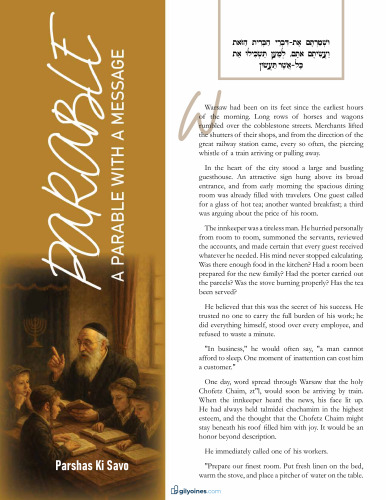
דבְ ֵרי ַה ְּב ִרית ַה ּזֹאת-ת ִּ ו ׁ ְּש ַמ ְר ֶּתם ֶא
לְ ַמ ַען ַּת ְׂש ּ ִכיל ּו ֵאת,וַ ֲע ִׂש ֶיתם א ָֹתם
שוּן
ׂ א ׁ ֶשר ַּת ֲע-ל
ֲ ּ ָכ
W Warsaw had been on its feet since the earliest hours
of the morning. Long rows of horses and wagons
rumbled over the cobblestone streets. Merchants lifted
the shutters of their shops, and from the direction of the
great railway station came, every so often, the piercing
whistle of a train arriving or pulling away.
In the heart of the city stood a large and bustling
guesthouse. An attractive sign hung above its broad
entrance, and from early morning the spacious dining
room was already filled with travelers. One guest called
for a glass of hot tea; another wanted breakfast; a third
was arguing about the price of his room.
The innkeeper was a tireless man. He hurried personally
from room to room, summoned the servants, reviewed
the accounts, and made certain that every guest received
whatever he needed. His mind never stopped calculating.
Was there enough food in the kitchen? Had a room been
prepared for the new family? Had the porter carried out
the parcels? Was the stove burning properly? Has the tea
been served?
He believed that this was the secret of his success. He
trusted no one to carry the full burden of his work; he
did everything himself, stood over every employee, and
refused to waste a minute.
"In business," he would often say, "a man cannot
afford to sleep. One moment of inattention can cost him
a customer."
One day, word spread through Warsaw that the holy
Chofetz Chaim, zt"l, would soon be arriving by train.
When the innkeeper heard the news, his face lit up.
He had always held talmidei chachamim in the highest
esteem, and the thought that the Chofetz Chaim might
stay beneath his roof filled him with joy. It would be an
honor beyond description.
He immediately called one of his workers.
Parshas Ki Savo "Prepare our finest room. Put fresh linen on the bed,
warm the stove, and place a pitcher of water on the table.
Everything must be spotless and in perfect order." has already been prepared."
"When is the guest expected to arrive?" the worker The Chofetz Chaim agreed. The innkeeper gathered
asked. his luggage, carried it out to the carriage, and helped
him inside. The driver flicked the reins, the horses began
"In a few hours," the innkeeper replied. "But for a
to move, and the carriage set off through the crowded
guest of this stature, one does not wait until the last
streets of Warsaw.
minute."
At first, the innkeeper sat in silence. He was
He hired a handsome carriage and set out for the
overwhelmed by the privilege of sitting beside the
railway station himself. A mountain of work awaited
holy Chofetz Chaim. After a little while, however, the
him at the guesthouse, but on this occasion he entrusted
Chofetz Chaim turned toward him.
it all to his servants. He could not bear the thought that
the Chofetz Chaim might step down from the train and "Tell me," the Chofetz Chaim asked, "what do you do
have to search for a place to stay. for a living?"
The station was in an uproar. Travelers dragged "I run a guesthouse," the man replied. "We have
heavy valises across the platform. Children clung to rooms, a kitchen, and a large dining hall. Travelers come
their mothers' coats. Porters shouted above the noise, from many different cities and stay with us."
while owners of inns and guesthouses darted among
the passengers, each hoping to
secure a new guest. At last, a long whistle sounded in the distance. A black
The innkeeper stood on the cloud of smoke rose above the tracks. Moments later,
platform and pulled out his
watch every few minutes.
the train rolled into the station. Its enormous iron
"The train should be here
wheels clattered against the rails, steam burst from
already," he murmured. beneath the engine, and the whole machine came to
At last, a long whistle a halt with a thunderous roar. The doors opened, and
sounded in the distance. A
black cloud of smoke rose hundreds of passengers began to descend.
above the tracks. Moments
later, the train rolled into the station. Its enormous
iron wheels clattered against the rails, steam burst from "And how is your livelihood?"
beneath the engine, and the whole machine came to a A smile appeared on the innkeeper's face.
halt with a thunderous roar. The doors opened, and
hundreds of passengers began to descend. "Baruch Hashem, Rebbe. We are never short of guests.
Business is good, and many of our visitors return again.
The innkeeper narrowed his eyes and searched the
I try to serve them properly and make certain that they
sea of faces. Suddenly, he caught sight of the Chofetz
are pleased."
Chaim. He pushed his way through the crowd and
hurried forward. הֹודּו לַ ה׳. "Give thanks to Hashem," said the Chofetz Chaim.
"I am happy to hear of your success."
"Shalom aleichem, Rebbe!" he cried with delight. "I
have been waiting for the Rebbe. Please grant me the For several minutes the Chofetz Chaim was quiet.
privilege of hosting the Rebbe at my guesthouse." The carriage jolted over the stones, and the cries of the
street merchants drifted in from outside. Then he asked
The Chofetz Chaim looked at him warmly.
another question.
"You came all the way here to meet me?"
"And what about setting aside fixed times for Torah
"Yes, Rebbe. A carriage is waiting outside, and a room study? When do you sit down to learn?"
The smile disappeared from the innkeeper's face. He nobleman's cold decree. For reasons listed in the order,
lowered his eyes to his hands and released a deep sigh. the nobleman had decided to confiscate the fields and
expel the peasant from the cottage.
"Rebbe, what can I tell you? The day is too short and
the work is too great. From before dawn until late at The peasant stared at him, certain that he had
night, I must be there to serve the guests. One man misunderstood.
needs a room, another needs a meal, and a third has a
"Expel me? From my home? I have lived here for so
complaint. If I am not present every minute, the entire
many years! My children were born here!"
place falls into confusion."
The servant shrugged.
He leaned a little closer to the Chofetz Chaim, like a
man explaining an obvious calculation. "The order has already been issued. Unless you find a
way to have it revoked, we will return and cast you and
"My entire livelihood depends on the satisfaction your entire family into the street."
of my guests. A satisfied guest returns, and he tells his
acquaintances that my establishment is a good place The peasant's wife stood in the doorway, a small child
to stay. But if I disappear in the middle of the day to in her arms. The older children huddled behind her.
sit and learn, who will serve them? Who will supervise The peasant looked at their frightened faces, and the
the kitchen? Who will make certain that the rooms are color drained from his own until he was white as chalk.
ready?"
No one in the cottage slept that night. The peasant
"I truly wish I could learn," he concluded with another paced from one end of the room to the other. From
sigh, "but I cannot abandon my livelihood." time to time he lifted the decree, stared at it again,
and immediately dropped it, as though the paper itself
The Chofetz Chaim listened to every word. He did burned his fingers.
not interrupt, nor did he answer immediately. For
a while he gazed through the carriage window at the The next morning, he hurried to the wisest men in
streets passing by. Then he turned to the innkeeper. the village and told them what the nobleman intended
to do.
"Listen carefully," he said. "I will tell you a mashal."
"You cannot stop him by yourself," one of them said.
In a small village far from the great city lived a simple "But if you travel to the capital and submit a petition to
peasant. He owned a modest cottage, worked several the higher authorities, they may be able to overturn the
fields, and kept a few animals in a stable. The land was decree."
not truly his. It belonged to the local nobleman, and
each year the peasant had to pay for the right to live and "How soon must I go?"
work there. "As soon as you possibly can," the man replied. "If
The peasant was not a man of great learning, but he the nobleman carries out his plan before you succeed
in having the order revoked, it may already be too late."
was honest, loyal, and hardworking. Every morning,
long before sunrise, he went out to the fields. He plowed, The peasant did not waste a moment. He gathered his
sowed, harvested, and carried the grain home. Years of papers, placed a little bread in a sack, and prepared to
labor had roughened his hands and bent his back. leave. His wife took the few rubles they had managed to
save and pressed them into his hand.
One afternoon, as he returned from the fields, he
noticed two unfamiliar horses tied near his cottage. Two "Go," she whispered, "and save us."
of the nobleman's servants stood beside the door. One
of them held a folded document in his hand. Her words echoed in his ears throughout the journey
to the railway station.
The peasant stopped abruptly.
When he reached the station, the platform was still
"What are you doing here?" he asked. almost empty. He hurried to the railway official.
The servant opened the paper and read aloud the "When does the train arrive?"
"In half an hour." swelled, and sweat began to pour from his forehead.
The passengers lifted their heads. At first they assumed
Half an hour. To another man, it might not have
that he was trying to move the bench. But when they
seemed long. To the terrified peasant, every minute felt
saw him pushing, straining, and groaning without pause,
like an entire year. He could not sit down. He paced
one of them finally asked, "What in the world are you
back and forth, stared down the tracks, pulled the
doing?"
papers from his pocket, examined them, and put them
away again. The peasant did not even stop.
"Who knows what is happening at home right now?" "Can't you see? I am making the train go faster! I must
he thought. "Perhaps the nobleman's men are already reach the capital urgently, and this train is moving too
on their way to my cottage!" slowly."
At last he heard the train. He stationed himself at Several passengers burst into laughter.
the edge of the platform, ready to leap through the
first open door. The moment the train stopped, he "You are speeding up the train by pushing a bench?"
scrambled aboard, found a place, and sat with his sack
The peasant was offended.
between his feet.
"Why are you laughing? When my horse cannot pull a
The whistle shrieked. The boiler groaned. The
wagon, I push from behind and it helps. This train must
enormous wheels began to turn, and the engine pulled
pull so many heavy carriages. I am trying to lend it some
the line of carriages away from the station in the
strength."
direction of the capital.
An elderly, serious-looking traveler folded his
But to the anxious peasant, the train was moving far
too slowly. newspaper and turned toward the peasant.
He stared through the window. The trees were indeed "Listen to me," he said. "Do you know how many
racing backward, but to his eyes everything seemed thousands of pounds this engine and its machinery are
sluggish and heavy. pulling? Do you really imagine that your two hands can
add power to such a gigantic train?"
"At this rate, I will never arrive," he muttered. "This
train is crawling like an exhausted horse." The peasant looked down at his roughened hands.
The other passengers paid little attention to him. One "Perhaps not very much," he admitted, "but surely a
read a newspaper, another slept, and a third watched the little..."
countryside through the window. The peasant, however, "No," the traveler replied. "Not only is your strength
grew more restless by the minute. insignificant beside the power of the engine; you are
Then he looked at the large wooden bench in front of standing inside the carriage."
him, and an idea flashed into his mind.
He pointed toward the bench.
Back in the village, whenever his horse struggled to
"You, the bench, and this entire carriage are already
pull a heavy wagon up a hill, the peasant would jump
being pulled by the same engine. When you push the
down and push the wagon from behind. That relieved
bench, you do not push the train at all. You only exhaust
the horse's burden, and the wagon really did move faster.
yourself."
"Why should I not do the same thing here?" he
The peasant stopped. His arms dropped helplessly to
thought. "Perhaps the train needs a little help."
his sides. He stood in embarrassment in the middle of
He rose, rolled up his sleeves, planted both hands the carriage while the wheels beneath his feet continued
against the bench in front of him, and began to push their steady rhythm, moving at precisely the same speed
with all his strength. as before.
His face turned crimson. The veins in his neck He sat down and wiped the sweat from his face.
"Is there truly nothing I can do?" he asked in a broken The peasant looked toward the smoke-darkened
voice. "My home and family are in danger. I must arrive windows at the front of the train. He slipped a hand
sooner." into his pocket and grasped the ruble his wife had given
him. At last he understood the difference.
The elderly traveler now leaned closer to him.
Until now, he had poured all his strength into an effort
"Yes," he said, "there is something you can do. The
that had not added so much as a drop of speed. He had
power of this train does not come from the benches,
and it does not come from the passengers sitting in the sweated, strained, and groaned, convinced that he was
carriages. Its power comes from the fire that heats the helping - while the train had continued at exactly the
water in the great boiler." same pace.
"And how can that fire be made stronger?" A train is not driven by the passenger who pushes
hardest inside the carriage. It is driven by the fire in the
"By adding more coal. Go to the first carriage, where engine.
the fireman tends the boiler. Tell him that you are in
desperate need and that you are willing to give him The Chofetz Chaim finished the mashal and looked at
a ruble if he can add more coal and raise the steam the innkeeper. Outside the carriage, shops, pedestrians,
pressure. If you truly wish to add power to the train, do wagons, and horses continued to pass by. Inside,
not push the bench. Put coal into the boiler." everything had grown quiet.
THE ENTERPRETATION............
The innkeeper already understood where the Chofetz He opens his eyes in the morning, and his mind is
Chaim's words were leading. already filled with calculations. He must call a customer,
answer a supplier, pay a bill, solve a problem, supervise
"Hashem sits in Heaven and sustains the entire world
an employee, and make certain that no one takes away
with a power beyond our comprehension, from the
his opportunity.
greatest of His creations to the smallest," the Chofetz
Chaim said softly. "Do you imagine that if you struggle He really does want to learn. He has nothing against
for one more hour and then another, never pausing attending a shiur. He knows that Torah is holy and
even to learn Torah, you will somehow add strength to precious. Yet he tells himself, "Not now. Right now I am
His direction of the world?" busy with business. When things become a little calmer,
"You believe that you are helping the train of your I will sit down and learn."
livelihood by pushing the bench. In truth, you are But things never become calmer. One customer
merely exhausting yourself." leaves and another enters. One problem is settled, and
The innkeeper lowered his eyes. two new ones appear. The man runs faster, sleeps less,
and worries more.
"And where," he asked quietly, "does one put in the
coal?" He pushes the bench with both hands - and remains
convinced that he is pushing the train.
The Chofetz Chaim answered, "When you establish a
fixed time for Torah study, that is when you place coal This does not mean that a person should not work.
into the boiler. Torah draws blessing into everything A Jew must do what is required of him. He must be
you do." honest, diligent, responsible, and careful. The innkeeper
had to serve his guests, just as the merchant must run
This is not merely the story of an innkeeper in Warsaw. his business. But he must know who the true Master is
It is the story of every person who runs, rushes, and and where the real power of livelihood originates.
works from morning until night because he is certain
that his entire livelihood rests upon his own shoulders. The bench inside the carriage is also part of the train.
One must sit upon it. It must be kept clean. If it breaks, beside streams of water, which yields its fruit in its season, whose
it must be repaired. But the bench is not the boiler. leaf does not wither; and everything he does will succeed."
Our work is the vessel through which we receive (Tehillim 1:2-3)
our livelihood. The blessing that allows that vessel to
succeed comes from Hashem. This is what the Torah Why must this promise be written in the Torah,
teaches: repeated in the Prophets, and stated yet again in the
Writings?
לְ ַמ ַען ַת ְּשׂכִ ּילּו ֵאת כָ ּל־,ת־דּבְ ֵרי ַהבְ ִּרית ַהזֹּאת וַ ֲע ִש ֶׂיתם א ָֹתם
ִ ּוש ַׁמ ְר ֶתּם ֶא
ְ
א ֶשׁר ַת ֲּעׂשּון.ֲ Because human eyes see only the bench directly in
front of them. A person sees the business, the customer,
"You shall safeguard the words of this covenant and fulfill the merchandise, and the accounts. He can touch them.
them, so that you may prosper in everything you do." He can push them. But the boiler is farther ahead,
hidden behind iron walls. The fire and the pressure of
(Devarim 29:8) the steam are not visible to him. He therefore begins to
Rabbi Yehoshua ben Levi teaches in the Gemara: believe that only what he can see is real.
ְּומ ֻשׁלָ ּׁש, וְ ָשׁנּוי בַ ּנְ ּבִ ִיאים,ּּתֹורה
ָ ַ ָדּבָ ר זֶ ה כָ ּתּוב ב:הֹוש ַׁע בֶ ּן לֵ וִ י
ֻ ְָא ַמר ַרבִ ּי י The Torah comes and tells him once, twice, and three
נְ כָ ָסיו ַמצְ לִ ִיחין לֹו- ּּתֹורה ָ ַעֹוסק ב ֵ כָ ּל ָה:בַ ּכְ ּתּובִ ים. times: The true power is not where your eyes imagine
it to be. The power lies in the fire of Torah and in the
"Rabbi Yehoshua ben Levi said: This teaching is written in the blessing of Hashem.
Torah, repeated in the Prophets, and stated a third time in the
Writings: Whoever occupies himself with Torah, his possessions A man can throw himself into his work with every
prosper." ounce of strength. He can make one more phone call,
remain in the office for one more hour, and pursue one
(Avodah Zarah 19b) more customer. From the outside, it appears that he is
bringing the train to its destination more quickly.
The Gemara first brings the verse from the Torah:
But if he tears the daily Torah session out of his
לְ ַמ ַען ַת ְּשׂכִ ּילּו ֵאת כָ ּל־,ת־דּבְ ֵרי ַהבְ ִּרית ַהזֹּאת וַ ֲע ִש ֶׂיתם א ָֹתם
ִ ּוש ַׁמ ְר ֶתּם ֶא
ְ
schedule, he has removed coal from the boiler so that
א ֶשׁר ַת ֲּעׂשּון.ֲ
he can have more time to push the bench.
"You shall safeguard the words of this covenant and fulfill
Could there be a greater contradiction? He removes
them, so that you may prosper in everything you do."
the very source of blessing because he wants more time
(Devarim 29:8) to search for blessing.
It is repeated in the Prophets: The yetzer hara does not always say, "Do not learn." If
he spoke so openly, a Jew would refuse to listen. Instead,
ּשמֹר ׁ ְ לְ ַמ ַען ִת,יֹומם וָ לַ יְ לָ ה
ָ וְ ָהגִ ָית ּבֹו,ּתֹורה ַהזֶ ּה ִמ ִפּיָך
ָ ֹלא־יָ מּוׁש ֵס ֶפר ַה he arrives with a reasonable calculation.
ת־ד ָּרכֶ ָך וְ ָאז ַת ְּשׂכִ ּיל
ְ כִ ּי ָאז ַתּצְ לִ ַיח ֶא,ל־הכָ ּתּוב ּבֹו
ַ ָלַ ֲעׂשֹות כְ ּכ.
"Today is an exception," he whispers. "Today there is
"This Book of the Torah shall not leave your mouth. You an important customer. Tomorrow you will learn."
shall contemplate it day and night, so that you may carefully do
everything written in it; for then you will make your way successful, Tomorrow he returns with a new reason. The
and then you will prosper." following day brings a different emergency. In this way,
the fixed learning time is pushed aside day after day,
(Yehoshua 1:8) until the person can no longer remember the last time
And it is stated a third time in the Writings: he sat peacefully before a sefer.
וְ ָהיָ ה כְ ֵּעץ ָשׁתּול.יֹומם וָ לָ יְ לָ הָ תֹורתֹו יֶ ְהגֶ ּה ָ ְ ּוב,ּתֹורת ה׳ ֶח ְפצֹו ַ ְכִ ּי ִאם ב The solution is not to wait for a day when there will be
וְ כֹל ֲא ֶשׁר־יַ ֲע ֶשׂה יַ צְ לִ ַיח, ֲא ֶשׁר ִפ ְּריֹו יִ ֵתּן בְ ִּעּתֹו וְ ָעלֵ הּו ֹלא־יִ ּבֹול,ל־פּלְ גֵ י ָמיִ ם
ַ ע.ַ no work. Such a day may never come. The solution is to
establish a fixed time that the demands of work cannot
"Rather, his desire is in the Torah of Hashem, and in His dislodge. A person must decide: This time belongs to
Torah he meditates day and night. He shall be like a tree planted Torah. Not if I am able. Not if the day is quiet. Every
day, without exception. You will succeed not despite the fact that you learn
Torah, but with the blessing that Torah brings into your
Sometimes he will learn with a calm mind, and
sometimes he will learn amid heavy worries. Sometimes path.
he will approach the shiur eagerly, and sometimes he The Torah does not promise only spiritual
will have to drag himself there. Yet every time he opens
understanding. It says:
the sefer, he places another piece of coal into the boiler.
A fixed Torah session also changes the person himself. ּל־א ֶשׁר ַת ֲּעׂשּון
ֲ ָלְ ַמ ַען ַת ְּשׂכִ ּילּו ֵאת כ.
The innkeeper who runs among his guests all day
"So that you may prosper in everything you do."
slowly begins to imagine that he alone holds everything
together. But when he sits down for his shiur, closes the (Devarim 29:8)
door, and opens a Gemara, he reminds himself:
Torah brings success into all that a Jew does.
"I am not the engineer. I am a passenger. Hashem is
driving the train." The innkeeper feared that if he stepped away for
This awareness does not lead to laziness. On the an hour, one of his guests might not receive his tea at
contrary, it produces calm, healthy hishtadlus. A person precisely the right moment. The Chofetz Chaim revealed
does what he must do, but he is not shattered when that he was making a far greater mistake: He was so
events fail to follow his calculations. He understands preoccupied with the carriage that he had forgotten
that not every minute of frantic rushing produces more about the engine pulling the entire train.
income, and not every minute given to Torah takes
income away. Every person has his own guesthouse. For one, it is
a store; for another, an office; for a third, a home filled
A minute of Torah is not time stolen from the business.
It is the fire that brings blessing into the business. with responsibilities. Everyone has guests who call,
doors that must be opened, and accounts waiting on
The peasant on the train truly sweated. His hands the table.
genuinely hurt. His intentions were good as well. But
good intentions cannot add power to a force that does But amid all the noise, a person must hear the whistle
not drive the train. of the train and remember where its power comes from.
In the same way, a person may sincerely exhaust Stop convincing yourself that one more push against
himself for the sake of his family. He wants to provide the bench will save your livelihood. Go to the engine.
for his children, pay his debts, and live with peace of
Open the sefer. Put coal into the boiler.
mind. Yet if his entire plan consists of "pushing a little
harder," he must stop and ask himself: Establish a firm, unmovable time for Torah study.
"Am I truly pushing the train - or am I merely pushing Guard it as carefully as you would protect your most
the bench?" important customer. Come to it not merely when you
happen to have time, but because you know that from
Perhaps the customer really must be answered now.
there comes the blessing in your time, your work, your
But perhaps the call can wait until after the shiur.
Perhaps the business needs eight hours of his day, but home, and everything you do.
it does not need his entire mind, heart, and soul twenty- Hashem drives the train. Our task is not to push
four hours a day. Perhaps not every so-called emergency
the bench. Our task is to keep the holy fire of Torah
is truly an emergency.
burning.
And when the yetzer hara cries that the train will
stop if he goes to learn, he should remember the three Based on a teaching of the Chofetz Chaim, zt"l.
witnesses: Torah, Nevi'im, and Kesuvim. All three
declare the same truth:
Copyright 2026 by: A mushel to learn
ת־ד ָּרכֶ ָך
ְ כִ ּי ָאז ַתּצְ לִ ַיח ֶא. Sign up to recieve our weekly publication:
or to send feedback:
"For then you will make your way successful."
Email: musheltolearn@gmail.com
(Yehoshua 1:8)