
Kollel Lihoraah - English — Rosh Hashana (2026-09-07)
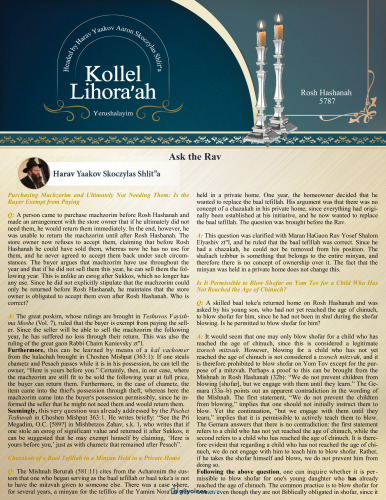
Rosh Hashanah
5787
Ask the Rav
Purchasing Machzorim and Ultimately Not Needing Them: Is the held in a private home. One year, the homeowner decided that he
Buyer Exempt from Paying wanted to replace the baal tefillah. His argument was that there was no
concept of a chazakah in his private home, since everything had origi-
Q: A person came to purchase machzorim before Rosh Hashanah and nally been established at his initiative, and he now wanted to replace
made an arrangement with the store owner that if he ultimately did not the baal tefillah. The question was brought before the Rav.
need them, he would return them immediately. In the end, however, he
was unable to return the machzorim until after Rosh Hashanah. The A: This question was clarified with Maran HaGaon Rav Yosef Shalom
store owner now refuses to accept them, claiming that before Rosh Elyashiv zt"l, and he ruled that the baal tefillah was correct. Since he
Hashanah he could have sold them, whereas now he has no use for had a chazakah, he could not be removed from his position. The
them, and he never agreed to accept them back under such circum- shaliach tzibbur is something that belongs to the entire minyan, and
stances. The buyer argues that machzorim have use throughout the therefore there is no concept of ownership over it. The fact that the
year and that if he did not sell them this year, he can sell them the fol- minyan was held in a private home does not change this.
lowing year. This is unlike an esrog after Sukkos, which no longer has
any use. Since he did not explicitly stipulate that the machzorim could Is It Permissible to Blow Shofar on Yom Tov for a Child Who Has
only be returned before Rosh Hashanah, he maintains that the store Not Reached the Age of Chinuch?
owner is obligated to accept them even after Rosh Hashanah. Who is
correct? Q: A skilled baal toke'a returned home on Rosh Hashanah and was
asked by his young son, who had not yet reached the age of chinuch,
A: The great poskim, whose rulings are brought in Teshuvos V ayish- to blow shofar for him, since he had not been in shul during the shofar
ma Moshe (Vol. 7), ruled that the buyer is exempt from paying the sell- blowing. Is he permitted to blow shofar for him?
er. Since the seller will be able to sell the machzorim the following
year, he has suffered no loss through their return. This was also the A: It would seem that one may only blow shofar for a child who has
ruling of the great gaon Rabbi Chaim Kanievsky zt"l. reached the age of chinuch, since this is considered a legitimate
Furthermore, this can be lear ned by means of a k al vachom er tzorech mitzvah. However, blowing for a child who has not yet
from the halachah brought in Choshen Mishpat (363:1): If one steals reached the age of chinuch is not considered a tzorech mitzvah, and it
chametz and Pesach passes while it is in his possession, he can tell the is therefore prohibited to blow shofar on Yom Tov except for the pur-
owner, “Here is yours before you.” Certainly, then, in our case, where pose of a mitzvah. Perhaps a proof to this can be brought from the
the machzorim are still fit to be sold the following year at full price, Mishnah in Rosh Hashanah (32b): “We do not prevent children from
the buyer can return them. Furthermore, in the case of chametz, the blowing [shofar], but we engage with them until they learn.” The Ge-
item came into the thief's possession through theft, whereas here the mara (33a–b) points out an apparent contradiction in the wording of
machzorim came into the buyer's possession permissibly, since he in- the Mishnah. The first statement, “We do not prevent the children
formed the seller that he might not need them and would return them. from blowing,” implies that one should not initially instruct them to
Seemingly, this ver y question was alr eady addr essed by the Pischei blow. Yet the continuation, “but we engage with them until they
Teshuvah in Choshen Mishpat 363:1. He writes briefly: “See the Pri learn,” implies that it is permissible to actively teach them to blow.
Megadim, O.C. [589?] in Mishbetzos Zahav, s.k. 1, who writes that if The Gemara answers that there is no contradiction: the first statement
one stole an esrog of significant value and returned it after Sukkos, it refers to a child who has not yet reached the age of chinuch, while the
can be suggested that he may exempt himself by claiming, ‘Here is second refers to a child who has reached the age of chinuch. It is there-
yours before you,’ just as with chametz that remained after Pesach”. fore evident that regarding a child who has not reached the age of chi-
nuch, we do not engage with him to teach him to blow shofar. Rather,
Chazakah of a Baal Tefillah in a Minyan Held in a Private Home if he takes the shofar himself and blows, we do not prevent him from
doing so.
Q: The Mishnah Berurah (581:11) cites from the Acharonim the cus- Following the above question, one can inquir e whether it is per -
tom that one who began serving as the baal tefillah or baal toke'a is not missible to blow shofar for one's young daughter who has already
to have the mitzvah given to someone else. There was a case where, reached the age of chinuch. The common practice is to blow shofar for
for several years, a minyan for the tefillos of the Yamim Nora'im was women even though they are not Biblically obligated in shofar, since it
is a time-bound positive mitzvah. This is Practical Corner:
indeed the ruling of the Shulchan Aruch By Rabbi Nesanel Odzer from the Rabbanim of Beis
(O.C. 589:6): “Similarly, one who has already Horaah KLY
fulfilled the mitzvah may blow for them.” The
Mishnah Berurah (s.k. 9) explains that they have a Which Fruit Gets the Bracha by the “Simanim” on Rosh Hasha-
mitzvah in hearing shofar, in the category of mi she'eino nah?
metzuvah v'oseh—one who is not obligated but nevertheless
performs the mitzvah. According to the practice of Ashkena- Q: At the Rosh Hashanah table, many people make a בורא פרי
zim, women even recite a brachah on the mitzvah, as Tosafos העץon the apple dipped in honey. However, dates and
writes in Kiddushin (31a, s.v. d'lo): “From here Rabbeinu Tam pomegranates are often on the table as well, and both are from the
deduced that women recite brachos on time-bound positive mitz- .שבעת המיניםWhich fruit should receive the bracha?
vos, even though they are completely exempt.” However, in the
case of a young girl whose fulfillment of mitzvos is through the A: We first need to review the general rules of .קדימה בברכות
mitzvah of chinuch, one might suggest that there is no obligation Among the שבעת המיניםthemselves, the rule is כל המוקדם בפסוק
to educate her in the performance of time-bound positive mitzvos. :מוקדם לברכהwhichever species appears earlier in the Torah’s
If so, there would be no mitzvah involved and it would not be per- order takes precedence. Since the דבשin the pasuk refers to dates,
missible to blow shofar for her. Or perhaps there is no distinction. a date precedes a pomegranate, as it is closer to the word .ארץ
It would seem clear that one may blow shofar for a young girl. When two foods have the same bracha, there is a further question
This argument—that girls are not included in chinuch for time- whether שבעת המיניםor חביבcomes first. In ,סימן רי״א סעיף אthe
bound positive mitzvos—is not a valid concern. Puk chazi mai Shulchan Aruch rules that שבעת המיניםtakes precedence over
ama davar—look at the widespread practice: among Ashkenazim, .חביבIn סעיף בhe brings the Rambam, who holds that חביבtakes
young girls commonly recite a brachah when taking the lulav and
when sitting in the sukkah. Therefore, regarding shofar as well, precedence. There is also a dispute as to the definition of :חביב
there is certainly some element of mitzvah in educating them to does it mean the food that a person generally prefers, or the food
hear the shofar, and it is permissible to blow for them. Neverthe- he prefers right now? The Mishnah Berurah writes that the prima-
less, it would be appropriate to tell the young girl not to recite a ry halachah follows the first opinion: שבעת המיניםtakes
brachah on the shofar, but rather to listen without a brachah. precedence, and חביבmeans that which is generally more
In the sefer Chinuch LaNa'ar, by HaGaon Rabbi Y.Y. Blau zt"l preferred. Accordingly, if an apple, date, and pomegranate are all
(22:7), he brings an opinion that one should not blow shofar before him, the bracha should be made on the date. It precedes the
for young girls on Yom Tov. However, in practice, one should apple because it is one of the ,שבעת המיניםand it precedes the
not rule this way; rather, it is permissible to blow for them, as pomegranate because it is .מוקדם בפסוקThis is indeed what Rav
explained above. Avigdor Nebentzahl שליט״אtold us .הלכה למעשהThere are,
however, two possible לימודי זכותfor those who specifically wish
Foods Containing Vinegar on Rosh Hashanah to begin with the apple. The first is to rely on the Rambam that
חביבprecedes ,שבעת המיניםtogether with his understanding that
Q: Many people ask regarding the Mishnah Berurah חביבis determined by what one prefers at that moment. Thus, if
(583:5), who writes that some refrain from cooking foods the apple dipped in honey is especially חביבto him at that time
containing vinegar, such as borsht and the like, as a
because of the סימןfor a sweet year, there is room according to
siman tov. See also the Mateh Ephraim (se'if 3), who
that opinion to begin with it. However, these are not the primary
writes that for this reason some refrain from eating
foods and dishes that contain bitterness. Does this opinions .להלכהA second possibility is to remove the dates and
mean that one should be stringent to avoid even pomegranates from the table before making the bracha. The Mish-
foods in which vinegar is merely an ingredient? nah Berurah writes that the rules of קדימהapply when both foods
are before him. Nevertheless, applying that rule here is still some-
A: HaGaon Rabbi Yosef Shalom Elyashiv zt"l and what of a chiddush, since he already plans to eat the dates and
other great poskim already ruled that there is no pomegranates and intends for this very bracha to exempt them.
concern with eating foods containing a mixture One could therefore argue that they are already part of the same
of vinegar on Rosh Hashanah. Simply speaking, eating and should still enter the calculation of .קדימה
the intent is that only a food whose primary in-
gredient is vinegar is included in this custom. Summary: The preferable practice is therefore to make בורא פרי
However, another food that merely contains a העץon the date. One can eat a small piece of the date, then eat the
small amount of vinegar as an ingredient is not apple dipped in honey and say its ,יהי רצוןand later return to the
included in the custom. date and say its .יהי רצוןIn this way, the halachos of קדימהare
fulfilled without losing anything from the familiar Rosh Hashanah
simanim.
If you have any question that you would like to be featured in
this column, or any questions in general please feel free to
email halacha@kollellihoraah.org
Take a part in spreading the light!
Email info@kollellihoraah.org for sponsorship opportunities.
To receive this weekly publication via email, Click here or email info@kollellihoraah.org.
We are having our Annual Slichos Campaign!
Please help us reach our goal of building Klal Yisroel through
Limud Hatorah.
Donate here: https://causematch.com/kl2026