
Olas Shabbos Minkatch - English — Rosh Hashana (2026-09-07)
:
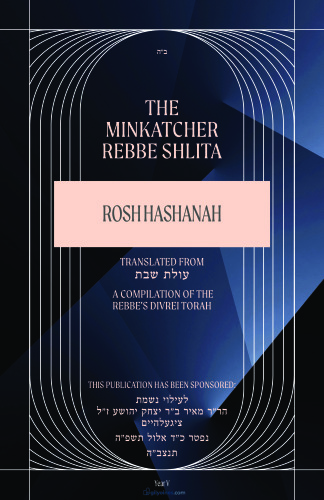
ב”ה
THE
MINKATCHER
REBBE SHLITA
ROSH HASHANAH
TRANSLATED FROM
עולת שבת
A COMPILATION OF THE
REBBE’S DIVREI TORAH
THIS PUBLICATION HAS BEEN SPONSORED:
לעילוי נשמת
הר"ר מאיר ב"ר יצחק יהושע ז"ל
ציגעלהיים
נפטר כ"ד אלול תשפ"ה
תנצב"ה
Year V
2 The Minkatcher Rebbe on Rosh Hashanah
ROSH HASHANAH
יֹום טֹוב ֶׁׁשל ֹרֹאׁש ַהַ ָּׁׁשָנָה ֶׁׁשָחָל ִִל ְְהיֹות ְּּב ַׁׁש ָּּבת
The Yom Tov of Rosh Hashanah
that falls out on Shabbos.
(Rosh Hashanah 29b)
THE YEAR’S FIRST SIMAN
We need to examine the wording of the Mishnah (Rosh Hashanah 29b) and
understand why it specifies, “ – יום טוב של ראש השנה שחל להיות בשבתThe
Yom Tov of Rosh Hashanah that falls out on Shabbos…” It could simply have
said, ראש השנה שחל להיות בשבת. What is the significance of including the
words “ ”יום טובbefore “?”ראש השנה
Indeed, the tzaddikim, of blessed memory, emphasized that Chazal’s words
are exact; even an extra word or subtle variation in phrasing indicates a deeper
meaning. By describing Rosh Hashanah as a Yom Tov in this particular context,
when it coincides with Shabbos, Chazal imply that such a Rosh Hashanah
carries the special status of a Yom Tov, a time of immense goodness and
blessing (see Sha’ar Yissaschar, Moznayim L’Mishpat 54). The very fact that
Rosh Hashanah begins on Shabbos is itself a ‘siman tov,’ a good sign for the
year ahead.
Translated and Published ( ראש השנה תשפ"זYear V) 3
The Siman of Malchus
We can understand this siman as following the same principle that underlies all
the other simanim we are accustomed to observing on Rosh Hashanah, about
which Chazal teach (Kerisos 5b; see also Horayos 12a), השתא דאמרת סימנא
סילקא ותמרי, כרתי, יהא רגיל אינש למיכל בריש שתא קרא ורוביא,– מילתא היא
“Now that you have said that a siman holds significance, a person should be
accustomed to eat, at the beginning of the year, gourd and fenugreek, leek,
beets and dates.”
Still, it is worth delving deeper into why, if a siman “holds significance,” it is not
incorporated into every occasion and every season. Why did Chazal fix the
practice of simanim specifically at “reish shata,” at the beginning of the year?
The placement of the Gemara’s discussion provides the answer. Just before
Chazal talk about the simanim of Rosh Hashanah, they note (ibid.) that
“Kings are anointed beside a spring so that their kingship should continue
and endure.” Why beside a spring? Because the continuous flow of its waters
serves as a siman that the king’s reign, too, should continue and endure.
On Rosh Hashanah, we, too, anoint our King. In fact, it is the central theme
of the day’s avodah and shapes the entire structure of the day’s tefillos. As
Chazal teach (Rosh Hashanah 34b), אמרו לפני מלכיות כדי שתמליכוני עליכם.
Rosh Hashanah is the day upon which we proclaim the Kingship of Hashem,
accept His Malchus upon ourselves, and daven that His Kingship should be
revealed throughout the entire world.
Even the shofar carries this message. It symbolizes the trumpets and horns
sounded at the beginning of a new king’s reign, proclaiming throughout
the land that a new kingship has begun. Rabbeinu Saadiah Gaon likewise
explains, among the reasons for the shofar, that Rosh Hashanah is the day of
the creation of the world, when the Holy One, blessed be He, became King
over His creation.
With this, the words of the Gemara are clarified. השתא דאמרת סימנא מילתא
—היאonce we recognize that a siman has particular significance at the
moment when kingship is established, —יהא רגיל אינש למיכל בריש שתאwe
4 The Minkatcher Rebbe on Rosh Hashanah
surround ourselves on Rosh Hashanah with blessings and foods that can be
seen as simanim that embody our personal hopes for the entire year: that
we should be the “head,” that our merits should increase, that our enemies
should be cut away, and that we should be granted a good and sweet year.
Because the goodness and blessing we seek through these simanim are not
only for ourselves; they are the means through which His Kingship is revealed.
For when Klal Yisrael is blessed, the honor and glory of His Kingship become
increasingly revealed throughout the world.
When the Day Becomes a Siman
This same principle can be taken one step further. Just as the foods we eat
on the first night of the year are a siman of the goodness for which we ask to
befall us throughout the year, so too we can look at the day on which the year
begins as a good siman of the character of the blessed days that will follow.
After all, we know that nothing in the order of creation is accidental. Even the
calendar itself, and the way the days of the year are arranged, are under Divine
providence.
Therefore, when reish shata itself falls on Shabbos Kodesh, a day of rest and
blessing, there is, in the spirit of “”סימנא מילתא היא, a beautiful indication that
the holiness, menuchah, and blessing of Shabbos will extend throughout the
entire year.
This is what the Mishnah is medayek in when it says, יום טוב של ראש השנה שחל
להיות בשבת. When the beginning of the year itself is Shabbos Kodesh, a day
that is entirely good, there is therein a siman that the continuation of the year,
with Hashem’s help, will likewise possess the character of a “Yom Tov.” That
it will be a year of rest and blessing, holiness and spiritual ascent, expanded
awareness and clarity of mind, and abundant salvations and goodness.
The Bnei Yissaschar (see Maamarei HaShabbasos 7:6) writes extensively
about the spiritual benefits that every Shabbos offers for atonement and
easing severe judgments. And if this is the koach of Shabbos in an ordinary
week of the year, then when Shabbos arrives together with the beginning
Translated and Published ( ראש השנה תשפ"זYear V) 5
of the year, its holiness is present at that very first moment of judgment and
envelops Klal Yisrael with its spiritual protection.
Thus, the fact that Rosh Hashanah falls on Shabbos is not merely a
circumstance of the calendar; it is itself a powerful siman. The year does
not begin only with the awe of judgment. It begins beneath the shelter of
Shabbos Kodesh, beneath the influence of its holiness and beneath its power
to awaken Divine mercy. Into the moment when the three books are open,
and every person stands before the Heavenly Court, comes the kedushah of
Shabbos to awaken mercy and atonement and to shield us from the full force
of din and kitrug.
When Shabbos Silences the Shofar
There is an even deeper dimension to this, based upon the words of Chazal
(Shabbos 118b), לא שלטה בהם אומה ולשון- אלמלי שמרו ישראל שבת ראשונה
– “Had Klal Yisrael observed that first Shabbos in the midbar, no nation or
tongue would have been able to rule over them.”
Looking back, it may seem that we lost the powerful opportunity of protection
that that first Shabbos offered us. However, perhaps we can say that when
the first day of the year coincides with the first Shabbos of the year, the day
embodies the virtue of that “”שבת ראשונה.
In fact, this would explain Chazal’s gezeirah prohibiting the sounding of the
shofar on Shabbos Rosh Hashanah. The reason, as the Gemara explains
(Rosh Hashanah, ibid.), is the concern that a person might go to someone
knowledgeable in the halachos of shofar to learn how to blow, and in the
process transgress the melachah of carrying the shofar four cubits through
the public domain.
At first, this seems almost surprising, given how unlikely the transgression
is to occur, and that the price of guarding it is that the entire Klal Yisrael
goes without the most meaningful mitzvah of the day—the mitzvah which
announces Hashem’s coronation, stirs hearts to teshuvah, voices our deepest
tefillos, and urges Hashem from His Kisei Din to His Kisei Rachamim.
6 The Minkatcher Rebbe on Rosh Hashanah
Yet this very paradox contains the deeper message. Chazal prioritized
Shabbos and allowed the shofar to remain silent because that silence—our
shemiras Shabbos—contains the same tremendous power.
When Rosh Hashanah falls on Shabbos, and we are extra vigilant to guard
this Shabbos in its entirety, we perhaps gain back what we lost in the midbar.
By being strictly shomer this Shabbos Rishonah, even at the expense of
forgoing the shofar’s power to awaken our teshuvah and bring us rachamim
and forgiveness, we merit to reclaim the protection that “no nation or tongue
can rule” over us—neither the nations that seek to destroy us in this world,
nor the accusing spiritual mekatrugim that seek to persecute us in Shomayim.
A Yid who comes into a Shabbos Rosh Hashanah should be m’chizzuk,
knowing that he enters the year with a siman tov already written before him,
simply because the year opens on a day of menuchah and brachah, on a
day whose kedushah and protective power to evoke rachamim and sweeten
din envelop him in the very hour the books are opened before Him. And the
silence of the shofar is part of that siman. It quietly signifies that by guarding
this Shabbos and declaring Hashem’s sovereignty over himself, over Klal
Yisrael, and over the entire creation, he allows the brachos with which the
year has begun to accompany him into every day that follows.
May it be the will of Hashem that all the good simanim and every favorable
allusion we perceive at the beginning of the year should come to fruition
in blessing and salvation. May we all merit a good and sweet year, a year
characterized by the kedushah and menuchah of Shabbos, a year of
redemption and salvation, a year in which the kavod of His malchus is revealed
throughout the world with the coming of Moshiach ben David speedily in our
days, through His abundant mercy and kindness.
Translated and Published ( ראש השנה תשפ"זYear V) 7
To receive our translations of Olas Shabbos directly to your inbox,
please email ‘Munkatch’ to: torah.subscribers@gmail.com
For sponsorship opportunities or to dedicate this publicationin honor of a
loved one, celebration, or Yahrtzeit, etc. please click on the link below.
https://tapcube.co/TORAH
8 The Minkatcher Rebbe on Rosh Hashanah