
Horeini - English — Rosh Hashana (2026-09-07)
Rosh Hashanah 5787 לעילוי נשמת מנחם מנדל בן יהושע דב בס”ד
Weekly Torah forum
to deepen halachic
and ideological
knowledge and
to strengthen the
mitzvah of kibbud
Issue no. 142 av va’eim
Dibros Dibros Kodshecha
Kodshecha Kibbud Av V’eim in the Parshah
Way of Life ”’ אם כבנים רחמנו כרחם אב על בנים וגו,“אם כבנים אם כעבדים
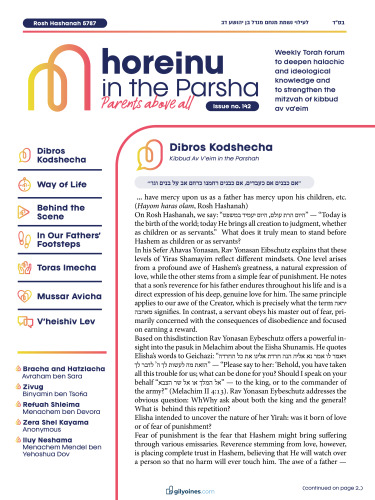
... have mercy upon us as a father has mercy upon his children, etc.
Behind the (Hayom haras olam, Rosh Hashanah)
Scene On Rosh Hashanah, we say: “ היום יעמיד במשפט,“ — ”היום הרת עולםToday is
the birth of the world; today He brings all creation to judgment, whether
In Our Fathers’ as children or as servants.” What does it truly mean to stand before
Footsteps Hashem as children or as servants?
In his Sefer Ahavas Yonasan, Rav Yonasan Eibschutz explains that these
levels of Yiras Shamayim reflect different mindsets. One level arises
Toras Imecha from a profound awe of Hashem’s greatness, a natural expression of
love, while the other stems from a simple fear of punishment. He notes
that a son’s reverence for his father endures throughout his life and is a
Mussar Avicha direct expression of his deep, genuine love for him. The same principle
applies to our awe of the Creator, which is precisely what the term יראה
מאהבהsignifies. In contrast, a servant obeys his master out of fear, pri-
V’heishiv Lev marily concerned with the consequences of disobedience and focused
on earning a reward.
Based on thisdistinction Rav Yonasan Eybeschutz offers a powerful in-
sight into the pasuk in Melachim about the Eisha Shunamis. He quotes
Elisha’s words to Geichazi: “ויאמר לו אמר נא אליה הנה חרדת אלינו את כל החרדה
“ — ”הזאת מה לעשות לך ה’ לדבר לךPlease say to her: ‘Behold, you have taken
Bracha and Hatzlacha
Avraham ben Sara all this trouble for us; what can be done for you? Should I speak on your
behalf “ — ”אל המלך או אל שר הצבאto the king, or to the commander of
Zivug
Binyamin ben Tsofia the army?” (Melachim II 4:13). Rav Yonasan Eybeschutz addresses the
obvious question: WhWhy ask about both the king and the general?
Refuah Shleima
Menachem ben Devora
What is behind this repetition?
Elisha intended to uncover the nature of her Yirah: was it born of love
Zera Shel Kayama
Anonymous
or of fear of punishment?
Fear of punishment is the fear that Hashem might bring suffering
Iluy Neshama
Menachem Mendel ben
through various emissaries. Reverence stemming from love, however,
Yehoshua Dov is placing complete trust in Hashem, believing that He will watch over
a person so that no harm will ever touch him. The awe of a father —
(continued on page 2..)
which flows from love and rests in the trust that he purely from love. My Iyrah, too, is rooted in that
will always protect his child — is fundamentally love.”Hearing this, Elisha showed her how to draw
different from a servant’s fear of punishment. down Hashem’s blessing, as the pesukim describe.
The Zohar writes that the day Elisha spoke to the This is a fundamental principle in Rav YonasanEib-
Eisha Shunamis was actually Rosh Hashanah. This schutz’s approach: True yirah of parents flows from
gives deeper meaning to Elisha’s words: “You have love, not fear. It is a deep, loving reverence—the
taken all this trouble for us” refers to the dread of same respect given to a revered Rav or leader.
judgment. He was asking: “What drives your fear? This is the awe of a child, and it is the heart of our
Is it love—speaking directly to the King? Or is it fear prayer: “ אם כעבדים, — ”אם כבניםIf as children, we lean
of punishment—appealing to the commander?” entirely on Your mercy for a favorable judgment,
She answered with wisdom: “”בתוך עמי אנכי יושבת just as a father has compassion for his children. If
— “I dwell among my people.” I belong to Hash- as servants, our eyes remain lifted to You, waiting
em’s children, and a child’s awe of his father stems for Your grace.
Just as it is the duty of every Jew to learn the halachos applicable to
Way of Life everyday life, from berachos and Shabbos to shemiras halashon, so
is he obligated to learn and review the laws of kibbud av va’eim, a
Kibbud Av Va’eim in
constant and very serious mitzvah. Neglecting this study is liable to
Halachah and Minhag lead the person to unwittingly violate many halachos.
Based on Sefer Halachos of Kibbud Av Va’eim on Shabbos and the Chagim
by Rabbi Shimshon Kurlandsky, author of Hame’oros Hagedolim.
Halachos of Kibbud Av Va’eim ready committed and is bound by the mitzvah of
Relevant to Rosh Hashanah collective responsibility that all Jews bear for one
Blowing Shofar in Place of One’s Father another’s mitzvah performance. Therefore, he may
When a father serving as the baal tokeah in shul is not back out of his commitment to his friend.
struggling and cannot blow the shofar successfully, If the mother asked first: Although a woman is
his son should step up to blow in his place if he is not strictly obligated in shofar דאורייתא, if he prom-
capable. Although the son may be hesitant out of ised her he would blow for her, he must honor that
concern for his father’s dignity and fear of embar- promise—even if his friend asks him later. Fulfill-
rassing him, the halachah dictates that he should ing his mother’s request is a מצווה דאורייתאof Kibbud
proceed. Rather than feeling humiliated, a father Av Va’eim. (Rav Yitzchak Zilberstein, Shliyt” a)
naturally feels genuine joy and pride in seeing his
son carry on his path and fulfill the mitzvah on
“If ignoring a friend’s kindness is like denying
behalf of the congregation. (Rav Yitzchak Zilber-
the goodness of Hashem, how much more so
stein, Shlit” a)
with our parents—who are Hashem’s part-
Shofar Blowing for a Friend vs. One’s Mother
ners in our creation! For this reason, Hashem
When a person is only able to blow the shofar for
equated honoring and revering them with His
one individual and is faced with a choice between
own.”
a friend (who is halachically obligated )דאורייתאand
(Maharam Chagiz, Eileh HaMitzvos, Mitzvah
his mother (who is exempt )דאורייתא, the priority
33)
depends on who asked first:
If the friend asked first: The Ba’al Toke’a has al-
Rosh Hashanah 5787 // Issue no.142 // pg 2
V’heishiv Lev
Questions and Answers from the
Desk of Rabbanim and Therapists
?
e following question appears in Sefer Ohel Yaakov on the
Th
halachos of Kibbud Av Va’eim (p. 404)
A teenager who loved mitzvos dearly made a special point of
fulfilling the mitzvah of hearing the tekias shofar on every Rosh Ha-
shanah. She once overheard her mother telling a friend how deeply
she longed to go to Shul to hear the shofar, but she had to stay home
to care for her young children.
Although the daughter often watched her younger siblings, the moth-
er did not ask—or even hint—that she should stay home on Rosh
Hashanah. She knew how much distress missing the mitzvah would
cause her daughter. Still, her mother’s deep desire to hear the shofar
was well known. Behind the Scene
The daughter asked, “How should I act?” Should I go to shul to merit A maamar Chazal or
the precious mitzvah of hearing the shofar, or should I forgo it for my halachah related to
mother’s sake and stay home to watch my siblings? kibbud av va’eim is
concealed in the picture. Send in
>
A person must prioritize their own spiritual growth first when the solution, and you’ll be entered
it comes to mitzvos. The rule is “—”חייך קודמיםone’s own spiritual to win a prize!
life takes precedence. However, in this case, the daughter is not
obligated in the mitzvah of shofar, as women are exempt from time- Solutions may be sent by
bound mitzvos aseh. In contrast, she is fully obligated in the mitzvah email to: riddle@horeinu.org
fax to: 077-602-1640
of kibbud av. Although her mother did not ask her to forgo it on her
behalf, it is nevertheless clear that this is her mother’s wish; and if
the daughter fulfills that desire, she will thereby fulfill the mitzvah
of Kibbud Av Va’eim. It is preferable to forgo a mitzvah from which
one is exempt in order to merit a mitzvah in which one is obligated
d’Oraysa.
The Rashba holds that the primary mitzvah of Kibbud Av Va’eim
applies only to actions that directly benefit the parent—such as pro- Solution to Behind the Scenes –
viding food and drink, clothing, and attending to their physical needs. It seems that if one’s father serves as the
Chazzan during the High Holy Days and asks
However, if a parent asks a child to do something that does not di- his son to come pray with him to assist with the
melodies, the son is obligated to do so, because
rectly benefit the parent, it does not fall under the commandment this is included in attending to him. (Veyevarech
David, Kibbud Av Va’eim, ch. 4, §60)
to honor a parent. One might therefore think that, according to this “Maaseh Avos”
opinion, no mitzvah of kibbud av v’em is being fulfilled here.
The Rashba holds that a child is exempt only when the parents derive The raffle winners were informed of their win.
no gain or pleasure from the matter. In this case, the mother derives
tremendous benefit from hearing the shofar, and the daughter fulfills
her mother’s wish by enabling her to perform the mitzvah. This is a
true fulfillment of kibbud eim.
The Rav’s psak: The daughter should offer to stay home and watch
her siblings so her mother can go to shul to hear the shofar.
You can direct questions to Horeinu advisers
via the email address appearing on the last page.
Confidentiality guaranteed
’ תנחומא האזינו סי’ ד.2 ירושלמי חגיגה פ”ב ה”א.1
Rosh Hashanah 5787 // Issue no.142 // pg 3
Have a story that can inspire others in kibbud av va’eim?
In Our Fathers’ Share it with us—or send a contact number—
at Newsletter@horeinu.org.
Footsteps \(English and Hebrew welcome!)
True Stories of Kibbud Horim
Released from the Army: The Merit Finally, the father mentioned that his son was ex-
of Honoring His Father traordinarily careful in the mitzvah of Kibbud Av
Rav David Bornstein, author of Chasdei David, de- Va’eim. “He gives all his money to his parents,” the
voted many years of his life to securing the release father told the Rebbe, “retaining only twenty agoros
of young men drafted into the Polish army. Those for travel expenses.” The Rebbe then said in Yiddish:
were difficult times. The leaders of the Polish army “בַאפרייט
ַ דַארף ָיָא
ַ ער,ַַא ַזַא כיבוד אב איז ַַאזוי ווי לערנען תורה
spared no one, cruelly conscripting everyone into — !ווערןSuch kibbud av equals Talmud Torah; he
service. Sons were torn from their mothers’ em- must be exempt!” When the young man appeared
brace, and young married men from their homes. before the draft board, he was placed at the very
The situation became unbearable as everyone was end of the line. By the time the officials reached
forced to serve in the military. him, they had already met their quota, and he was
At that time, the author of Chasdei David stepped granted complete exemption from military service.
in as a lifesaver. Many young men of enlistment age (Malchus Beis David, p. 164)
sought his blessing. He would then decide for each Not With His Father for Rosh Hashanah—by Force
one who would find favor and who, Heaven forbid, of Kibbud Av
would not—whether they would be conscripted The sefer Mishnas HaKibbud recounts the story
into the Polish army or released. of Rav Mordechai Twersky of Kozmir, who was
On Rosh Hashanah, before tekias shofar, all those staying at the medicinal springs during the summer.
facing the draft that year would approach him in Rosh Hashanah was approaching. The doctors in-
the beis midrash seeking his blessing and asking to sisted he remain there through the Yomim Noraim,
be remembered in his prayers. Each one received but he refused to listen, as he could not bear being
his warm blessing. away from his father in Trisk. His attendant wrote
Though not a chassid himself, the young man— to his father, the holy Maggid of Trisk, explaining
whose father was a prominent Sochatchover chas- the situation. In a response letter, the Maggid ruled
sid—came before the Rebbe on Rosh Hashanah, that the mitzvah of kibbud av required him to listen
right before the shofar was blown, to say he was up to the doctors and to remain there for Rosh Hasha-
for military service. The Rebbe did not look at him nah and Yom Kippur.
or say anything in response. He fulfilled his father’s request, returning to his
Fearing for his future, he went to the Rebbe with father’s presence in Trisk only for Sukkos.
his father during the Aseres Yemei Teshuva, once . (Gedulas Mordechai, 26)
again mentioning his impending draft.
The Rebbe looked up and replied: “Since you work
in a factory, it would be better for you to serve in Get Horeinu
the military. After all, someone has to fulfill the Delivered to
draft. Otherwise, they will say that all Jews refuse Your Inbox!
to serve”
Father and son remained standing before the Reb- Horeinu’s weekly newsletter is
be in complete astonishment, unable to process available by email in English,
his words. After a few moments, the young man Hebrew, and Yiddish.
mentioned his situation again, but there was no
reaction. The father then turned to the Rebbe and To join our email list, write to
began recounting his son’s virtues, yet the Chasdei us at: office@horeinu.org
(Please specify English, Hebrew or Yiddish).
David did not respond.
Rosh Hashanah 5787 // Issue no.142 // pg 4
Sefer HaChaim
An Inspiring Call to Action for
the Days of Rachamim, to merit
“”למען יאריכו ימין ולמעט ייטב לך
As though you had bound yourselves before Me
We learn in the Gemara: רעה אינה מצטרפת למעשה, “ For Yisrael, a good
“תקעו לפני בשופר של איל כדי שאזכור לכם עקידת יצחק intention is joined to action, whereas a bad in-
”בן אברהם ומעלה אני עליכם כאילו עקדתם עצמכם לפני tention is not; Among the nations, this is not so.
Blow before Me with a ram’s shofar so that I will At our core, every Jew has an innate longing to
remember for you the Binding of Yitzchak, son of fulfill Hashem’s will and to give up everything
Avraham, and I will account it to you as though to sanctify His Name, just as our Avos did.
you bound yourselves before Me. This desire became so deeply ingrained in the
One would think Hashem remembering the Jewish nation’s soul that today it can be hard to
Akeidah by itself is enough. That pure mesir- grasp what was so extraordinary and unprece-
as nefesh carries more than enough weight dented about Avraham and Yitzchak’s nisayon,
to bring forth the zechus Avos for the Day of or why the Akeidah awakens such profound
Judgment. Why, then, is it necessary to add, awe. Sacrificing one’s life to fulfill Hashem’s
“I will account it to you as though you bound blessed will has become part of a Jew’s very
yourselves before Me”? nature.
This idea requires explanation. We were never Every ounce of mesiras nefesh throughout our
asked to give up our lives. What merit is there history stems directly from the Akeidah. From
in saying “as though you bound yourselves” that moment on, doing the will of our Father
when this is seemingly not the case? Why in- in Heaven was woven into the Jewish heart as
voke a merit that has no apparent connection second nature—a deep, unquestioned desire.
to us? . Every Jew has one true, inner desire at their
1
Rav Yitzchak Blazer writes in Kochvei Or : Our core: to fulfill the will of Hashem. Rav Chaim
chachamim said, “”הסתכל הקב״ה באבות וברא העולם Volozhin wrote that a Jew’s ability to give up his
— Hashem looked at the Avos and created the life al kiddush Hashem throughout the gener-
world. ations stems entirely from Avraham’s original
When we think about this, we realize that were act of mesiras nefesh at the Akeidah.
it not for the merit of the Avos, the world could Our Chachamim point to the incredible dis-
not exist. When Klal Yisrael sinned with the חטא play of Kibbud Av Va’eim by Yitzchak during the
העגל, Moshe Rabbeinu prayed and pleaded, “זכור Akeidah. It says in Pirkei d’Rabbi Eliezer that
— ”לאברהם וכו׳Remember Avraham, etc.The Yitzchak said to Avraham, his father, “Father,
same applies when we mention the Akeidah bind my hands and feet, lest I kick you and end
on Rosh Hashanah—without that merit, the up desecrating the honor due to a father.”
world would be destroyed. It is solely in the This reveals that within the soul of every Jew
zchus of the Avos that the entire world contin- lies the root of Kibbud Av Va’eim, extending
ues to exist. even to self-sacrifice. Inherited directly from
Why does the Akeidah possess such power to the Akeidah, this devotion lets us awaken the
shield Klal Yisrael throughout time? zechus Avos on Rosh Hashanah and be in-
The Meshech Chochmah explains the princi- scribed in the Book of Life.
ple: “ ומחשבה, מחשבה טובה מצטרפת למעשה,בישראל
ח”ב מאמר ס”ז.1
Rosh Hashanah 5787 // Issue no.142 // pg 5
written by Y. Binyamin
Mendy shares a story about Tatty and Mommy
and the mitzvah of kibbud av va’eim
The Sound of the Shofar
Everyone has a special part of the Rosh Hashanah there weren’t any tall grown-ups standing right in
davening they love most. Some kids can’t wait for front of me, so I had a clear view straight to the
“Achila lakel,” while others look forward to the bimah. Everything was set.
special tunes and melodies. The part I wait for all Right then, Abba tapped me on the shoulder.
day is the shofar blowing. Of course, I daven too, “Mendi.” “Yes, Abba?”
and I really try to have kavanah, especially on Rosh Abba pointed to an elderly man standing near the
Hashanah. But the shofar is just something else. It aisle. I didn’t recognize him. He was leaning heavily
sends shivers up my spine. No matter how many on his cane, looking around for a seat.
times I’ve heard it in “Please move back
cheder throughout next to me,” Abba
Elul, hearing it on whispered. “And give
Rosh Hashanah—in him your seat.”
a completely silent I looked at Abba,
room, with hundreds then at the old man,
of men and boys—is then at my seat,
totally different. and back at Abba.
Sometimes I peek Now?? All year
at the baal toke’a. long, no one ever
He always tries so needed to sit in my
hard to make sure seat! Not at the first
every sound comes Selichos, not during
out crisp and clear. Kriyas HaTorah, not
At the same time, he even at Friedman’s
is closing his eyes aufruf a month and
tightly, concentrating with kavanah. a half ago. And now, three minutes before tekios,
My usual spot is right next to Abba, but as we someone suddenly needed to sit in my seat?
get closer to tekios, I always wiggle forward. From I almost asked Abba if we could figure something
there, I can hear more clearly and get a good else out, but then I looked at him and saw he
look at the baal toke’a. That’s super important to was already giving up his seat. So I grabbed my
me. Hearing the shofar blasts without seeing the machzor and shuffled down to the other end. That’s
baal toke’a just isn’t the same. I mean, you can still when I realized we had a problem: Reb Shlomo
hear it, but something’s missing! was standing right in front of me!
When they started saying “Lamenatzeach” right Reb Shlomo is a very nice man—truly. The thing
before the tekios, my heart was already pounding is, he’s nearly as tall as the Aron Kodesh. His son
with excitement. I quickly checked to make sure was standing right next to him. He’s tall enough
(continued on page 7..)
Rosh Hashanah 5787 // Issue no.142 // pg 6
to change a light bulb without even using a chair! But something was still bothering me—that thought
I couldn’t see the baal toke’a at all—not even the I’d had. After all, Abba had asked me to move,
edge of his tallis. and this man really was old and needed a seat.
I tried shifting a little to the right. Didn’t help. To So why did I feel as if something had been stolen
the left. A shtender was blocking the way. Up on from me? Through all the tekios, one thought kept
my tiptoes? Yay! Now I could see half of the baal running through my mind: Abba had asked me to
toke’a—I could see through the gap. Wonderful. move, and I did.
The brachos began, and my heart pounded in my I was already planning to head back to my spot
chest. There was absolute silence. when I saw the old man lean toward Abba. “יישר
Then—tekiah! At that exact moment, someone כוח,” he whispered to him. “You really saved me.”
behind me started dragging a shtender, and a Abba pointed at me. The old man looked over, and
little kid to my left started coughing. The sound I suddenly felt a little shy. He smiled warmly and
of the tekiah seemed to come from another shul said, “Ah, so it was you!” I wanted to say, “You’re
altogether. welcome,” but the words wouldn’t come out. He
I glanced back at Abba; the old man was sitting placed his hand gently on my shoulder. “May you
there, peacefully, right beside him. And I must always be zocheh to bring your father true nachas.”
admit, my first thought, “What a pity I had to switch And that was it. No big drashah, no elaborate story,
places,” wasn’t exactly proper for Rosh Hashanah. no deep ideas—just one simple sentence. But his
I immediately felt ashamed of myself, but if I’m words went straight to my heart: “May you always
honest, that’s what went through my head. be zocheh to bring your father true nachas.”
By the next tekiah, I could already hear better. Maybe I didn’t hear the tekios as clearly as I wanted
During the shevarim, it came through loud and to, but I listened to Abba. Maybe I didn’t get to see
clear, and by the teruah, I even caught a glimpse the baal toke’a; maybe I was a bit distracted, but
of the shofar, right between Reb Shlomo’s shoulder I learned what truly matters. That is what matters
and the hat of the man next to him. most.
Partner with us in publishing the Horeinu newsletter >>
Quickpay/zelle
Email us Donate via our website dedications@horeinu.org.
at newsletter@horeinu.org pay.banquest.com/horeinu Specify “Weekly Newsletter” in the memo.
To receive the weekly newsletter via email, simply write “Add
me” in the subject line and send to newsletter@horeinu.org
Created by the Worldwide Horeinu organization. Our goal is to
spread awareness and help Klal Yisroel strengthen the mitzvah of
kibbud av va’eim with the guidance of gedolei Yisroel Registered
organization #580780617
We welcome your feedback! Email newsletter@horeinu.org or fax: 077-602-1640 for
opportunities to dedicate or sponsor an issue l’iluy nishmas or l’zechus a parent or a loved one,
or for a zechus for children, zivugim, refuah shleimah, and hatzlachah.
You can also send us your personal stories to help inspire others.
www.horeinu.com / REQUIRES GENIZAH /