
Zichri Toras Moshe - English — Sukkos (2026-09-21)
סוכות ה’תשפ”ז
Vol. #274
Making Room
A distinguished Yerushalmi, Reb Shmuel were furious. “What does he care if he parks
Belchavitz*, lived with his large family in somewhere else for eight days?” they argued.
Yerushalayim. For years, he had built his sukkah Then they started with halachic reasoning,
on the balcony of their apartment, but as his claiming that it was not at all clear that the spot
children grew older and the family grew larger, the belonged exclusively to this neighbor. All the
little sukkah could no longer hold everyone residents shared rights to the area, so why should
comfortably. they dismantle an entire sukkah because of one
His sons therefore decided one year that they unreasonable demand?
would build a large sukkah downstairs in the Reb Shmuel listened and then gave them his
courtyard. answer. “I will not sit in a sukkah that causes
They measured the area another Jew pain. If you want me to eat
carefully, purchased walls to the my Yom Tov meals in this sukkah,
exact dimensions they needed, take it apart and move it.”
and spent hours laboring over the That was the end of the
construction. Finally, after discussion.
considerable effort, the sukkah Reluctantly, the sons began
stood complete. again. They dismantled the sukkah they had spent
Then came a knock at the door. It was one of hours constructing, carried the pieces to another
the neighbors. “Part of your sukkah,” he informed part of the courtyard, and rebuilt the entire
them, “is standing in the place where I park my structure, this time in a place that fully satisfied
car. I want you to take it apart and move it the neighbor.
somewhere else.” The first day of Sukkos passed. Late that night,
Reb Shmuel tried to reason with him. The after Yom Tov had ended, the family was asleep
sukkah had already been built, his sons had in their sukkah when they were suddenly
invested hours of hard work, and it was only for awakened by tremendous crashes from across the
the eight days of Sukkos. Perhaps, just this once, courtyard.
the neighbor could park elsewhere. They rushed outside.
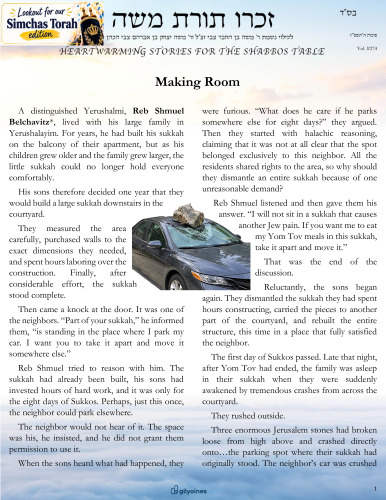
The neighbor would not hear of it. The space Three enormous Jerusalem stones had broken
was his, he insisted, and he did not grant them loose from high above and crashed directly
permission to use it.
Edited by: Binyamin Lieb
onto…the parking spot where their sukkah had
When the sons heard what had happened, they originally stood. The neighbor’s car was crushed
1
under them. anguish. He had insisted on making room for
The family stared at the wreckage. Had they someone else, even when he believed he did not
refused to move their sukkah, their children have to. Only later did they discover what else had
would have been sleeping in that exact spot. The been made room for.
outcome scarcely needed imagining. Their lives.
Reb Shmuel had given up a perfectly reasonable They made room for another Jew — and Heaven made
argument because he refused to cause another Jew room for them to live.
Targeted Esrog
Sukkos was fast approaching, and not a single messenger returned and described what had
esrog could be found. Then, just before Yom Tov, transpired, the answer became clear.
three esrogim arrived at the home
When Reb Shlomo Dovid
of Reb Chaim Ozer
Yehoshua received the esrog, the
Grodzinski (1863–1940) — the
heaviness of the war seemed to lift
only three esrogim in all of
from his shoulders. It was as
Lithuania for the Sukkos of 1939.
though he had stepped into a
Now it fell upon Reb Chaim botanic garden on a bright summer
Ozer to decide who would receive day, the weight of fear momentarily
the remaining two. dissolved by a breath of Gan Eden.
The assumption was obvious: the greatest cities The Rebbe took the esrog and danced with it
would be chosen. Yet the onlookers were stunned through the entire night — and that became his
when the Gadol Hador decided otherwise. preparation for this sacred mitzvah.
The second esrog was sent to the Lutsker Rav, His students reflected, “I do not recall whether
Rav Zalman Sorotzkin (1880–1966), whose Reb Chaim Ozer ever explained that this was the
community was also large and distinguished. But reason, but even if he did not, it was pashut that
it was the third recipient that left everyone this was why. He understood that simchah is a vital
astonished. It was sent to Baranovitch — to the ingredient in avodas Hashem, and he gave that
Slonimer Rebbe, Reb Shlomo Dovid Yehoshua kedimah over others who would merely shake it.”
Weinberg (1887–1940).
And so, in a year darkened by uncertainty and
What made this so surprising was that there shadow, one man’s joy became a beacon — a
were many greater cities, and the Rebbe, at the reminder that when simchah is guarded and
time, was still young. Why would he be given elevated, it has the power not only to
Edited by: Binyamin Lieb
precedence over other towering Rabbanim? fulfill a mitzvah but to illuminate an entire
The question did not linger for long. When the generation.
To share your own story, questions, comments, sponsorships, or to subscribe email: TheZichruTorasMoshe@gmail.com or call R’ Moshe Hirschberg 732 569 8111 2
©All Rights Reserved
Please do not read during davening or learning Have a wonderful Shabbos
סוכות ה’תשפ”ז
Vol. #274
Dancing Before the Nazis
Yechezkel Gewertzstone* flew to Eretz Yisrael for Yom Yid by his collar. I couldn’t look away. Something inside me
Tov of Sukkos, overjoyed at the thought of spending broke. I ran to him and overpowered him.”
Simchas Torah in the presence of his Rebbe. Each passing
He closed his eyes. “The Nazi, humiliated, turned to me
day of Sukkos filled him with greater anticipation of the
and said, ‘Your end has come.’ I’d received a death sentence
dancing, the singing, and the electrifying kedushah of his
for a capital crime.”
Rebbe’s beis midrash. It was what he lived for.
The old man’s voice dropped to a whisper. “The Nazi
But Hashem had other plans. Shortly before Simchas
Torah, Yechezkel fell ill. His plans, his dreams, and his joy raised his revolver…then paused. ‘One minute,’ he said. ‘If
all collapsed in a moment. While that I kill you, I’ll have to bury you. And I don’t want to waste
the effort. Dig your own grave. When it’s
alone was painful, what tormented him
even more was knowing where he would ready, I’ll pull the trigger.’”
now be spending Simchas Torah: in the The man’s eyes glistened as he
small local shul of the moshav where he continued. “I took the shovel. I dug a few
was staying. The place was lifeless — no inches, and then I stopped. I thought to
fire, no simchah. For Yechezkel, it was as myself, ‘These are my final moments in this
though his world had turned upside-down. world. Should I waste them digging a hole, or should I dance my last
And indeed, that night, the hakafos were subdued — hakafos before my Creator?’
routine, almost dreary. That is, until one man changed “So I dropped the shovel…and I danced.”
everything.
His voice shook. “I danced in front of that Nazi — my
An elderly Jew suddenly came into shul, leapt into the feet flying, my soul on fire. I danced as though Heaven itself
center of the circle, and began to dance. His feet barely was watching. The Nazi was furious. He screamed, cursed,
touched the ground, and his eyes burned with light. Though threatened — but I couldn’t stop. I was already in another
well into his seventies, he moved like a young man of world.”
twenty, radiating ruach and chiyus. Before long, his energy
had swept through the entire tzibbur, lifting them higher and “When he finally dragged me away, he said, ‘You think
higher. you’re free because I didn’t shoot you right away? I’ll make
your punishment worse.’ He took my name and address,
Yechezkel was transfixed. Who was this man?
and he handed it to the commander.”
When the hakafos ended, he couldn’t contain himself. He
approached the dancer, his voice trembling with curiosity. The man’s voice softened again. “But Hashem, in His
infinite mercy, arranged that my case was lost in their files.
“Tell me,” he said, “where do you get such strength,
The Nazis never came for me. And that year, I had my
such simchah? It’s something deeper…”
Simchas Torah — not in a shul, not with a Rebbe, but in a
The man smiled softly. “Ah,” he said. “You want to ditch before a Nazi with a gun.”
know? Then listen.”
He smiled at Yechezkel. “So, my friend, tell me — after
The man paused, his eyes distant. you’ve danced before death itself, after you’ve learned that
“As a child,” he began, “I lived through the war. It was
Edited by: Binyamin Lieb
simchah is stronger than fear, after you’ve seen what it means
Simchas Torah, 1940, in Łódź. I was on my way to shul for to be truly alive — is it any wonder,” his eyes twinkled, “that
davening and hakafos. In the street, I saw a Nazi dragging a even seventy years later, I’m still dancing?!”
3
The Siddur and the Song
Rabbi Avrohom Gold was walking through the streets of Then, one Shabbos, as she was walking down the street, she
Yerushalayim when a stranger stopped him. heard a niggun drifting from a home in her neighborhood. She
“Are you from Detroit?” the stranger asked him. stopped. It was the same niggun she had heard in Meron. She
stood outside listening as the melody stirred everything she had
“Yes,” Rabbi Gold replied. felt there. Something inside her shifted.
“Then I have a story you need to hear.” When she returned home, she told her father that she had
Rabbi Gold explained that he was on his way to his mother- changed her mind. She would not marry the non-Jew. Soon
in-law’s home and was already running late. afterward, she agreed to meet Yisrael, and this time, she saw him
differently. Before long, they became engaged, much to her
The man smiled. “Your mother-in-law will be very happy you
father’s immeasurable joy.
stopped. This story is about her.”
One afternoon, while visiting his kallah,
Well then, Rabbi Gold thought, then I
Yisrael asked if he could borrow a siddur for
certainly should hear what he has to say.
Minchah. She brought him the small white
In the 1930s, the Klein family* settled in siddur from Meron. He opened the cover,
Detroit, where proper Jewish education was and then he froze. The color drained from his
difficult to find. Their daughter grew up with face. “Where did you get this?” he asked her.
almost no connection to Yiddishkeit and
She told him about the man she had seen
eventually drifted far from her roots.
davening in Meron, the stranger who had lent
When she announced that she intended to marry a non- Jew, her his siddur and then insisted that she keep it.
her father was devastated. Yisrael’s hands began to tremble. “The name written inside
During a trip to New York, Mr. Klein met a frum young this siddur is my brother’s name.”
Holocaust survivor named Yisrael.* Impressed by him, he For years, Yisrael had believed that his brother had perished
encouraged Yisrael to move to Detroit, promising to help him in the Holocaust. Now, holding his siddur, he realized that his
find work and rebuild his life. Deep-down, Mr. Klein hoped that brother had survived.
perhaps his daughter would take an interest in him and
reconsider her plans. The young woman’s journey to Eretz Yisrael had not only
changed the course of her own life. It had revealed that a brother
But when Yisrael arrived, she wanted nothing to do with him. long believed lost was still alive.
Her mind was made up.
The man in Yerushalayim then turned to Rabbi Gold.
In one final attempt, Mr. Klein offered to send his daughter
to Eretz Yisrael for several weeks, all expenses paid. He hoped “And do you know which home that niggun was coming from
that seeing the land and experiencing Yiddishkeit firsthand might on the Shabbos when she changed her mind?” Rabbi Gold
awaken something within her. He promised that if she returned shook his head. “It was the home of your in-laws, Rav and
unchanged, he would no longer stand in her way. She agreed. Rebbetzin Kahane.”
During her trip, she visited Meron. The niggunim, the dancing, Rabbi Gold stood speechless.
and the intensity of the tefillos stirred her deeply. At one point, A niggun sung inside an ordinary Jewish home had drifted
she noticed a man davening with extraordinary concentration through an open window and stopped a young woman in her
from a small white siddur. When he finished, she asked if she tracks. That melody led her back to Yiddishkeit, brought her
could borrow it. He gladly handed it to her. When she was done, together with her roots, and ultimately helped reunite a family
he told her she could keep it. torn apart by the Holocaust.
Edited by: Binyamin Lieb
She returned to Detroit carrying the small white siddur, but Rav and Rebbetzin Kahane had never known who was
told her father that her decision had not changed. She still standing outside their home that Shabbos. They had never
intended to marry the non-Jew. Her father was heartbroken, but known what their singing had set in motion. (Heard from Harav
he had given his word. Eli Yelen.)
To share your own story, questions, comments, sponsorships, or to subscribe email: TheZichruTorasMoshe@gmail.com or call R’ Moshe Hirschberg 732 569 8111 4
©All Rights Reserved
Please do not read during davening or learning Have a wonderful Shabbos