
TORAS AVIGDOR - ENGLISH - BOOKLET — Sukkos (2026-09-21)
I N M E M O RY O F M RS
R S . C L A R A C H O P P A " H A N D M E N U C H A M A R KOW
KO W I T Z A " H
K
THE CHOPP HOLDINGS EDITION
RAV
R A V AVIGDOR
AV I G D O R M
MILLER
ILLER Z
ZT"L
T"L
CHODESH
CH
C HO
ODES
ODDES
ESH
SH EL
ELU
ELUL
LU
ULL
lttc
ltc
tctec
tecchgr
techgr
hg
h grroup
g oup
ou p.co
cco
om
SUKK
KOOS
T H ER AV
Y
YOOAVI
M GT D O R MIL L E R Z T ”L
TOV
O OF HUM
OV MILI L IIT
TY
ילויי ננשמת
ת
שמת לעילוי
לע ו
לו
ילוע
אליהוו ע״
ע״ה אליה
יהה אל
משה
״ר רר׳ ש
מש והר״ר
מוהר״ר כי בן
בן מ ר
והר מרדכי
רדכי
רד
מרד
חק מר
יצחק
״ר רר׳ צ
יצ והר״ר
מוהר״ר
מוהר
והרמ
תשפ״וו ללפ״ק
פ״ק שפ״ו
שפ״
תשרי ת פ
״ג תשרי
נלב״ע יי״ג
לב״ע
לב״ע
ננלב״
ילוי ננשמת
שמת ולעילויי
ולעילו
ילוולע
ון ה
הי״ו
י״ו שמעון
מעון
שמע
מעים ש
חיים
״ר ר׳ חי
והר״ר
מוהר״ר
והרר
ה
~ חט״א מ
יבדלחט״א
חט״א
בדלחט״
בת ייבדל
בדל בת
ע״ה
ע״ה בלומא
לומא
מא רת בבלו
לו מרתהחשובה מ
שובה
שובה
החשוב
האשה הח
האשה
תשפ״ו ללפ״ק
פ״ק שפ״ו
שפ״ו
תשפ״
חשון ת
״ג חשון
נלב״ע יי״ג
לב״ע
לב״ע
ננלב״
~ ~ ~
משפחתו
חתו חי׳׳ ווכל
משפ
ל
כל חי
ח
ה
שרה
שר ש
י׳ בבןן
ארי׳
ף אר
יוסף
ות ייוס
וס לזכות
לזכ
~
ענינים
כל עני ם
נים בכל דולה ב
ה
גדולה
ולהרחבה ג ל
דול רחבה
רחבה
חה ולה ב להצלחה
הצלח
להצל ל
~~~Lowenthal
~Steif
P I C K U P YO U R B O O K L E T S T O D AY !
NEW DISTRIBUTION
LOCATIONS
Jackson, NJ Manchester, NJ
Gelbfish Family Auerbach Family
27 Valley Road 817 7th Avenue
Important Notice to Our Readers
rs
Please note that due to the upcoming Yom Tov season,,
there will be limited distribution of our publication forr
7REHFRPHDGLVWULEXWRURUƖQGDGGLWLRQDOORFDWLRQV
Shmini Atzeres.
Email distribution@torasavigdor.org
If you would like to make sure you receive it, you can sign up to have it
emailed directly to you.
Sign up here: torasavigdor.org/email
COMMUNITY
SPOTLIGHT
Khal Sasregen Sokolov
Brooklyn, NY
Interested in having your shuI highlighted?
Email a photo and community information to
info@torasavigdor.org
COMM U NITIES WHERE TOR AS AVIGDOR IS LE ARNED
Casa Grande, AZ Lakewood, NJ Columbus, OH Haifa, Israel
Phoenix, AZ Long Branch, NJ University Heights, OH Har Yona, Israel
Tempe, AZ Manchester, NJ Wickliffe, OH Afula, Israel
Chandler, AZ Oakhurst, NJ Bala Cynwyd, PA Hadera, Israel
Mesa, AZ Passaic, NJ Lancaster, PA Netanya, Israel
Ahwatukee, AZ Howell NJ Elkins Park, PA Charish, Israel
Tucson, AZ Springfield Township, NJ Philadelphia, PA Rechasim, Israel
Huntsville, AL Union Township ,NJ Pittsburgh, PA Vienna , Austria
Beverly Hills, CA Teaneck, NJ Scranton, PA Madrid, Spain
Los Angeles, CA Toms River, NJ Dallas, TX Barcelona, Spain
Valley Village, CA Las Vegas, NV Houston, TX Ceuta, Spain
Waterbury, CT Brooklyn, NY Plano, TX Seville, Spain
Charleston, SC Mill Basin, NY Nashville, TN Gateshead, U.K.
Aventura, FL Flatbush, NY Smyrna, TN South Hill, U.K.
Boca Raton, FL Queens, NY Norfolk, VA Edgware, London, U.K.
Boynton Beach, FL Rego Park, NY Seattle, WA Golders Green,
Delray Beach, FL Forest Hills, NY Montreal, Canada London, U.K.
Fort Lauderdale, FL Marine Park, NY Toronto, Canada Hendon, London, U.K.
Hollywood, FL Boro Park, NY Jerusalem, Israel Manchester, UK
Miami Beach, FL Kensington, NY Givat Ze’ev, Israel Gibraltar, UK
North Miami Beach, FL Williamsburg, NY Kiryat Ye’arim, Israel San Pedro Sula, Honduras
Orlando, FL Midwood, NY Beit Shemesh, Israel Buenos Aires, Argentina
Atlanta, GA Gravesend, NY Beitar Illit, Israel Panama City, Panama
Dunwoody, GA Crown Heights, NY Neve Daniel, Israel Mexico City, Mexico
Savannah, GA Cedarhurst, NY Yesodot, Israel Chiapas, Mexico
Chicago, IL Lawrence, NY Chemed, Israel Hidalgo, Mexico
Lincolnwood, IL Far Rockaway, NY Modiin, Israel Veracruz, Mexico
Louisville, KY Inwood, NY Modiin Illit, Israel Guatemala City,
Brighton, MA Great Neck, NY Rehovot, Israel Guatemala
Brookline, MA Kew Gardens Hills,NY Elad, Israel San Marcos,
West Roxbury, MA Long Beach, NY Achisamach, Israel Guatemala
Baltimore, MD Manhattan, NY Bnei Brak, Israel Guayaquil, Ecuador
Olney, MD Monsey, NY Tel Aviv, Israel Caracas, Venezuela
Pikesville, MD New City, NY Ramat HaSharon, Israel Colombia
Oak Park, MI Pomona, NY Rishon LeZion, Israel Havana, Cuba
Southfield, MI Rochester, NY Petach Tikva, Israel San Salvador, El Salvador
St. Louis Park, MN Spring Valley, NY Ashdod, Israel Tonacatepeque, El Salvador
Chesterfield, MO Staten Island, NY Ashkelon, Israel San José, Costa Rica
St. Louis, MO Thiells, NY Netivot, Israel Zürich, Switzerland
Cherry Hill, NJ Wesley Hills NY Kiryat Malachi, Israel Melbourne, Australia
Carteret, NJ West Hempstead, NY Arad, Israel Thornhill, Canada
Clifton, NJ Woodmere, NY Be’er Sheva, Israel Cebu, Philippines
Deal, NJ Woodridge, NY Dimona, Israel Johannesburg, South Africa
Edison, NJ Washington Heights, NY Yerucham, Israel Cape Town, South Africa
Elizabeth, NJ Belle Harbor, NY Ofakim, Israel Pretoria, South Africa
Freehold, NJ Cincinnati, OH Tiberias, Israel Lusaka, Zambia
Jackson, NJ Cleveland Heights, OH Karmiel, Israel
Don’t see your community? Contact us to add your location.
732.844.3670 / info@torasavigdor.org
לע״נ הרב בנימין בן שמשון שטיינבערג זצ״ל
GET CLARITY IN ומרת מרים בת בנימין ע״ה
THE ~~
OF THE GEMARA,
ONE STEP AT A
~
TIME, AND LOVE
IT!
TASTE
T AST THE
GET CLARITY IN THE ~~ OF THE GEMARA,
SWEETNESS
S
SW EE ONE STEP AT A TIME, AND LOVE IT!
OF
O
CLARITY
CLAR IN
YOUR LEARNING!
Step # Type of Step 1st Word of Step Comment About Step (optional)
ABOUT "THE CODE" Number Letter Word Comment or Summary of Step
When you learn a gemara, in order to
follow the flow of the sugya, you must
know where each step begins, and
what type of step it is. This code helps
you focus on each step of the gemara.
HOW TO USE IT
1) Identify what the first word of
each step is.
2) Identify what type of step it is -
Question, Answer, Statement
Proof, (Dichuy).
3) Number each step of the sugya
starting again by each sugya.
By writing down the code, it will help
you focus on, and keep track of the
steps of the sugya so it can flow like
a conversation.
Question | Answer | Statement | Proof
For full size cards, contact 347-330-7011
~~
What makes a step? As long as the "A great system in which everyone can succeed
or are still addressing their in their learning. It is worthwhile to publicize."
point, it is part of the step.
~=~
"I looked over this mehalech, and it is a very good
m
mehalech for kids, bochurim, or anyone.
II’m fully maskim to it."
QUOTES ABOUT THIS MEHALECH
“THIS MEHALECH GIVES ME A CLEARER PICTURE IN ANYTHING I LEARN.”
“IT GETS THE TALMIDIM VERY INVOLVED IN THE SUGYA.”
“IT HELPED VERY FAST. THE LEARNING BECAME MUCH MORE GESHMAK.”
“IT HELPED ME CLARIFY WHAT I KNOW AND DON’T KNOW IN THE SUGYA.”
FOR QUESTIONS, TO RECEIVE CARDS
OR TO JOIN A CONTEST
R’ YAAKOV STORCH · 347-330-7011
EMAIL THECODETOGEMARA@GMAIL.COM
© Copyright 2026 by: TorasAvigdor.org
SUKKOS
RAV AVIGDOR MILLER ZT"L
BASED ON HIS BOOKS, TAPES & WRITINGS OF TALMIDIM
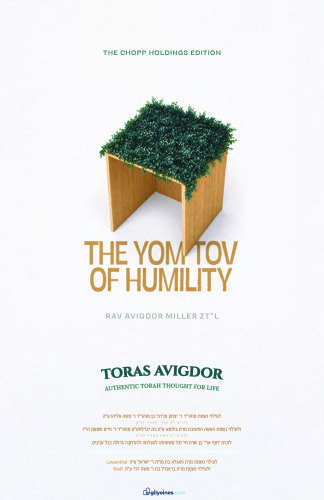
THE YO M TOV OF H UMI L I T Y
CONTENTS:
Part I. Bowing in Humility - 5
Part II. The Sukkah of Humility - 11
Part III. Practicing Humility - 16
Part I. Bowing in Humility
The Yom Tov Bow
One of the glorious experiences of the Yom Tov of old was when
the Jew came into the Beis Hamikdash and bowed down before
Hakadosh Baruch Hu. Every male was obligated to be oleh regel,
to travel up to Yerushalayim and be seen in the azarah and bring
certain korbanos; but included in the procedure was to bow down
to Hakadosh Baruch Hu. That was part of the old-time system of
celebrating a Yom Tov — to fall down on the ground.
And it’s so important that we mention it every day in the Yom Tov
Mussaf. We’re describing the various things that went lost with the
5 / TORAS AVIGDOR . SUKKOS . THE YOM TOV OF HUMILITY
Beis Hamikdash and we say, ˙ ֹלים ַל ֲﬠלוֹ ˙ ¿ו ≈ל ָר‡וƒ ֹ – ¿ו ≈‡ין ֲ‡נַ ¿חנ ּו י¿ כוWe can’t go
up today to fulfill the mitzvah of re’iyah. We’re sad about that because
it was a tremendous experience! We don’t realize what we’re missing.
Three times a year, the nation went up to Yerushalayim. They packed
what they needed and they forsook their homes and began marching
on the road to the Mikdash. And as they went down the road, from
every village new groups came down to meet them and the crowd
became bigger and bigger. After a while, the road was mobbed with
people, everyone singing shiros v’sishbachos to Hakadosh Baruch Hu.
A beautiful sight!
And finally they arrived in Yerushalayim and came into the
Mikdash to fulfill the mitzvah of ( י≈ ָר ∆‡ה ָּכל ¿זכו ¿ּר ָךShemos 34:23). Ah, to
visit the Beis Hamikdash and see the ז ¿מ ָרםƒ ˘ ָירם ו ¿ּבƒ ׁ ּיים ¿ ּבƒ וƒ ים ַ ּב ֲﬠבוֹ ָ„ ָ˙ם ו ¿ּלƒ!כ ֲֹהנ
ּ
When people came and saw the avodas Beis Hamikdash, they were
transformed from head to foot. And all that is included in what we’re
missing out on: ˙ ֹלים ַל ֲﬠלוֹ ˙ ¿ו ≈ל ָר‡וƒ ֹו ≈‡ין ֲ‡נַ ¿חנ ּו י¿ כו.¿
Coming to Bow
But we shouldn’t forget the next part in the davening. We’re
ָ ∆ה ׁ ¿˘ ַּ˙ ֲחווֹ ˙ ¿ל ָפנƒ – ו ¿ּל
looking forward to all of that but we mention also יך
that we used to bow down in front of You. “Hashem, please rebuild for
us the Beis Hamikdash so that once again we’ll be able to bow down
to You.”
It’s an interesting thing because on our own we might not have
realized how important that is. It’s an adjunct, an accessory to the
experience, but is it so important that it should be one of the few
things we specify in our tefillos? The Anshei Knesses Hagedolah who
instituted the words of davening were very wise men and if they
included these words in the Mussaf we must say that bowing down
is considered a very important form of avodah.
Elkanah Makes Aliyah
And I’ll prove it to you. You remember how Elkanah, the father of
Shmuel, went up every year to the Mishkan in Shiloh for Yom Tov? So
the Navi says he had three purposes in mind (Shmuel I 1:3):
6 / TORAS AVIGDOR . SUKKOS . THE YOM TOV OF HUMILITY
One of them was 'ל ¿ז ּב ַֹח ַלהƒ – to bring korbanos. You couldn’t bring
them anywhere else; in those days, it was ossur to bring korbanos
on a bamah because Shiloh was the Mishkan and so you wouldn't
be yotzei your obligation anywhere else — you had to bring the Yom
Tov offerings to the Mishkan (see Zevachim 112b). A very important
reason for Elkanah to travel.
Another reason was ' ים ַלהƒּפנ¿ ָחס ּכ ֲֹהנƒ י וƒלי ָח ¿פנƒ – ¿ו ׁ ָ˘ם ׁ ¿˘נ≈ י ¿בנ≈ י ≈ﬠthe two
sons of Eili, Chofni and Pinchas, were there. Eili, their father, was the
kohen gadol and a shofet, too — the leader of Sanhedrin — and his
two sons were very important talmidei chachomim. And therefore,
Elkanah went up in order to talk things over with them. Maybe they
spoke in learning. Maybe Elkanah had certain questions that came
up during the year; he wanted eitzos, counsel. Whatever it was, to go
up to talk to the kohanei Hashem was a purpose in itself — they didn’t
have telephones in those days.
Aliyah for What?
So you have here two very good reasons; to bring korbanos and
to speak with the gedolei hador. Each one by itself is a good enough
reason to travel up to Shiloh. But pay attention now. Those were the
second and third reasons on the list. You know what the first reason
was? The first on the list, before korbanos and before meeting the
gedolei hador, was 'ה ׁ ¿˘ ַּ˙ ֲחווֹ ˙ ַלהƒ – ¿לto bow down to Hashem.
It’s a queer thing. Is it so important — the number one purpose?
Absolutely. Because listen to the word lehishtachavos. The word
hishtachavah comes from the word shachah which means to be low.
But hishtachavah is hispael; it’s reflexive – to make yourself low. You
don't say “bow” in lashon kodesh; you “make yourself low to Hashem.”
Aliyah L’tzorech Yeridah
Lehishtachavos means to put your face on the ground and lie
there because you want to lower yourself before Hashem. And so
Elkanah threw himself onto the floor and he didn't get up right
away. He wasn’t in a hurry. He took his time and he was thinking,
7 / TORAS AVIGDOR . SUKKOS . THE YOM TOV OF HUMILITY
“I'm bowing down lifnei Melech Malchei Hamelachim, Hakadosh
Baruch Hu. He rules the entire universe, as far as space goes and
beyond! He created it and ל‚¿ ֻ„ ָּל˙וֹ ≈‡ין ≈ח ∆˜רƒ ו,¿ there's no searching out His
greatness (Tehillim 145:3). And I, what am I? A little man, a tiny speck
of protoplasm that He created.”
And for that alone it was worth making a big journey to the
Sanctuary — just to fall down on the ground on your face and feel
that you are low before Hashem.
Who, Me? Yes, You!
“Oh, please,” you say, “Is that really necessary? I don't have to
bow down. I know already that Hashem is bigger than I am. Who isn't
humble to Hashem? Unless chas v’shalom he's an atheist. But a man
who believes in the Creator certainly is humble before Hashem. Who
in the frum world will be arrogant towards Hashem?”
And the answer is: everybody. Every human being is arrogant
towards Hashem. And even though with his lips he may say words
of pious hypocrisy, in his heart he doesn't back down even before
Hashem. That's human nature because actually Hashem made man
endlessly great. And he knows it; naturally he knows, subconsciously,
that he has a neshamah, a chelek of Hashem that was breathed into
him. Every man is tremendously great! And that's why a man must
work on himself to be humble to Hashem. It takes work, effort, to
learn that attitude.
A Passing Dream
It’s so important for a man to realize that without Hashem, he
is nothing. You cannot do a thing to help yourself. םƒ ּב ≈י„י ׁ ָ˘ ַמיƒ – ַה ּכֹל
Everything is in the hands of Heaven! (Brachos 33b). – ¿ּכח ∆ֹמר ¿ ּביַ „ ַה ּיוֹ ≈ˆר
We're like a piece of clay in Hashem's hands (Yirmiyah 18:6). People are
born and they die and nothing is remembered of them. What are we?
– ַּכ ֲחלוֹ ם יָ עוּףWe’re like a dream that goes away (Iyov 20:8).
And that’s why the bowing down of hishtachavah is so important.
Because we have to take action to realize the greatness of Hakadosh
8 / TORAS AVIGDOR . SUKKOS . THE YOM TOV OF HUMILITY
Baruch Hu, that it shouldn’t be – ¿ו ָרם ¿ל ָב ∆ב ָךYou shouldn’t feel elevated
in your heart (Devarim 8:14). – רוֹ ¿ממ ּו ה' ¡‡ל ≈ֹ˜ינ ּוOnly Hashem we elevate!
(Tehillim 99:5). And how? ֹה ׁ ¿˘ ַּ˙ ֲחו ּו ¿ל ַהר ָ˜ ¿„ ׁ˘וƒ – ¿וWe bow down to Him
(ibid. 99:9). Hishtachavu is the opposite of rommemu. You make
Hashem high in your mind when you make yourself low in front of
Him.
A Modest Beginning
That's why one of the most important functions in our prayers
is something that most people overlook. You're beginning to say
Shemoneh Esrei so you give a prefatory bow. You think it’s not so
important. Baruch Atah Hashem; the words you’re going to say, that’s
important — but the bow? That’s just the signal that you’re starting
now.
No; you're missing the whole point. It's a law in the Gemara
(Brachos 34a) you must bow down at the beginning of the Amidah
because that's the first lesson. That’s number one; the most important
thing is the bowing down and acknowledging that there's Somebody
higher than you are.
And so, don't be in a hurry. While you're bowing, take your time
and get the full benefit of that. The bending of the knee is only a
motion of the body, but its purpose is in order to influence the mind;
you bend your knee in order to bend your mind. And therefore it
pays when you bow down to utilize the opportunity, “I'm humbling
myself to You. I’m bowing before the greatness of the King of the
universe.”
Mind Over Motion
Of course, it matters what’s doing in your head, what you’re
thinking. There are all types of good attitudes that have to be
attached to the physical act of bowing down. Otherwise, what is it
just to bow? You see that sometimes in the shul, a man jerks down,
he jerks up, like a robot. He’s not thinking at all. No, we are humbled
in gratitude. So much You are giving me! הי ָﬠ ַליƒ ֹ˘יב ַלה' ָּכל ַּ˙‚¿ מוּלוƒ ׁ ‡ָ ַמה
– What can I pay You back, all that You did for me? (Tehillim 116:12).
9 / TORAS AVIGDOR . SUKKOS . THE YOM TOV OF HUMILITY
Of course, if you don’t think, so it’s nothing. He says, “I bow down
to You Hashem,” but in his heart he is bowing down only to himself.
He thinks he’s the one who helps himself. He imagines himself a self-
made man.
No; the one who bows is “making himself low.” “I’m helpless,” he
says. “I’m on the receiving end and I can’t pay back anything. One
thing I can do and that is to generate this feeling of humility.”
It’s so important to humiliate yourself before Hashem, to
acknowledge your littleness, your nothingness, that merely to bow
down is an achievement of the first magnitude! Isn't it a pity people
don't understand that? You’re lowering yourself before the Master.
You’re acknowledging Him as the King.
Taking a Bow
That’s what the first word of Shemoneh Esrei is telling you:
Baruch. What does that mean “we bless Hashem”? Now, no matter
what others will tell you, the real meaning is that it stems from the
word berech, a knee, and baruch Atah means “You are the One to
Whom the knees are bent.”
And therefore, it shouldn't be a genuflection, a jerk bending
down. No. Utilize that first bending of the knee. It’s a great service of
Hashem. We don’t stand up straight in front of You; we kneel to You.
We don’t kneel today; we bend our knees, however. That’s a sign of
hachna’ah.
Not for Him, by the way. Our humility is meaningless to Hakadosh
Baruch Hu. He doesn’t need it. He doesn't feel elevated or honored
if we weak little human beings demonstrate our humility to Him. It’s
for us, for our perfection to generate this feeling of humility. So don't
be in a hurry when you bend over. Remain for a little while. Make use
of the opportunity every day.
Yom Tov Humility
But in the ancient days, it was something much bigger, much
more. Yom Tov meant that מים ַ ּב ּ ׁ ָ˘נָ ה י≈ ָר ∆‡ה ׇּכל ¿זכו ¿ּר ָךƒ ׁ˘ ּ ¿פ ָﬠúֹ ˘ָ ׁ – three times
10 / TORAS AVIGDOR . SUKKOS . THE YOM TOV OF HUMILITY
a year we present ourselves – ∆‡˙ ּ ¿פנ≈ י ָה ָ‡„וֹ ןbefore the Master, Hashem
(Shemos 34:23). That word ָ‡„וֹ ןis remarkable; it’s not used ordinarily
on Hashem. But it is used here to emphasize that basic function of
Yom Tov, that we come to the Beis Hamikdash to demonstrate that
we are nichna to a Master. A nation left their homes to trek along the
byroads and main roads until they reached Yerushalayim, traveling
up for miles in order to come into His Home. And for what purpose?
'ה ׁ ¿˘ ַּ˙ ֲחווֹ ˙ ַלהƒ – ¿לTo make themselves low to Him.
That’s the avodah that was reinforced every year on Yom Tov.
Of course, each Yom Tov has some more purposes. If it’s the chag of
Chag Hamatzos or if it’s Zman Matan Toraseinu, whatever it is, each
one its own avodah. But this certainly is a function of every chag;
we reinforce this feeling of humility by lowering ourselves before
Hakadosh Baruch Hu.
Part II. The Sukkah of Humility
The Sukkah Academy
Now, as much as every Yom Tov has this function, when we come
to the Yom Tov of Sukkos, we have to understand that these seven
days are especially dedicated to this principle. Because on Sukkos
we have the mitzvah of living in a sukkah and one of the fundamental
lessons that the sukkah is trying to teach us is humility.
All the mitzvos, you have to know, are a form of teaching. Besides
for just fulfilling the command of Hashem, מ ¿ˆווֹ ˙ ∆‡ ָּל‡ ¿ל ָˆ ≈רףƒּ ּ¿˙נ ּו ַהƒלֹ‡ נ
˙ ֹר ּיוƒ – ָ ּב ∆הן ∆‡˙ ַה ¿ ּבthe mitzvos are intended to refine our minds and
our characters (Bereishis Rabbah 44:1). It means if you go into a
sukkah and you’re happy — it’s a Yom Tov atmosphere, ornaments
are hanging in the sukkah, your family is there and they’re serving a
nice meal also, so you make a bracha leishev basukkah because you’re
fulfilling the mitzvah — very good! But there are purposes there, too,
and if you’ll think about them, that’s the best way to sit in the sukkah.
11 / TORAS AVIGDOR . SUKKOS . THE YOM TOV OF HUMILITY
And the more you put into it, the more you’ll achieve, the more you’ll
be refined.
The Proud Nation
The purpose of the sukkos, it says openly, is יכם ∆ ˙≈ ֹ– ¿ל ַמ ַﬠן י≈ ¿„ע ּו ּ„וֹ רו
that your generations should know י‡י ƒ ˆƒ ֹ ¿˘ׂ ָר ≈‡ל ¿ ּבהוƒ˙י ∆‡˙ ¿ ּבנ≈ י יƒּ ּכי ַב ֻּס ּכוֹ ˙ הוֹ ׁ ַ˘ ¿בƒ
םƒמ ¿ˆ ָריƒ ı – ‡וֹ ָ˙ם ≈מ ∆‡ ∆רthat I caused your forefathers to dwell in sukkos
when I took them out of Egypt (Vayikra 23:43). And one of the reasons
why Hashem did that was so we should learn to be humble. After
all, they were going into Eretz Yisroel where they would live like
aristocrats, in big stone homes on their own land, and that would be
dangerous.
Dangerous to what? To their character. Because there’s a
warning in the Torah: Hashem says that when you come into Eretz
Canaan and you’ll disinherit the previous inhabitants and dwell in
batim tovim, nice homes — an emphasis on good homes, strong
and secure — so you must beware of ו ָרם ¿ל ָב ∆ב ָך,¿ that your heart might
become proud (Devarim 8:14).
Now what does it mean “your heart will become proud”? Does
it mean you’ll walk around boasting of your home? It could be, but
that’s not what it really means. If somebody has a nice home, to
some extent it may contribute to his arrogance, it might make him
conceited, but that’s not the point here at all. – ¿ו ָרם ¿ל ָב ∆ב ָךYour heart
will become proud, ' – ¿ו ׁ ָ˘ ַכ ¿ח ָּ˙ ∆‡˙ הyou’ll forget about Hashem.
Forget Hashem?! That’s impossible! They’re not going to forget
Hashem in Eretz Yisroel! They’ll continue to do mitzvos. They’ll
separate terumah and ma’aser from their grain. They’ll keep kashrus
and taharas hamishpacha. Even the dinim of tumah v’taharah and
everything else they’ll keep. So what does it mean they’ll forget
Hashem?
Feeling Too Secure
It means that you won’t think about Him as your Benefactor, as
your security. It’s possible to do all these mitzvos and still to forget
12 / TORAS AVIGDOR . SUKKOS . THE YOM TOV OF HUMILITY
that you have a Master over you. Because if you’re not busy with
humility, you'll begin to imagine that you’re good without Him. Of
course, you won’t say that — you won’t even think it — but your
character will change.
When you live in a beautiful, comfortable home, you tend to
forget that there’s Somebody over you. In the desert, you didn’t have
any permanent dwellings; you only had tents, temporary makeshift
huts that at any moment when you heard the trumpets blow you had
to put them together quickly on the back of a donkey and set out
on the trek in the desert to some other place, so you couldn’t feel
too arrogant. You turned around and looked back where you had
encamped for some time and you see there’s nothing left except a
little bit of garbage, and you’re traveling again, so you didn’t feel a
permanence at all.
But when they came to Eretz Yisroel and they settled in, it was
a different story. Not only they settled permanently, but they were
living in beautiful dwellings — houses that they didn’t have to take
apart and transport on the back of an animal to someplace else.
And so, naturally, people tend to forget that really they’re not so
important.
Deflating the Proud
And therefore, in order to prepare for that test, Hashem said,
מ ¿„ ָ ּבר ¿ל ַמ ַﬠן ַﬠ ּנ ¿ֹ˙ ָךƒּ עים ׁ ָ˘נָ ה ַ ּבƒ יך ∆זה ַ‡ ¿ר ָ ּב
ָ ˜ֹ∆ יכ ָך ה' ¡‡ל
ֲ ֹלƒ – ¿ו ָז ַכ ¿ר ָּ˙ ∆‡˙ ָּכל ַה ∆ ּ„ ∆ר ¿ך ֲ‡ ׁ ∆˘ר הI
took you into the Midbar for forty years to humble you, to prepare you
(Devarim 8:2). In the Midbar, they were always reminded that they
were entirely dependent on Hashem. They were secure, yes, but you
can’t feel like a big shot when you’re living in a desert in a tent. And
that was the purpose. That was the intention.
And that’s why we go into the sukkah — to be humbled before
Hakadosh Baruch Hu. We leave our nice homes, our carpets and our
chandeliers, our brick walls and sturdy roof, and for seven days we
go into a flimsy little hut, a weak kind of protection.
13 / TORAS AVIGDOR . SUKKOS . THE YOM TOV OF HUMILITY
The Revoked Citizenship
That’s what the possuk says, ˙˘ ָר ≈‡ל י≈ ׁ ¿˘ב ּו ַ ּב ֻּס ֹּכ
ׂ ¿ ƒ – ׇּכל ָה ∆‡ ¿ז ָרח ¿ ּביevery
citizen of Yisroel should dwell in sukkos (Vayikra 23:42). That’s a
queer word to use, ezrach. You don’t find it in other places. It doesn’t
say “every ezrach should eat kosher” or “every ezrach should keep
Shabbos.” It doesn’t say “every ezrach should refrain from shaving
with a razor blade.” Only when it comes to the sukkah, the possuk
says ezrach. What’s that about?
And the answer is ezrach means a bona fide citizen. You’re
established. You have a nice home and it’s not even stucco; it’s brick.
You think you’re pretty important. You feel that you’re an ezrach, a
permanent burgher, an important fellow? Then you need a reminder:
„ ַיר˙ ֲﬠ ַר‡יƒ ּ„ ַיר˙ ∆˜ ַבע ¿ו ׁ ≈˘ב ¿ ּבƒ מƒ ‡ˆ≈ – Move out of your nice home into a
temporary dwelling (Sukkah 2a).
A Humbling Hut
That’s why the sukkah has to be built in such a way that it’s not
a permanent type of home. You can’t make it so high a construction
that you’re forced to have sturdy walls. No. It has to be flimsy. That’s
a halacha of sukkah. Also, the Torah insists that the schach cannot
be a regular roof. Even though the roof will be of things that grow
from the ground, if it’s made in such a way that it is a permanent
construction, then it’s possul.
And so you see the insistence on the theme of something that is
temporary, something which humbles the one who dwells there. It’s
a very weak kind of protection. Some sticks, some schach; sometimes
it rains into your soup.
A goy can even heave a brick into the schach, chas v’shalom, and
it will fall through. You know sometimes your neighbor, a gentile,
makes trouble for you on Sukkos? He wants to call the city inspector
because you’re making an illegal structure. Or he makes other
trouble. I once was visiting a rabbi of a certain shul in East Flatbush
and he was making his sukkah. He had a Puerto Rican neighbor who
liked making trouble for him. And this rabbi went next door to him
14 / TORAS AVIGDOR . SUKKOS . THE YOM TOV OF HUMILITY
and he said, “Please, please,” he said, “don’t break down my sukkah.”
He was begging him. “Please don’t break down my sukkah.”
In his house, this rabbi was an important fellow — and he was,
by the way — but outside on Sukkos he didn’t feel so important any
longer. I was comforting him; I told him that he should be happy
that he was fulfilling one of the purposes of the sukkah. You go into
the sukkah to remind yourself that you’re not as important as you
thought. You’re insecure, unprotected. Without Hashem, you’re
nothing.
Homeless Citizens
And that’s why the ezrach is emphasized. That weak kind of
construction is for the purpose of teaching the one living there that
he’s not so important. Even if you’re a permanent, real bona fide Jew,
you should also move out because you have to be reminded that
you’re not as important as you imagine. You look up and see overhead
nothing but schach. The people passing by won’t give you much
privacy there. You can’t sit like a melech when you’re in a place that
has two walls and a tefach. “I’m like a homeless man, chas v’shalom.”
Now, you don’t see a homeless person who’s arrogant. How can
he be arrogant if he’s living on a park bench? Maybe he’s rude, he
never learned any manners; he’s bitter — but arrogant he’s surely
not. And in a small way, that’s what you’re doing in the sukkah. It’s for
the purpose of humbling you.
The Great Unhoused
And now we understand something puzzling about the practices
of Avraham, our father. „ֹ‡ – ¿ו ַ‡ ¿ב ָרם ָּכ ≈ב„ ¿מHe was very heavy with
wealth, מ ¿˜נ∆ ה ַ ּב ∆ּכ ∆סף ו ַּב ָּז ָהבƒּ – ַ ּבwith huge herds, huge flocks, and trunks full
of silver and gold (Bereishis 13:2).
Now, a wealthy man could have built himself a beautiful home. He
could buy a plot and build a brick house surrounded by gardens and
orchards. That’s what we would have done. Even if you’re a tzaddik,
so you’re not going to build a palace maybe, but at least a home,
15 / TORAS AVIGDOR . SUKKOS . THE YOM TOV OF HUMILITY
SPREAD HASHEM’S NAME IN THE WORLD
T H E I M PAC T O F YO U R D O N AT I O N
How many more yidden would
THOUSANDS STRENGTHEN SPREAD CONTINUE
of Yidden will be Emunah, Bitachon Hashem’s Name Rabbi Miller’s legacy
inspired every week and Yiras Shamayim around the world for generations you like to bring closer to
Hashem every week?
OUR
GOAL MORE
FOR BOOKLETS
5787 EVERY
WEEK
ADD 10 ADD 20 ADD 50 ADD 100
BOOKLETS BOOKLETS BOOKLETS BOOKLETS
Rabbi Miller spent his life EVERY EVERY EVERY EVERY
spreading the Name of WEEK WEEK WEEK WEEK
Hashem around the world.
Help us continue his mission.
$5 / week $10 / week $25 / week $50 / week
E V E RY S T E P C O U N T S
Call or text: 732.844.3670 Zelle: info@torasavigdor.org torasavigdor.org/expand5787
something. It’s interesting, however, that Avraham always dwelt in
a tent.
Now, you could say, there was a reason for the tent. Avraham was
always traveling: – ָהלוֹ ¿ך ¿ונָ סוֹ ַﬠHe was always on the move (Bereishis
12:9). Because he had a purpose and that was to preach to everybody
that there is a Master of the World. Wherever he went, that was his
business – ּי ¿˜ ָר‡ ¿ ּב ׁ ≈˘ם ה' ≈˜ל עוֹ ָלםƒ ( ַוBereishis 21:33). There’s a Ribono Shel
Olam! That was Avraham’s business; he went around from place to
place preaching that. So you might say that he couldn’t build a palace
for that reason.
Practice What You Preach
But that wasn’t the only reason. It was a principle: he should
never become arrogant. He should always remind himself that he’s
not so secure, that he’s bowed down before Hashem. It wasn’t only
that he preached about it — he practiced it. And living in a flimsy
structure helped.
It was only Lot who finally broke with his rebbe, Avraham, and
went away to Sedom. At first it says – ַו ∆ ּי ¡‡ ַהלhe pitched his tent (ibid.
13:12). But finally, he gave up Avraham’s way of life and he moved into
a house. It says openly that he lived in a house in Sedom (ibid. 19:2).
So he gave up the ways of his rebbe.
But Avraham and Yitzchak, they dwelt in tents. Even Yaakov, who
built a house, moved out soon and went back to the tents. They lived
in tents always. And so we see that it was a principle of the Avos that
they should never forget this great principle: to live with the attitude
of hishtachavah, to make yourself low before Hashem.
Emulating Our Forefathers
Now, we don’t do that. We’re not as great as our forefathers. And
Hakadosh Baruch Hu doesn’t require it either. “Live in a nice home,”
He says. “I want you to be happy and comfortable. But once a year,
for seven days, I want you to be like the Avos and like your forefathers
16 / TORAS AVIGDOR . SUKKOS . THE YOM TOV OF HUMILITY
in the Midbar. And therefore, on Sukkos, „ ַיר˙ ֲﬠ ַר‡יƒ ּ„ ַיר˙ ∆˜ ַבע ¿ו ׁ ≈˘ב ¿ ּבƒ מƒ ‡ˆ,
≈
and practice up on this great middah of humility.”
And therefore, isn’t it a rachmanus when people sit in the sukkah
and don’t think about what the sukkah is about? To walk into the
sukkah after making all preparations and the mind should be blank?
A very great loss.
When you sit in the sukkah, immediately the first result should be
you’re nichna, you’re humbled before Hashem. It’s very important to
keep that in mind when you come into the sukkah. At least for seven
days, to go through the motions, to practice this ideal of ˙ ֹה ׁ ¿˘ ַּ˙ ֲחווƒ ¿ל
ַ to make yourself low before Hashem.
'לה,
Part III. Practicing Humility
Raising the Bar
Now, we’ll take it one step further. How do you work on this
avodah of humility in the sukkah? So we said that when you come
into the sukkah, immediately try to remind yourself of this purpose:
“I’m here now because I want to practice being nichna, humbled
before Hashem.” It’s a good idea to keep that in mind anytime you
walk into the sukkah. Even if you do it a little bit you're successful
because you're superior to anybody else.
But let’s climb the ladder of anivus to Hakadosh Baruch Hu,
another rung. Here, you’re sitting in the sukkah and everyone is
talking. Wonderful! It’s simchas Yom Tov. But you have to remember
what the sefarim say, that you have to be careful what you say in
the sukkah (Mishnah Berurah 639:2). You can’t fool around. You can’t
make jokes. The sukkah is no place for leitzanus. A moshav leitzim in
the sukkah is entirely contradictory to the purpose.
Superfluous Speech
Of course, – ּ≈˙ ׁ ¿˘ב ּו ¿ּכ ≈ﬠין ָּ˙„וּר ּוYou have to live normally in the sukkah
(Sukkah 26a). But you have to be careful, too. A makom kadosh like a
17 / TORAS AVIGDOR . SUKKOS . THE YOM TOV OF HUMILITY
sukkah requires more vigilance; you can’t talk leitzanus, lashon hara,
in such a place.
But it’s an interesting thing the sefarim say that even superfluous
words you shouldn’t speak in the sukkah (see Mateh Efraim 625:65).
A remarkable idea; it’s a good practice to be careful not to say
unnecessary words in the sukkah. And it pays to understand why
that’s so.
Healthy for Body and Soul
Now, we have to know that there are various benefits of silence.
One is that you’ll sin less — ‡בי‡ ≈ח ¿טƒ רים ≈מƒ ּב ¿„ ָבƒ ( ָּכל ַה ַּמ ¿ר ∆ ּבהAvos 1:17). If you
have any kind of long conversation, you're certain to do some sin in
order to continue the run of the conversation. You'll look for other
things to say, and you'll bring in names of people and you'll find some
faults in them. Or you might say some leitzanus against something
that's kodesh. That's how it is in the course of time; רים לֹ‡ י∆ ¿ח ַ ּ„לƒ ¿ ּברֹב ¿ ּ„ ָב
– ּ ָפ ׁ ַ˘עin a multitude of words you cannot avoid a sin (Mishlei 10:19).
Even a person who is a lamdan who studied the Chofetz Chaim's
sefarim will be nichshal if he talks at length. And those who didn't
learn, no question about it. So that’s enough of a reason to keep your
mouth closed.
It’s also healthier. י˜ה ƒ ˆָ – ל ֹ‡ ָמI found nothing better
ָ ˙ƒ ˘¿ ׁ ּ מƒ ‡˙י ַל‚ּ וּף טוֹ ב
for your health than silence (Avos 1:17). There are a lot of things you
can do to protect your health. Exercise is important. Proper sleep is
important. Eating properly is important. But this Tanna examined
them all and he found that silence is the best thing for your health.
By the way, people will like you more, too. Absolutely. People
who don’t speak much gain friends. It’s a fact that quiet people are
well-liked. I myself know a number of quiet people who are quite
popular; people are happy to be in their company.
18 / TORAS AVIGDOR . SUKKOS . THE YOM TOV OF HUMILITY
Displaying Your Insides
But there’s something else in shtikah that is more than all of that:
Silence is a sign of a humble person. And we’ll explain that in two
ways.
Number one: In Mishlei (18:2) it states, ּב ¿˙בוּנָ הƒ סילƒ ¿ּכıֹ – לֹ‡ יַ ¿ח ּפa
fool does not desire understanding, ֹל ּבוƒ ˙ ֹה ¿˙ ַ ּ‚ ּלוƒ ‡ם ¿ ּבƒ ּכיƒ – he desires to
reveal his own mind. It means that the foolish fellow is not interested
in listening. He wants to talk. Why does he want to talk? He has an
instinct of turning himself inside-out to people, of displaying his
emotions and demonstrating his thoughts.
Sometimes you watch a man sitting on a park bench; he’s talking
for hours. You might even envy him; he’s a fountain of speech while
you’d fall short of words. Or maybe you see people sitting in shul
talking and talking from Mah Tovu until Aleinu. What do they have to
talk about so much? Why is it that the k’sil is so interested in telling
people so many things?
The answer is, he’s talking about himself — what he saw, what
he heard, what he thinks. It’s the middah of egoism. He’s interested
in himself and he wants to show himself to others. Now, the truth is
that often it doesn’t compliment him too much when he starts taking
off his clothes and displaying himself to other people. He empties out
the contents of his mind and he doesn’t realize that people ridicule
him for that. But that’s what his instinct is; his ego drives him to talk
as much as he can.
And to a certain extent, it applies to everyone. It’s an effort to
be silent. You’re fighting against this animal within you that wants to
bark or meow or make noises, to show that it’s there, to demonstrate
anochi, that “I am here.” And therefore, when a man is able to keep
his mouth closed, he is forcing that quality to be repressed.
The Silent Treatment
Especially if you have what to say. Let’s say somebody talks to
you about a certain subject which you know a good deal about, but
you keep your mouth closed and listen to him; that’s good practice.
19 / TORAS AVIGDOR . SUKKOS . THE YOM TOV OF HUMILITY
Share the limelight. Let other people chatter; you just listen. Nod
your head, smile, be friendly, but keep your mouth closed. It’s a
tremendous training of character.
Here’s a man, he likes to stop me on the street to tell me his
vertlach, his pshetlach. So I’m quiet. I nod and listen. Now, actually I
have a hundred times as much as he has to say, and better things — I
listened to my rebbeim for years in Slabodka and they had very good
things to say. But I keep quiet. I don't say anything of my own. I just
listen. I’m practicing.
Silent Awareness
But there’s something much more. Because you can add the
thought: why am I quiet? You have to listen to what Shlomo Hamelech
says in the beginning of Chapter 5 of Sefer Koheles, a very important
function of keeping quiet:
ָ פƒ ּ – ַ‡ל ּ¿˙ ַב ≈הל ַﬠלDo not be hasty with your mouth, ל ¿ ּב ָך ַ‡ל י¿ ַמ ≈הרƒ ¿ו
יך
ˆי‡ ָ„ ָברƒ ֹ – ¿להוand your heart should not be in a hurry to utter a word,
ֹ˜יםƒ ל ¿פנ≈ י ָה ¡‡לƒ – before Hashem. Whatever you say, you’re saying in the
Presence of Hashem. םƒֹ˜ים ַ ּב ּ ׁ ָ˘ ַמיƒ ּכי ָה ¡‡לƒ – Hashem is in Heaven, ¿ו ַ‡ ָּ˙ה ַﬠל
ı – ָה ָ‡ ∆רyou’re down here on earth, you’re standing in front of Him, ַﬠל
ָ ¿הי ּו ¿„ ָב ∆רƒ – ≈ּכן יTherefore, your words should be few.
טיםƒּ יך ¿מ ַﬠ
And so he’s introducing to us a new motivation, why you should
be quiet: because you're in the Presence of Hashem.
So now we begin to understand that silence is not merely a good
quality that keeps you away from sin. It’s not merely something that
will keep you healthy and will cause you to be more appreciated
by people. Silence makes you humble! Hashem is greater than you
are! םƒֹ˜ים ַ ּב ּ ׁ ָ˘ ַמיƒ ּכי ָה ¡‡לƒ – Hashem is here above you. He’s looking at you.
Where do you get the authority to open your mouth in the Presence
of the King? You need silence in order to be humble to Hakadosh
Baruch Hu.
20 / TORAS AVIGDOR . SUKKOS . THE YOM TOV OF HUMILITY
Silent Humility
And this is based on the principle of מי ׁ ∆˘ ָ ּ‚„וֹ לƒ ּב ¿פנ≈ יƒ ָח ָכם ≈‡ינוֹ ¿מ ַ„ ≈ ּבר
מ ּ∆מנּ ּוƒ – a wise man does not speak in the presence of somebody bigger
than him (Avos 5:7). Silence means that you know you are standing in
the presence of someone.
Let’s say Governor Cuomo would be visiting here. I wouldn’t open
my mouth. Now, Cuomo is a nobody. He’s a shlemazel; a shlepper and
a bum, a low character. But if he was here, I’d keep quiet. After all,
Hashem gave him authority for the time being. Let’s hope he’ll lose
the next election, but for the time being he’s the governor and so a
wise person keeps quiet in the presence of that tramp.
A normal person feels humility before someone in authority.
Even when I visit a doctor, I have so much respect for him so I keep
quiet. He knows so much in that field of which I know nothing at
all. I'm humbly quiet. That's old-fashionality; that's how we were
brought up. We're supposed to find it difficult to talk in the presence
of someone bigger than us. It's only a fool, an idiot, who will prattle
in the presence of מ ּ∆מנּ ּוƒ מי ׁ ∆˘ ָ ּ‚„וֹ ל.
ƒ
And therefore, Koheles is saying we can measure the extent of
your humility to Hashem by the looseness of your mouth. If you
actually felt you were standing in the Presence of Hashem, you
couldn't talk that much. If you could open your mouth and talk freely,
it's the clearest proof that your belief is only a superficial stereotype.
It’s not real.
Sukkah Silence
Now, this middah is something especially good to practice up
in the sukkah. It’s the little humble hut teaching you humility, that
you’re not the ezrach you imagined yourself to be. And so this is an
excellent place to train yourself.
So imagine Cousin Jake comes over on Chol Hamoed to visit.
“Aha!” you’re thinking, “A chance to remind myself that I’m standing
in the Presence of Hashem. I’ll keep my mouth closed as much as
possible.”
21 / TORAS AVIGDOR . SUKKOS . THE YOM TOV OF HUMILITY
He walks into the sukkah and starts talking, and you’re very
polite, of course. “How are you, Jake? Long time no see! How’s the
family?” Whatever it is, you say something — but then you stop
because you’re standing in front of Hashem. You might have to open
your mouth here and there to say a word or two, but that’s it. You
smile pleasantly but you can’t talk much when you’re in the Presence
of the Melech Malchei Hamelachim, Hakadosh Baruch Hu.
Of course, he shouldn't know. If he’s here at the lecture, so
practice on someone else. But whoever it is, it’s a wonderful training
in anavah; it’s a very big achievement to practice humility in the
sukkah.
Practice Makes Perfect
Now, actually you're not an anav yet. But just by keeping your
mouth closed, you're influencing yourself toward the middah of
anavah. That’s a big principle in the Torah psychology which the
Sages teach us. It’s the famous principle: ˙ ֹימ ּיו
ƒ ƒ ּיוּ˙ ¿מעוֹ ∆ר ∆ר˙ ∆‡˙ ַה ּ ¿פנƒחיˆוֹ נƒ – ַה
your outwardliness stirs up your inwardliness (see Mesillas Yesharim,
Ch. 7).
Each one of us aspires to gain more humility; we want to feel the
Presence of Hashem more and more as the days and the years go
by. And now Koheles tells us how to get it. The more you keep your
mouth shut thinking that you're standing in the Presence of Hashem,
the greater you become.
Try it once. There's a kick to it. It's like taking vitamins. Try and
you'll see. I suggest doing it a few times a day in the sukkah. With
chaveirim, your wife, your father-in-law, whoever. “I’m going to try
to keep my mouth closed because I’m standing in front of Hashem.
Even if I have to say something, I’ll count my words.” Chop short your
sentence.
That’s an achievement. That's vitamins for your soul. It puts
into you such an awareness that you're standing in the Presence of
Somebody bigger. That's a good exercise. It's externality but ˙ּ ּיוƒחיˆוֹ נƒ ַה
˙ ֹימ ּיו ¿ It will stir up in you such a wave of emunah.
ƒ ƒמעוֹ ∆ר ∆ר˙ ∆‡˙ ַה ּ ¿פנ.
22 / TORAS AVIGDOR . SUKKOS . THE YOM TOV OF HUMILITY
That’s how you learn humility. It’s like bowing down to Hashem.
In your mind, you're laid out flat, prostrated in front of Him.
The Secret of the Sukkah
And so it’s something you can do always — if you do it all year
long once a day you’re a very wise person — but the sukkah, that’s the
place made for that. You’re exposed to the sky, to Hashem; you’re not
such an ezrach when it’s two walls and a tefach, and therefore don’t
waste the opportunity.
Here you built a sukkah already. It was a big job — maybe it was a
big expense, too. But finally, the sukkah is standing. You even asked
the rabbi to come down and inspect it and he gave his hechsher —
everything is kasher v’yashar; the schach is sufficient, the walls were
made to the din.
So maybe you think you can lean back and relax now. No, you
can't relax. Now you have to get busy utilizing the sukkah to produce
from yourself what the sukkah was built to produce.
Have a Wonderful Sukkos
Let’s Get Practical
Put Yourself On Mute
Sukkos is the Yom Tov of humility, a time when we forgo the comforts
of our homes and dwell in a humble hut for one week.
This Sukkos, bli neder, I am going to make a conscious effort for at
least ten minutes each day to zip my lips in the sukkah. I will maintain
cordiality, letting others have the spotlight, while keeping in mind
that I am basking in the Presence of Hakadosh Baruch Hu.
This week’s booklet is based on tapes:
R-53 - Great by Silence | 271 - Tenants in This World | 614 - The Sukkah
664 - Perfection of Humility | 776 - Service by Silence
Listen to the original lectures of Rav Miller zatzal on the Mipihu Phone Line
USA: 718-400-7220 | Israel: 778509304 | UK: 3303505768
T O R AS AV I G D O R P I L L A R S
Joey & Pamela Sakkal
לעילוי נשמות
מרת פאגלא בת
מורינו ר' ישראל ע"ה
Lowenthal
ומרת בראנדל
בת ר' משה דוד ע"ה
Steif
לזכות נתן יוסף
בן שהלה תמר חיה
ודבורה בת מלכה
ltctechgroup.com
gotavi co
gotavi.co
TapestryHealth.com
Shabbos and Yom Tov
Let us compare Shabbos to the Yomim Tovim. It is written, "Six days shall you work
and do all your labor, and the seventh day is Shabbos to Hashem, your God." (Shemos
20:8-9) What is this verse telling us? Simply speaking, it says that the six weekdays are
a time of doing. "Six days shall you work..." The Vilna Gaon explains it differently. He
says the verse hints at the six Yomim Tovim: the first days of Pesach, the last days of
Pesach, the first days of Sukkos, the last days of Sukkos, Shavuos, and Rosh Hashanah.
On these days, it is permitted to do the work of cooking and of carrying objects from
domain to domain - "Six days shall you work and do all your labor." But "the seventh
day is Shabbos to Hashem, your God" - Shabbos is different. On Shabbos these
melachos are forbidden.
What is the basic difference between Shabbos and Yom Tov? Each holiday has a
special mitzvah, while Shabbos does not. Pesach has matzah, Rosh Hashanah has
shofar, Yom Kippur has fasting and teshuvah, Sukkos has sukkah and lulav. All these
mitzvos are like an engine that generates kedushah. Matzah is called nahama
dimehemnusa, the bread that brings a person to emunah. The sound of the shofar
penetrates the depths of our neshamah and affects us. And so on.
Shabbos has none of these. The very word "Shabbos" is derived from the word
shevisah, "cessation from activity." If we were to define the essence of Shabbos, we
would point to this word. It is an absence of everything else; a cessation of the activity
that preceded it. Yom Tov is compared to a picture; each one has its own beautiful
scene. But Shabbos is like a mirror — it has no content of its own. Shabbos is a day on
which the whole world stops - no plowing, no cooking, no writing, etc. And when
everything stops, what's left? Hashem! On this day, there's no world. There's only
Hashem. Therefore, the mirror of Shabbos reflects Hashem. That is why we say that
Shabbos is the day of Hashem.
And that is why Shabbos has so many intricate halachos. In order to fulfill the
mitzvah of lulav, you just need to pick up a lulav. Shaking it in six directions adds to
the mitzvah, but the basic Torah requirement is fulfilled the moment you take the
lulav into your hand. Whereas on Shabbos, every move we make is complicated. For
twenty-four hours, we must pay attention to everything we do. We make a salad, open
the refrigerator, turn on the tap, want to pull off a paper towel...everywhere we
turn it's Shabbos, Shabbos, and again Shabbos. And not just in the kitchen and the
living room. When we go outside, we again encounter Shabbos: the complex laws of
transferring objects from domain to domain. And so it is with virtually every move we
make on Shabbos.
Hilchos Shabbos surround and permeate our lives because Hashem surrounds
everything and fills everything. We live this reality on Shabbos. There is nothing but
Shabbos; there is nothing but Hashem. The entire world ceases to exist, and we are
now with Hashem alone, since there is nothing else. In this way, the numerous
restrictions of Shabbos allow us to break free of the bounds of ordinary, mundane
reality. Today, we are not just human beings living in the everyday world. We are
transformed and uplifted to a whole new plane of reality in which we are alone with
Hashem.
Sponsored In Honor of My Husband
David Ben Chana
May Hashem bless him with health, happiness and much nachat!
WEEK 70 - Sukkos To Sponsor: ShabbosInspired@gmail.com
FROM
IT
S
RA
I
K LY V
BBI MI
EE
L
W LE
A R
Subscribe today and receive O N LY
Toras Avigdor every week $2.50
delivered right to your mailbox. A WEEK
Email mail@torasavigdor.org
Call/Text 732.844.3670
QUESTION
What should we think when we shake lulav by Hodu in Hallel?
ANSWER
So when you do the na’anuim tomorrow by Hallel and you say, “'הוֹ „ ּו ַלה
ּכי טוֹ בƒ – We thank You Hashem for all of the good You’ve done to us,” you
have to be prepared to thank for something. You’ll go into Hodu with a
blank head, with nothing?
So you’ll think, let's say, like this: “Didn’t I marry off my daughters
well?” Did you ever think about that when you say Hodu? It wouldn’t be a
bad idea to make one na’anuim for each son-in-law. “Ay-yah-yay! I’m
thanking You, Hashem, for this son-in-law.” And by the next na’anuim,
ּכי טוֹ בƒ 'הוֹ „ ּו ַלה, “I’m thanking You, Hashem, for the next son-in-law.” That’s
how to work it. It’s such a very big thing to have married off your children
well that you can never thank enough for a good son-in-law or for a good
daughter-in-law. And that’s how you should think when you make the
na’anuim. It shouldn’t just be a mechanical thing.
You think it’s silly! It’s not silly at all. I do it. Many times I think like this:
One na’anuim is for my oldest son-in-law. “Baruch Hashem, I have a good
eidim! Baruch Hashem!” And then, “Baruch Hashem, I have a good second
son-in-law. And baruch Hashem for the next eidim. Baruch Hashem,
there’s no trouble there. I never hear any machlokes. My daughters live in
shalom with my eidim. Baruch Hashem, I’m happy. Such good eidims.”
That’s why we make na’anuim. That’s what it means Hodu: “I’m
thanking You for what You’ve given to me.” September 1989
Printed by:
Sponsorship available for $360 • Call/Text 732.844.3670
The Zman Is Starting.
Join Chavra D’Hilchisa and make this
the year you master halacha l’maaseh.
n I bacck outut of ththe d
the deea
all? Is
Is a ver erbba
al aggreeeem meen nt bbiind
ind
ndingingg?? W
in Whhat
at makes akes
ak es a mik ikva
vah kosh
hen is wa
water
ter shhe’
te euuvvim
im? H Hoow iss a mikkva vah bu
vah buNE
iilllt?
tt?
W?!M
Miilchi
lchig
lc hhiig sp
spoooon iin
n a flfleei
eisshhiigg pot?
ot? Ca
ot Can I use t
agai
ag ainn? Ca
n? anMASTER
I ba
acckk outut of thhe ddeea all? Wh
WMASTER
ho ha has to to pay foorr thhee dam am agee?? Is
ag
MASTER Is a veerrba bal aggreeme
ding? WhattHILCHOS
makkes es a mik i va
vahh ko
kossh sher?
sher
her
er?? Wh
When
When
CHOSHEN en iiss wate
water
waateterr sh
she
hee’’u
uvvim
imHILCHOS
? Ho
How iss a mikva
How ikkva
vah
ah bu uilt? C
e th
thee pot
poot ag
again?
aiin?? Is
SHABBOS Is tthe
he foo
he oodd still
sttilillll mutar?
MISHPAT Can
Ca n I ba
backck outt of of th
thee NIDDAH
deeal
d a ? Is
al? Is a vvereerba
erb
errbba
bal
al ag
al agre reem
re emee
em
ding? What makes
Rav Simcha es a Londenski
Bunim mikvah kosher? withWhenRav Zev is water she’uvim?
Cohen HoowDov
with Rav Shmuel is Bernath
a mikvah bu
chi
higg sp
spoo
oonn in
in a flei
fleish
shigig pot
ot?? Can
Can I use th the po
p t aggaiin?? Can Can I babackck out of the the de
th deal
al?
l? Wh
Whoo h
pay for the damage? Is a verbal agreement binding? What makes a mikvah kosher? Wh
wat
ater
er she
he’u
uvi
vim?
m? How is a mik ikva
vahh bu
va builililt?
t? Can I use th thee po
pott aggaiain?
n? Is the food d stil
tilll mutta
SIGN
N UP TOD
DAY וֹמﬢ ַﬠל ְמנָ ת ֵ ַה ּל
יקין ִ ַמ ְס ּ ִפ,ַﬥ ֲﬠשׂ וֹת
CHAVRA.NET ,ְּביָ דוֹ ִל ְלמוֹﬢ ו ְּל ַל ֵּמד
929.691.9486 .ִל ְׁשמוֹר וְ ַל ֲﬠשׂ וֹﬨ
THE YOM TOV
OF HUMILITY
R AV AV I G D O R MIL L ER Z T ”L