
Olas Shabbos Minkatch - English — Sukkos (2026-09-21)
:
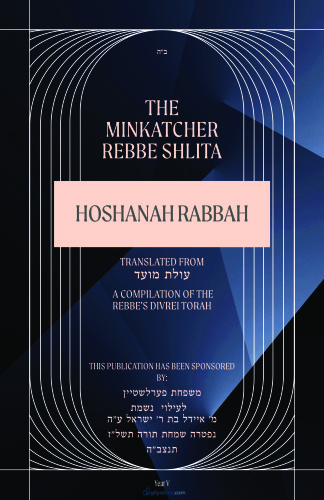
ב”ה
THE
MINKATCHER
REBBE SHLITA
HOSHANAH RABBAH
TRANSLATED FROM
עולת מועד
A COMPILATION OF THE
REBBE’S DIVREI TORAH
THIS PUBLICATION HAS BEEN SPONSORED
BY:
משפחת פערלשטיין
לעילוי נשמת
מ' איידל בת ר' ישראל ע"ה
נפטרה שמחת תורה תשל"ז
תנצב"ה
Year V
2 The Minkatcher Rebbe on Hoshanah Rabbah
HOSHANAH RABBAH
The Final Seal and The Open Gate
We are taught in Maseches Rosh Hashanah (16b) that Yom Kippur is the
awesome day upon which our judgment reaches its final conclusion, and
the destiny of the coming year is sealed. As we proclaim in the stirring words
of Unesaneh Tokef, וביום צום כפור יחתמון,“ – בראש השנה יכתבוןOn Rosh
Hashanah they are inscribed, and on the fast of Yom Kippur they are sealed.”
Indeed, the final tefillah of Yom Kippur is called Ne’ilah——עת נעילת שער
because it is the moment when the gates through which a Yid has poured
out his tefillos, his tears, his hopes, and his deepest yearnings throughout the
Yomim Nora’im are, seemingly, closed.
And yet, the Zohar Hakadosh (Vol. III, 31b, and elsewhere), as well as the
seforim hakedoshim (see Bnei Yissaschar, Tishrei 12), teaches us that the
koach of the chasimah extends until Hoshana Rabbah.
So which is it? If the Shaarei Shomayim are closed at Ne’ilah, what remains for
Hoshana Rabbah? If all doors have been sealed, what is left to accomplish?
Through what opening can a Yid still cry out to his Father in Heaven? Through
what gate can a tefillah still ascend on this holy day?
The answer is one of the most profound expressions of HaKadosh Baruch
Hu’s infinite rachmanus. Even as Yom Kippur draws to its close, even as the
gates of Heaven are being sealed, even as it seems that the opportunity to
alter the decree has passed, HaKadosh Baruch Hu leaves one gate open, one
door through which a broken heart can still enter: the Shaarei Dimah—the
Translated and Published ( הושענא רבה תשפ"זYear V) 3
Gates of Tears. As Chazal teach us (Brachos 32b), — שערי דמעה לא ננעלוthe
gates of tears are never locked.
And as long as that gate remains open, there is still a place for the tefillah
that rises from the deepest chambers of the heart. There is still a place for
the teshuvah born of a lev nishbar, for the trembling tears of one who can no
longer contain the pain, the longing, and the hope within his soul.
This is the extraordinary koach of Hoshana Rabbah. The koach of the
chasimah is still within reach because the Shaarei Dimah are still open.
Therefore, it is not merely another day for tefillah in Tishrei. It is a final, precious
moment of extraordinary potency in which a person can gather every pain
that has remained unspoken, every hope that has remained buried within
his heart, and bring it before Hashem. To stand before Him not with perfect
words, but with tears. And to plead with Him as a child pleads with his Father.
The Day of Dovid HaMelech
Though the Shaarei Dimah are open every day of the year, there is a particular
koach to enter its gates on Hoshana Rabbah because it is the seventh day of
Sukkos, when Dovid HaMelech enters the sukkah. And there is no one who
teaches us more profoundly than he how to daven with a broken heart.
Dovid HaMelech taught Klal Yisrael, for all generations, how to cry in tefillah
before Hashem. How to give voice to longing. How to place one’s very soul
before the Ribbono Shel Olam and hold nothing back. His entire sefer Tehillim
is the prayer of a person who, again and again, takes the deepest places
of human suffering—fear, loneliness, yearning, desperation, hope—and
transforms them into tefillah.
Indeed, he writes in Tehillim (6:7–9), , אשחה בכל לילה מטתי,יגעתי באנחתי
“ – בדמעתי ערשי אמסהI am wearied with my sighing; every night I drench my
bed, I melt my couch with my tears.”
And yet, from those tears emerges the triumphant declaration, כי שמע ד׳ קול
ד׳ תפלתי יקח, שמע ד׳ תחנתי,“ – בכייFor Hashem has heard the sound of my
weeping; Hashem has heard my supplication; Hashem will accept my tefillah.”
4 The Minkatcher Rebbe on Hoshanah Rabbah
He begins with weeping and concludes with the acceptance of his tefillah
because there is something profound to that progression. Dovid HaMelech is
teaching us that his tears were not merely an emotion that accompanied his
tefillah; they were themselves the tefillah. The tears carried his tefillah upward.
The brokenness of his heart became a voice before Hashem.
This is the power of Hoshana Rabbah, the day of Dovid HaMelech.
The Shaarei Shomayim may be closed, but the Shaarei Dimah remain open.
And therefore, whoever is not yet certain whether he has been inscribed and
sealed for life and for a year of goodness and blessing should know that this
is precisely the time to daven. This is the day to cry. Because this is the hour
when we stand before the מלך מתרצה בדמעות, our King Who is appeased by
tears.
On this day, when we daven for water, no expression better captures the
power of the day’s tefillah than the words of the Navi (Eichah 2:19), שפכי כמים
“ – לבך נוכח פני ד׳Pour out your heart like water before Hashem.”
—כמיםlike water, because water does not remain contained; it flows. It spills
through every opening, and it seeks every place it can reach. So, too, on
Hoshana Rabbah, spill your heart before Hashem. Bring Him every longing.
Every fear. Every dream. Every unanswered prayer. Every person for whom
you are davening, and every yeshuah you are still waiting to see.
Perhaps, then, Hoshana Rabbah will truly become what its name declares: a
day of Great Salvation. A day when abundant yeshuos are poured down upon
us and upon all of Klal Yisrael. A day when tears can become tefillah, tefillah
can awaken rachamim, and rachamim can bring yeshuah. The day when the
Shaarei Shomayim may be closed, yet one gate remains open through which
Hashem, in His infinite mercy, hears and accepts our tefillos and seals us in
the sefer of tzaddikim gemurim, for a life of goodness and peace, for yeshuah
and brachah, and for the ultimate Geulah Sheleimah.
Translated and Published ( הושענא רבה תשפ"זYear V) 5
הֹוַׁש ְְעָנָ א
ַ ֹלֵקינּו
ֵ הֹוַׁש ְְעָנָ א ְְל ַַמ ַַעְנְ ָך ֱֱא
ַ
Save us for Your sake, our G-d, save us.
For Your Sake, Hashem
The appeal of למענך אלקינו הושענאcan be understood in light of our minhag
(see Tur, Orach Chaim 664), just before Hallel on Hoshana Rabbah, to remove
the three rings binding the lulav.
These rings commemorate the three Avos, Avraham, Yitzchak, and Yaakov
(see Turei Zahav 651 and Shulchan Aruch HaRav 11), drawing their sacred
legacy upon us throughout Chag HaSukkos. The question we must ask, then,
is why would we deliberately loosen that bond now, at the very moment we
begin the solemn tefillos of Hoshana Rabbah?
To invoke the merit of the Avos, one must himself be worthy, standing on
the level of a tzaddik (see Shabbos 55a and Tosafos there, s.v. “V’Shmuel”).
Otherwise, drawing upon that zechus can itself, Heaven forbid, awaken a
kitrug against him. It is like a prince who does not conduct himself as befits
his stature. The very fact that he is the king’s son can become an accusation
against him, for it only serves to underscore the distance between his conduct
and the dignity of his lineage.
This sheds light on a seemingly puzzling aspect of the shofar on Rosh
Hashanah. The tekiah, shevarim, and teruah correspond to Avraham,
Yitzchak, and Yaakov, and serve to invoke their merit on the Yom HaDin (see
Zohar III, 99b). Yet the Gemara teaches that the shofar is also intended to
“confuse the Satan” (Rosh Hashanah 16b). At first glance, this is difficult to
understand. If we are not relying upon our own merits, but are coming before
Hashem through the merit of the Avos HaKedoshim, what power could the
Satan possibly raise against us?
The answer is that the very act of us calling upon their holy zechus can itself
awaken a kitrug against us. We therefore seek to confuse the Satan, so
that what is meant to stand in our defense should not become a source of
accusation.
6 The Minkatcher Rebbe on Hoshanah Rabbah
This is also reflected in the words we recite during Ne’ilah, in the piyyut of
the Thirteen Middos shel Rachamim: – בטוח אני באלה ובזכות שלשת אבות
“I place my trust in these [Thirteen Middos] and in the merit of the three
Avos.”
We cannot place our trust in zechus Avos alone. That merit must be joined
with the Thirteen Attributes of Mercy. For it is only because the Ribbono Shel
Olam is Keil rachum v’chanun, a compassionate and gracious G-d, that we
dare place our hope in the zechus of those who came before us.
When the Rings Come Off
There is, however, a distinction. The concern of awakening a kitrug applies
only when we rely upon the merit of others, even the Avos HaKedoshim.
But when we turn to Hashem Himself, there is no such limitation. We can
always place our trust in Him, for His compassion is not contingent upon
our perfection. He never ceases to extend His hand to those who turn to
Him.
As the pasuk states (Eichah 5:19), כסאך לדור ודור,“ – אתה ד’ לעולם תשבYou,
Hashem, remain forever; Your throne endures from generation to generation.”
Even when generations pass, even when human strength falters, even when
hearts grow faint and souls become diminished, “Your throne endures from
generation to generation.” Regardless of our madreigos, You are our eternal
source of hope and salvation.
For this reason, when we place the three rings upon the lulav to awaken
zechus Avos, we join that merit with the Thirteen Middos of Rachamim.
As my grandfather, the Ropshitzer Rebbe, writes (Zera Kodesh, Sukkos),
the word סוכהhas the gematria of seven times thirteen, alluding to the
fact that throughout the seven days of Sukkos, as the holy Ushpizin enter
the sukkah, they bring upon us the hashpa’os of the Thirteen Middos of
Rachamim.
On Hoshana Rabbah, however, we remove the three rings from the lulav to
demonstrate that even when we are not worthy to lay claim to zechus Avos,
we are never without a path to salvation. We can turn directly to the Ribbono
Translated and Published ( הושענא רבה תשפ"זYear V) 7
Shel Olam Himself. We place our trust in Him alone and ask that He save us
through His boundless kindness.
This can be understood in light of the Midrash (Vayikra Rabbah 30:9) on the
pasuk, (Vayikra 23:40) ולקחתם לכם פרי עץ הדר, which interprets the daled
minim as allusions to Hashem Himself:
—פרי עץ הדרthis is HaKadosh Baruch Hu.
—כפות תמריםthis is HaKadosh Baruch Hu.
—וענף עץ עבותthis is HaKadosh Baruch Hu.
—וערבי נחלthis is HaKadosh Baruch Hu.
We therefore remove the rings on Hoshana Rabbah, leaving only the four
minim, to symbolize that there is no lineage upon which we must rely, no merit
we must establish, no claim we must prove. There is only Him. And upon Him
alone, we place our trust.
This is the depth of the opening words of the day’s tefillos. This is what we
come to ask before anything else: “ – הושענא למענך אלקינו הושענאSave us,
for Your sake, Hashem.”
Even if we are not worthy that the holy Avos should intercede on our behalf,
even if we have fallen short of the greatness of those whose merit we carry,
there remains one thing we know with absolute certainty: —למענך אלקינוYou
are our G-d. Our King. Our Father.
And that is enough.
A father does not abandon his children, no matter how far they may have
strayed. A faithful shepherd does not forsake his flock, no matter how
diminished or distant they may have become.
And so, we turn to You alone, with nothing to invoke but Your own compassion,
nothing to rely upon but Your own mercy, nothing to plead but the eternal
bond between a Father and His children.
—הושענאSave us. Seal us for a year filled with only brachah.
8 The Minkatcher Rebbe on Hoshanah Rabbah
.הֹוַׁש ְְעָנָ א
ַ ּבֹוְר ֵֵאנּו
ְ הֹוַׁש ְְעָנָ א ְְל ַַמ ַַעְנְ ָך
ַ
Help us for Your Sake, our Creator, Help us.
A Salvation Yet Unseen
In our tefillos each day, we refer to Hashem as “Borei Refuos,” the One who
creates healing. This wording is significant. Hashem does not merely provide
healing; He creates it, bringing cures and remedies into existence where none
existed before.
We see this with our own eyes. There are many who suffer from illnesses for
which no cure can be found, despite all the medicines and treatments that
already exist in the world. For them, the Ribbono Shel Olam must create a new
cure, one that modern medicine has not yet seen.
The same is true of every kind of yeshuah.
Chazal teach (Sotah 49a), “There is not a day whose curse is not greater
than the day before it.” Every day brings its own burdens, its own darkness.
Every new day carries challenges that yesterday did not contain, needs that
yesterday did not know, and wounds that yesterday did not have to heal.
And so, each day again, the Ribbono Shel Olam must create new yeshuos,
salvations for circumstances that did not exist before, answers to questions
that had never previously been asked.
Indeed, our holy Avos and Rebbes, through the extraordinary kedushah of
their lives and their unwavering avodas Hashem, continually labored with
mesiras nefesh to draw new yeshuos into the world, opening new channels of
rachamim and brachah to countless Yidden.
But from those days until our own, we have fallen so very far. The spiritual
strength that once illuminated the world has diminished, and the challenges
confronting Klal Yisrael have taken on forms our ancestors could never have
imagined. We are living with tzaaros for which the yeshous of yesterday are
no longer enough. We need new yeshous. We need the Ribbono Shel Olam
to create something that has never yet existed.
Translated and Published ( הושענא רבה תשפ"זYear V) 9
And so, we turn to Him and plead, —למענך בוראנו הושענאFor Your sake, our
Creator, save us.
Have compassion upon us, Ribbono Shel Olam, and create for us the yeshuos
we need today. Bring into the world yeshous that have never yet been seen,
salvations for troubles for which no remedy has yet been found, a light where
we can no longer see a path to redemption.
הֹוַׁש ְְעָנָ א
ַ ּגֹוֲא ֵֵלנּו
ֲ הֹוַׁש ְְעָנָ א ְְל ַַמ ַַעְנְ ָך
ַ
Help us for Your Sake, Our Redeemer, Help us.
No Yid Left Behind
This can be understood in light of the words of Dovid HaMelech (Tehillim
18:27), “ – כי אתה עם עני תושיעFor You save an impoverished people.”
Imagine a king who announces that on a certain day, he will provide for all the
poor throughout his kingdom, supplying each of them with everything they
need. Word spreads, and on that appointed day, the poverty-stricken from
every corner of the kingdom make their way to the gates of the palace. They
are filled with joy. At long last, their poverty will come to an end.
Yet among them is one poor man who does not share their joy. On the contrary,
he stands at a distance, broken and weeping.
When they ask him why, he answers, “I am exceedingly poor. My poverty is
so great that I cannot even afford the journey to the king’s gates. And I am so
weakened by my destitution that I no longer have the strength even to walk
there. I will not make it to the Palace.”
The nimshal is abundantly clear. Even if we were to know with absolute
certainty that today is the day of the Geulah, we would still have reason to cry
out and plead הושענא למענך גואלנו. For the question is not only when Geulah
10 The Minkatcher Rebbe on Hoshanah Rabbah
will come, but who will be there to greet it? Who among Klal Yisrael will merit
redemption?
Only one out of every five Yidden left Mitzrayim (Rashi, Shemos 13:18). And
Chazal similarly teach (Sanhedrin 111a) regarding the future Geulah that of
every six hundred thousand, only two will remain to greet Moshiach.
It is for this reason that Dovid HaMelech praised Hashem with the words כי
אתה עם עני תושיע. Even if we are like that poor man, so impoverished and so
weakened that we cannot make our own way to the gates of salvation, even if
our sins and shortcomings have left us without the strength or merit to enter
on our own, Hashem Himself will save us. He will take us by the hand and bring
us within the gates of Geulah, including us among those who are redeemed.
Saved in Peace
Indeed, it is almost impossible to comprehend the anguish of enduring years
of darkness, of waiting and yearning and davening for redemption only to
arrive at the moment of Geulah and discover that we will not be among those
who experience it. To have borne the pain of galus for generations, only to find
that the Geulah has arrived without us, that its light will be witnessed by only
“one from a city and two from a family.”
Yet there is a comfort in knowing that this is only if the Geulah comes through
chevlei Moshiach, through the birth pangs and suffering that precede
redemption.
There is, however, another possibility.
The Geulah can come in fulfillment of the promise (Yeshayah 30:15), בשובה
“ – ונחת תושעוןIn tranquility and rest shall you be saved.” As Yirmiyahu (31:8)
prophesied, “I will gather them from the ends of the earth; among them will
be the blind and the lame, those with child and those in labor; in a vast throng
they shall return.”
And if Geulah will be of this nature, then all of Klal Yisrael will be included. Not
one Yid will be left behind. Not one family forgotten in galus.
This is why we repeat our plea, saying again and again, הושענא למענך גואלנו
הושענא.
Translated and Published ( הושענא רבה תשפ"זYear V) 11
First, we simply ask and daven for the Geulah Sheleimah to come, for the light
of Moshiach to arrive and dispel the darkness.
But we do not stop there.
We cry out again, —הושענאSave us, Ribbono Shel Olam. Do not let the Geulah
be a redemption in which only a few are saved. Let it be a yeshuah for all of Klal
Yisrael. Let every Yid be included. Let every family be reunited. Let every child
and every parent, every broken heart and every weary soul, merit to stand
together beneath the light of the Geulah.
Let us not merely hear that the Geulah has come. Let us see it. Let us live it.
Let us and our children be there to greet it. Let us be among those whom You
gather from the farthest reaches of the earth to walk through the gates of the
Geulah Sheleimah.
—הושענא למענך גואלנו הושענאFor Your sake, our Redeemer, save us. All of us.
Leave not one Yid behind.
To receive our translations of Olas Shabbos directly to your inbox,
please email ‘Munkatch’ to: torah.subscribers@gmail.com
For sponsorship opportunities or to dedicate this publicationin honor of a
loved one, celebration, or Yahrtzeit, etc. please click on the link below.
https://tapcube.co/TORAH
12 The Minkatcher Rebbe on Hoshanah Rabbah