
Olas Shabbos Minkatch - English — Bereishis (2026-10-05)
:
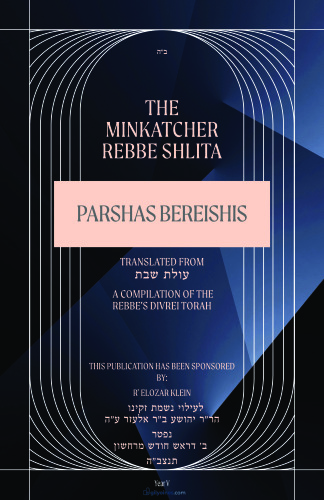
ב”ה
THE
MINKATCHER
REBBE SHLITA
PARSHAS BEREISHIS
TRANSLATED FROM
עולת שבת
A COMPILATION OF THE
REBBE’S DIVREI TORAH
THIS PUBLICATION HAS BEEN SPONSORED
BY:
R' ELOZAR KLEIN
לעילוי נשמת זקינו
הר"ר יהושע ב"ר אלעזר ע"ה
נפטר
ב' דראש חודש מרחשון
תנצב"ה
Year V
PARSHAS BEREISHIS
.ֹלִקים ֵֵאת ַַה ָּׁׁש ַַמִיִ ם ְוְ ֵֵאת ָָה ָָא ֶֶרץ
ִ ָּרא ֱֱא
ָ ְּבֵּראִׁשׁית ָּב
ֵ
In the beginning, G-d created the
heavens and the earth.
(Bereishis 1:1)
THE GIFT RENEWED EACH DAY
Rashi opens his commentary on the Torah with a question every Yid has
known since his first days in cheder.
Rabbi Yitzchak said: The Torah should have opened with (Shemos 12:2)
“ – החודש הזה לכםThis month shall be for you,” because it is the first
mitzvah given to Bnei Yisrael. Why, then, did it open with Bereishis?
Because of the pasuk (Tehillim 111:16) כח מעשיו הגיד לעמו לתת להם
“ – נחלת גויםHe declared the power of His works to His people, to give
them the inheritance of nations.” For if the nations of the world should
say to Bnei Yisrael, “You are thieves, for you conquered the lands of the
seven nations,” they say to them, “The entire earth belongs to the Holy
One, blessed be He. He created it and gave it to whomever was right in
His eyes. By His will He gave it to them, and by His will He took it from
them and gave it to us.”
Yet this answer itself calls for deeper understanding.
2 The Minkatcher Rebbe on Parshas Bereishis
The way of the world is that one cannot reclaim a gift. Once it is given to
another person and taken into the recipient’s possession, the giver loses his
ownership. The giver may have created it, purchased it, or treasured it for
many years, but once he gives it away, it no longer belongs to him. He cannot
simply return and take it back.
If so, what does it mean that HaKadosh Baruch Hu gave the land of Eretz
Yisrael to the seven nations by His will and then, by His will, took it from them
and gave it to us? Once He had given it to the nations, was it not theirs? And
if it was theirs, how is taking it away any different from the very injustice they
were claiming?
Furthermore, the fundamental question remains unanswered. We still don’t
understand why the Torah begins with an account of Brias HaOlam rather
than the first mitzvah, Kiddush HaChodesh. Even if it were necessary for the
Torah to teach us כח מעשיו הגיד לעמו, it still could have opened with the first
mitzvah and then, at some later point, told us about the creation of the world.
Why was it necessary for Bereishis to be the very first words we lein?
To understand this, we must first comprehend a fundamental distinction
between the will of man and the will of HaKadosh Baruch Hu.
The Will that Creates
When a human being desires something, his desire alone neither brings the
object into existence nor places into his possession. For instance, if a person
wishes to build a house, that wish itself does not erect its walls. He must think,
plan, act, and exert himself until the house is finally built. In other words, with man,
the will precedes the action, but the will itself does not accomplish the action.
With HaKadosh Baruch Hu, it is entirely different. When He wills something to
exist, it exists. His ratzon is not merely an intention that precedes creation; His
will itself is the very force through which creation comes into being.
And even more than that, not only does every creation come into being through
His will, but its continued existence also depends on that same Divine will.
Nothing in the world possesses an independent existence that can sustain
itself. Every creature and creation that presently exists is because HaKadosh
Baruch Hu wills its life at this very moment.
Translated and Published ( פרשת בראשית תשפ"זYear V) 3
As the pasuk says (Nechemiah 9:6), “ – ואתה מחיה את כולםand You give
life to them all,” and the seforim hakedoshim (see Reishis Chochmah, Shaar
HaKedushah 7) expound that it should not be read as מחיה, “gives life,” but
as מהווה, “brings into being.”
Indeed, this is what we proclaim every morning in the brachah before Shema,
המחדש בטובו בכל יום תמיד מעשה בראשית. The meaning is not merely that HaKadosh
Baruch Hu once created the world. He is המחדש, the One Who renews. And He
does so בכל יום תמיד, each day, at every moment, without interruption.
The Kedushas Levi writes this in our parshah:
The general principle is that the Creator, blessed be He, created
everything, and He is everything, and His hashpa’ah never ceases.
At every moment He pours shefa upon His creations and upon all the
worlds… Therefore, we say “ – יוצר אור ובורא חושךWho forms light and
creates darkness,” and not “ – יצר אור וברא חושךWho formed light and
created darkness.” We say יוצר, in the present tense, because at every
moment He forms; at every moment He pours life into every living thing,
and everything is from Him, blessed be He.
This changes the way we understand the word “creation.” Bereishis is not
merely a recount of what happened at the beginning of time. Creation is
happening now. At this very moment, the heavens exist because HaKadosh
Baruch Hu wills them to exist. The earth exists because He wills it to exist. Every
living creature draws its life from Him. Every breath, every blade of grass, every
movement of every creature is sustained by the shefa that flows from Him.
A Gift Unlike Any Other
This helps us understand that a gift from HaKadosh Baruch Hu is not like a gift
from a human being.
When a human being gives something to another person, even if he himself
fashioned that object, its continued existence does not depend upon him. Say,
for instance, a craftsman builds a table. Once the table is finished, it can stand
in a room whether or not he ever thinks about it again. Its continued existence
does not depend upon his ratzon. His connection to it is external; he built it and
he owns it, but when he gives it away, that ownership passes to the recipient.
4 The Minkatcher Rebbe on Parshas Bereishis
But the relationship of HaKadosh Baruch Hu to creation is different. “The
entire earth belongs to the Holy One, blessed be He,” not merely because He
possesses it as an owner. It belongs to Him because “He created it.” Its very
existence is rooted in Him. His will is what brought it into being, and His will
is what continually grants it life. Its mountains and valleys, its soil and its rain,
every grain of its earth, exist now only because He wills them to exist now.
Therefore, when we say, “By His will He gave it to them,” we do not mean that
He once possessed the land, desired to transfer it to the nations, and then
relinquished His relationship to it. Rather, it means that His will at that time was
for the land and the life within it to exist under the dominion and designation of
the seven nations, so He created it that way for that period of time.
And when we say, “By His will He took it from them and gave it to us,” we are
saying something equally profound. At the very moment that Hashem willed it to
become the Homeland of His Chosen Nation, that same land, renewed through
His continuous will, came into being as Eretz Yisrael, the nachalah of the Yidden.
There is therefore no contradiction between נתנה להםand נתנה לנו. It is not that
He gave it away and later took it back. There is always only one Baal Haba’as,
one Source of existence, one ratzon that sustains the world. And that ratzon
continuously determines the reality of the land, its purpose, and to whom He
chooses to entrust it at any given moment. There is no “taking back” in the
human sense. There is only a Divine will that gives, and gives again.
Perhaps this is why the Torah says about Eretz Yisrael (Bamidbar 13:2), אשר
“ – אני נותן לבני ישראלwhich I am giving to Bnei Yisrael.” It uses a lashon
of נותן, in the present tense, because the gift of Eretz Yisrael is a gift that is
continuously being given, because its existence itself is continuously renewed
through the will of HaKadosh Baruch Hu.
This is also the meaning of the pasuk (Shemos 13:11), אל ארץ הכנעני כאשר
“ – נשבע וגו׳ ונתנה לךTo the land of the Canaani, as He swore…and He will give
it to you.” The Mechilta (Parshas Bo, Pischa 18) explains, “It should not be like
an inheritance from your fathers; it should be in your eyes as though it were
given to you today.” For this is the essential character of Eretz Yisrael. It is a
gift from Hashem, and like all that derives its existence from His will, its giving
is continually renewed.
Translated and Published ( פרשת בראשית תשפ"זYear V) 5
Why the Torah Begins with Bereishis
With this understanding, we can return to Rashi’s original question: Why did
HaKadosh Baruch Hu open the Torah with Bereishis rather than with החודש
?הזה לכם
The answer is that this very first mitzvah reveals something fundamental
about the unique power entrusted to Klal Yisrael.
The pasuk (Vayikra 23:4) discussing the mitzvah of Kiddush HaChodesh
says, אשר תקראו ֹא ָָֹתם, and Chazal (Rosh Hashanah 25a) darshen that it
should be read as though it said ַַא �ֶֶּתם, “you”:
You, even if unwitting; you, even if deliberate; you, even if misled.
In other words, Hashem entrusted Bnei Yisrael with the power to establish the
zmanim by which the entire world conducts itself. When Beis Din declares the
new month, the month begins. When they determine the day, Pesach falls on
that day. They proclaim when the year starts and when the year ends, even if
they make a mistake, even if they act deliberately, even if they are misled.
Why?
Because this is the ratzon of HaKadosh Baruch Hu; it is part of כח מעשיו הגיד
לעמו. HaKadosh Baruch Hu revealed to Klal Yisrael that the world is constantly
being created according to His will, and that part of that will is for Klal Yisrael to
establish the zmanim of the world.
This is why the Torah begins with Bereishis; it teaches us the foundation upon
which the first mitzvah of Kiddush HaChodesh rests. Bereishis is not simply an
introduction to the story of how the universe came into being. It establishes the
premise that the world belongs to Hashem. And Kiddush HaChodesh reveals
that Hashem has chosen to entrust a dimension of that world to Klal Yisrael.
The Beginning and the End
Perhaps this also sheds light on the connection between the beginning and
the end of the Torah.
The Torah begins with בראשית ברא אלקיםand with כח מעשיו הגיד לעמו. It
teaches us that the entire world stands through the will of HaKadosh Baruch
Hu, and that He chose to reveal aspects of that Divine will through Klal Yisrael.
6 The Minkatcher Rebbe on Parshas Bereishis
And then, at the conclusion of the Torah, with the words ולכל המורא הגדול
“ – אשר עשה משה לעיני כל ישראלand all the great awe that Moshe performed
before the eyes of all the Yidden,” we are shown that same principle in action
through Moshe Rabbeinu. The miracles and wonders Moshe performed
before all the Yidden in the midbar (see Rashi) were not merely extraordinary
disruptions of the natural order. They revealed that nature itself is nothing
more than the ongoing expression of the will of the Borei Olam—and that He
entrusted Moshe Rabbeinu and Klal Yisrael with the ability to bring that will to
light in the world.
An Inheritance Without Boundaries
This idea also offers a new understanding of the remarkable words of Chazal
(Shabbos 118a), “ – המענג את השבת נותנין לו נחלה בלי מצריםOne who delights
in Shabbos is given a nachalah without boundaries.”
Why is the reward for delighting in Shabbos a nachalah, and what does it
mean to receive one without boundaries?
Perhaps the nachalah to which Chazal refer is Eretz Yisrael itself, described in
Daniel (11:16) as “ – ארץ הצביthe land of the deer.” To explain this designation,
the Gemara (Gittin 57a) states, “Just as the hide of a deer cannot contain its
flesh, so too Eretz Yisrael; when the Yidden dwell upon it, it expands.” As it is
said (see Sifri, Devarim 1), in the times of Moshiach, Eretz Yisrael will expand
to encompass the entire world.
In other words, Eretz Yisrael contains within itself the quality of a nachalah
without boundaries.
And why is this the reward for one who delights in Shabbos? Because
Shabbos is the greatest testimony of creation, revealing that its entire purpose
is Klal Yisrael.
The Midrash (Bereishis Rabbah 11:8) teaches that HaKadosh Baruch Hu said
to Shabbos, “ – כנסת ישראל בן זוגךKnesses Yisrael is your partner.” The holy
Zohar (II:63b) likewise teaches that Knesses Yisrael itself is called Shabbos.
Shabbos and Bnei Yisrael are bound together because Shabbos is the day
when creation points beyond itself, beyond the physical world, and toward the
Divine purpose for which that world was created.
Translated and Published ( פרשת בראשית תשפ"זYear V) 7
Therefore, we are promised, “Whoever delights in Shabbos is given an
inheritance without boundaries,” for it is, in essence, an expression of middah
k’neged middah. A Yid who reveals through his oneg Shabbos that the world
was created by His will, and that creation has a purpose centered on Klal
Yisrael, receives Eretz Yisrael, the land whose very boundaries testify that the
earth ultimately belongs to its Creator.
The nations may accuse Klal Yisrael of being thieves, of taking what is not ours.
But a Yid sitting at his Shabbos table answers that claim not with history or
argument but with Bereishis. He sings zemiros, makes Kiddush, delights in the
kedushah of the day; for one day each week, he steps outside the illusion of
ownership and remembers that nothing is truly his. And by doing so, he bears
witness to the truth of בראשית ברא אלקים. That the world belongs to its Creator.
The land belongs to its Creator. And the Creator, Who brings that world into
existence anew at every moment, is choosing to give it to His children.
As we begin the Torah anew, may it be the will of our Father in Heaven that
we see the moments and blessings of our lives not as possessions that have
become ordinary, but as precious gifts that HaKadosh Baruch Hu places in
our hands anew, every moment. And just as He sustained us through every
generation of darkness, may today be the day when He recreates us as a
redeemed people, bringing us up to Tzion in joyous song, with the arrival of
ben Dovid, speedily in our days, through His abundant mercy and kindness.
To receive our translations of Olas Shabbos directly to your inbox,
please email ‘Munkatch’ to: torah.subscribers@gmail.com
For sponsorship opportunities or to dedicate this publicationin honor of a
loved one, celebration, or Yahrtzeit, etc. please click on the link below.
https://tapcube.co/TORAH
8 The Minkatcher Rebbe on Parshas Bereishis