
The Maharsham Project - English — Bereishis (2026-10-05)
W E E K L Y T E S H U V A H I N S I G H T S F RO M T H E M A H A R S H A M O F B R E Z H A N
THE
MAHARSHAM שו״ת מהרש״ם
P RO J E C T
Issue No. 29 · Teshuvos Maharsham, chelek I, siman 67
מזל טוב להבה״ח חיים מנחם מרדכי גינצבורג נ״י נו״נ רשכבה״ג הגה״ק המהרש״ם זי״ע לרגל הבר מצוה
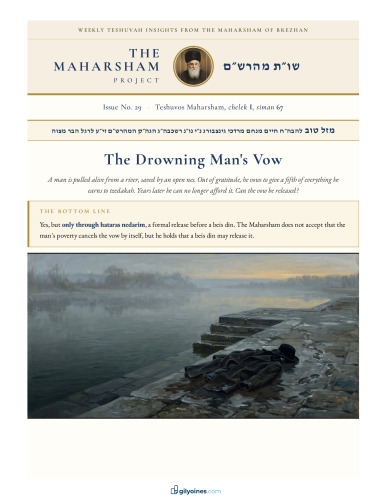
The Drowning Man's Vow
A man is pulled alive from a river, saved by an open nes. Out of gratitude, he vows to give a fifth of everything he
earns to tzedakah. Years later he can no longer afford it. Can the vow be released?
THE BOTTOM LINE
Yes, but only through hataras nedarim, a formal release before a beis din. The Maharsham does not accept that the
man's poverty cancels the vow by itself, but he holds that a beis din may release it.
✦
THE QUESTION
Rav Avraham Menachem Mendel Steinberg, av beis din of Sniatyn, sent the question. A man was drowning in a river and
was saved by an open nes. Out of gratitude, he made several vows: not to write his business letters before davening, even
though that writing is his parnassah; to say Tehillim and do his daily learning in Chok L'Yisrael before Shacharis; and to give a
fifth of what he earned each day to tzedakah. Years later, his circumstances had changed drastically. His earnings no longer
covered his needs, his wife was ill, and some of his children had died. He had already failed to keep his vows several times and
was afraid of further violations. He asked for relief, above all from the fifth. May a beis din release him?
✦
THE MAHARSHAM'S ANALYSIS
The Maharsham considers two possibilities: whether the hardship itself exempts the man, and whether a beis din may formally
release his vows.
1. A Dowry That Could Not Be Paid
Halacha recognizes nidrei onsin: a vow that circumstances outside a person's control make impossible to keep. The
questioner argued that this man's vow falls in that category, so that he does not even need a beis din. His main source was a
teshuvah of the Rosh, brought in Shulchan Aruch, Yoreh De'ah 232:16. A father promised a dowry for his daughter's
shidduch, and then the debts owed to him went bad. The Rosh holds he is exempt, because there is no greater ones than that.
The Chasam Sofer (Yoreh De'ah 228) reads that case differently. Poverty, he says, is common, shachiach, and a person who
makes a commitment should expect it. So the father was not released because of ones. He was released because of anan
sahadi, "we are witnesses": everyone knows that no father means to sell his house and sleep in the street to pay a dowry. It is
as if he had said that condition out loud. On this reading, the Rosh does not prove that hardship cancels a vow.
2. When Does the Obligation Take Effect?
The Maharsham shows that much depends on timing. The father's promise was to pay at the wedding, and the debts went
bad before the wedding. So the ones came before the obligation took effect, which is true nidrei onsin. The Ramban, brought
by the Rashdam, and the Rivash (siman 387) hold that an ones arising after a vow has taken effect does not release it.
The Ritva and the Nimukei Yosef (Nedarim, perek 3) add a distinction that points the other way. A vow to do something
takes effect only at the moment of doing it, so an ones that arrives first, even a loss of money and even a common one, stops it
from taking hold. A vow not to do something takes effect at once. A daily fifth is a vow to do something. The Maharsham
notes openly that the Ritva contradicts the Chasam Sofer on whether a common hardship counts.
3. A Fixed Sum or a Share of the Profit
The Taz (Yoreh De'ah 215) and the Shach (Yoreh De'ah 204) bring a case of a man who vowed maaser from his profits, kept it
for a while, then his situation weakened and he regretted it. They rule that he must still keep his vow. The Maharsham
suggests two ways our case may differ. There, the man's situation had only weakened somewhat, short of real ones. And a
share of the profit is different from a fixed sum: an ones can stop a man from paying a fixed sum, but a share shrinks when the
profit shrinks, so there is nothing for the ones to block. He leaves the point unresolved: וצ"ע.
4. The Maharsham's Own Answer
The reason that decides this part for him is a principle the Rambam states and the Shulchan Aruch codifies (Yoreh De'ah
247:2): a person never becomes poor from giving tzedakah. If so, the fifth is not what is reducing his parnassah. So how can
he be called an anus because of it? The hardship is real, but it does not come from the vow, and it cannot be the ones that
2
cancels it. Other poskim agree that poverty does not release such a vow, among them a teshuvah of the Rosh in the Tur and
Rav Betzalel Ashkenazi.
5. Can the Vow Be Released?
A vow that is not cancelled can still be released through hataras nedarim: a beis din of three hears the person and releases the
vow, based on his regret or on a consideration he did not have in mind when he made it. It is the same mechanism behind the
hataras nedarim many say on erev Rosh Hashana, but a specific vow like this one is brought to a beis din on its own, with its
details stated.
The questioner raised a warning from the Radvaz (siman 134): a chacham who releases a vow of tzedakah should be put in
niddui, because he causes a loss to the poor. The Maharsham answers that the Radvaz speaks of a man who can keep his vow
and simply regrets it. Here the man asks under pressure, which the Rema (Yoreh De'ah 230) allows, and he has already failed
several times to keep the vow. In such a case releasing the vow serves a mitzvah purpose (dvar mitzvah), because it prevents
further sin. No one would put a chacham in niddui for that.
6. A Vow Al Da'as Rabbim
There is one restriction, and it has exceptions. A vow made al da'as rabbim, that is, on the understanding of the community
and not on the person's own understanding, is generally not released. The Maharsham proves at length, from the Gemara in
Yoma and in Shevuos, that this restriction is from the Torah.
There are two grounds for permitting release here. First, the man did not specify whose understanding his vow depended on,
and according to a number of poskim a vow stated that way is not al da'as rabbim. Second, as the questioner wrote and the
Maharsham agrees, releasing it is a dvar mitzvah, and the Rashba, cited by the Mishneh LaMelech, holds that even a vow al
da'as rabbim may be released for a dvar mitzvah.
But the Maharsham does not accept the questioner's other argument, that the hardship released the man even without a
formal release. In his words: ולכן יש להתיר לו שבועתו אבל בלא התרה אין בידי להקל, "therefore one may release his oath,
but without a release I have no way to permit it."
THE P'SAK
A beis din may release the man's vows, including the fifth, through hataras nedarim. This is possible because he
did not specify whose understanding his vow depended on, and because he has already failed to keep it, which makes the
release a dvar mitzvah.
Without a formal release, the vows remain in force. The Maharsham does not hold that the man's poverty cancels
them by itself, because a person never becomes poor from giving tzedakah.
WHAT YOU N OW K N OW
Two questions are separate. Does hardship cancel a vow by itself? Can a beis din release it? Here the Maharsham answers
the first no and the second yes.
✦
W H Y I T M AT T E R S
His gratitude was sincere, and so was his distress when he could no longer keep his commitments. The Maharsham takes
both seriously. He upholds the obligation created by the vows while explaining how they may properly be released.
3
KE Y T E RMS
Nidrei onsin · ( )נדרי אונסיןA vow undone by Neder al da'as rabbim · ( )נדר על דעת רביםA Hataras nedarim · ( ) התרת נדריםThe formal
an unforeseen accident that made it impossible. vow made on the understanding of the release of a vow before a beis din, on regret or an
The Maharsham holds ordinary poverty does not community, not on the person's own opening; the remedy the Maharsham requires
qualify. understanding. It is generally not released. here.
According to the poskim cited here, a vow made
without that condition does not fall into this
category.
Anan sahadi · (" )אנן סהדיWe are witnesses": a Shachiach · ( )שכיחCommon, to be expected. A Dvar mitzvah · ( )דבר מצוהA mitzvah purpose.
condition so obvious that everyone understands common hardship is one a person should have Releasing a vow that a man keeps breaking
it, even if it was never said. planned for when he made his commitment. prevents further sin.
COMING NEXT WEEK
In 1906 a rav on the Lower East Side tried to close off half of Manhattan for carrying
on Shabbos with rivers and an iron railway.
The Maharsham agreed, but only for a pressing need. Six months later he wrote
again. What changed?
W H O WA S TH E M A H A R S H A M ?
Rabbi Shalom Mordechai HaKohen Schwadron, ben HaRav Moshe (1835–1911), served as the Rav of Brezhan in Galicia for
thirty years, from 1881 until his passing. He is best known for his seven-volume Shut Maharsham, containing thousands of
teshuvos on every area of halachah, and his Da'as Torah commentary on Shulchan Aruch. Regarded as one of the foremost
poskim of his generation, his piskei halachah are cited to this day.
P R I N C I PA L S O U R C E S
Gemara: Nazir 11b; Yoma 18; Shevuos 29a; Yerushalmi Nazir, perek 5.
Rishonim: Teshuvos HaRosh (Shulchan Aruch, Yoreh De'ah 232:16; Tur, Even HaEzer 118); Ramban; Rashba; Ritva and Nimukei Yosef, Nedarim perek 3; Shitah on Nazir in
the name of the Rosh; Teshuvos HaRivash 387.
Poskim: Shulchan Aruch, Yoreh De'ah 230 (Rema) and 247:2; Beis Yosef, Yoreh De'ah 259, quoting Rabbeinu Yerucham; Taz, Yoreh De'ah 215; Shach, Yoreh De'ah 204 and 232;
Radvaz 134; Rashdam, Yoreh De'ah 104; Rav Betzalel Ashkenazi 35; Mishneh LaMelech; Chasam Sofer, Yoreh De'ah 220 and 228.
Source text: Teshuvos Maharsham, chelek I, siman 67.
R E C E I V E T H E M A H A R S H A M P RO J E C T E V E RY W E E K
Scan the QR code or visit kechnia.org/maharsham to subscribe. Free weekly delivery to your inbox.
Gratitude made the vow. A beis din can release it.
This translation is presented for Torah study and enrichment purposes only. It is not intended as halachah l'maaseh. The translator has made every effort to render the Maharsham's words faithfully,
but this English adaptation may contain errors or imprecisions. For any practical halachic question, consult your own Rav.
The Maharsham Project · kechnia.org/maharsham · · לעילוי נשמת הגה״ק רבי שלום מרדכי בן רבי משה הכהן זצללה״הinfo@kechnia.org
4