
Living Appreciation — Shmini Atzeres - Simchas Torah (2026-09-28)
בס"ד
Dedicated in the zechus for a refuah shleimah לע״נ סימה בת מרדכי שמחת תורה-וזאת הברכה
for Nissim Yosef Chaim ben Asnah Miriam יוסף ז״ל
andShoshana Emuna Bas Penina Devora Issue 240
and everyone else who needs.
Appreciation: a pipeline for blessing. They treasured what Hashem had already given them,
After many years of devotedly leading Klal Yisrael, the and He blessed them with more.
time came for Moshe Rabbeinu to leave this world. This is a powerful lesson for all of us. It is easy to
Before his passing, he blessed each of the shevatim, imagine that we will feel satisfied once we have a little
giving each one a heartfelt brachah suited to their unique more. Naftali teaches us to begin with the gifts already
qualities and role in this world. When it was Naftali's in our hands. When we stop measuring our portion
turn to receive a brachah, he exclaimed, “Naftali is against someone else’s and recognize the kindness
satisfied with favor and filled with the blessing of Hashem has shown us, we discover how much we
Hashem.” (Devarim 33:23) already have to be grateful for. That appreciation is
The Alshich explains that there is a strong connection itself precious to Hashem, and it can open the way for
between these two clauses. Naftali were further brachah.
'satisfied with favor' meaning that they How fitting that we read these words on
appreciated what they had, viewing Simchas Torah, a day devoted to rejoicing in
everything as an undeserved gift from the most precious gift Hashem has given us.
Hashem. Rather than looking at what As we complete Vezos Haberachah, the final
others had and feeling that something was parashah in the Torah, we celebrate another
missing, they felt content with their own full cycle of reading His holy words. Our
portion. As a result, they were "filled with the blessing dancing expresses our gratitude for the privilege of
of Hashem." This very appreciation opened the way having the Torah in our lives and for all the goodness
for further blessing. They were “satisfied with favor,” it brings us.
and in that merit, they became “filled with the blessing
of Hashem.” Chazal teach that true good is found in Torah (Avos 6:3). It
fills our lives with meaning, guides us through this
The abundance of their portion was remarkable. It world, and enables us to merit eternal life in Olam
included the fertile region of Ginosar, whose fruits Haba. It infuses our lives with such tremendous
were so delicious that the Gemara describes Rabbi holiness and meaning as well as with healthy
Yochanan eating extraordinary quantities of them (Eruvin boundaries. Learning Torah has such a powerful effect
30a). Everyone spoke of these good qualities and longed and helps us become better and more refined people
to be able to taste them. In fact, Chazal ask why fruits (Eichah Rabbah Ch.2). It helps us defeat our yetzer hara
of this caliber didn’t grow in Yerushalayim. They helping us conquer our temptations. (Kiddushin 30b)
explain that those coming to the Beis HaMikdash for
On Simchas Torah, this appreciation finds expression
Yom Tov might otherwise say that the delicious fruit
in the joy of our dancing, both by night and by day. We
alone had made their journey worthwhile. Hashem
thank Hashem for the Torah we have been privileged
wanted their hearts to be directed toward the true
to learn and rejoice in the opportunity to begin again.
purpose of their visit, without the attraction of these
Just as Naftali’s gratitude brought further blessing, our
fruits becoming a motive of its own. (Pesachim 8b)
joy in the Torah can bring an abundance of spiritual
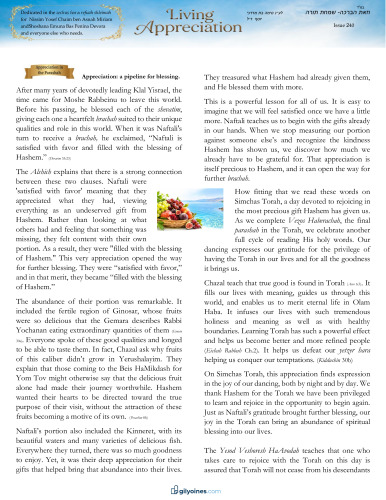
Naftali’s portion also included the Kinneret, with its blessing into our lives.
beautiful waters and many varieties of delicious fish.
Everywhere they turned, there was so much goodness The Yesod Veshoresh HaAvodah teaches that one who
to enjoy. Yet, it was their deep appreciation for their takes care to rejoice with the Torah on this day is
gifts that helped bring that abundance into their lives. assured that Torah will not cease from his descendants
(11:15). The appreciation we express today can bring
blessing to generations yet to come.
A moving story about the great Tzadik, the Yismach Yisrael
illustrates how precious this heartfelt joy can be. One Simchas The verse states “Torah tzivah lanu Moshe, morashah
kehillas Yaakov”—Moshe commanded us the Torah, an
Torah, he noticed a man dancing with extraordinary enthusiasm.
inheritance for the congregation of Yaakov" (Devarim 33:4).
He jumped and danced with such delight that an onlooker might Chazal teach that morashah, inheritance, can also be read as
have thought he was crazy. Yet it was his sincere love for the me’orasah, betrothed (Berachos 57a). This reveals an
Torah that filled him with such overwhelming joy. He was integral aspect of our relationship with Hashem, we are so
unconcerned with his own dignity, wanting only to express what to speak, 'married to Him. Chazal teach that when we
was in his heart. The man had been married for many years but received the Torah, Hashem held Har Sinai above our heads
had not yet been blessed with children. Seeing his wholehearted (Shabbos 88a). Our Rabbis teach that the mountain
resembled a chuppah, symbolizing that we were now
joy and his willingness to set aside his dignity for the honor of the
becoming 'married' to Hashem. This is something very
Torah, the Yismach Yisrael declared that he would merit a son. important to bear in mind during Simchas Torah. We dance
Indeed, less than a year later, after so many difficult years of with great joy, expressing our great appreciation for the
waiting and yearning, the man was blessed to hold his own privilege to have the Torah in our lives, enabling us to have
beloved son in his this exceedingly close relationship with Hashem.
arms. Although Moshe wasn’t privileged to enter Israel, Hashem
Roka Haaretz Al Hamayim still wanted to show him the land’s beauty and therefore
took him to a lookout point (34:1). Hashem knew that
The average person takes five thousand steps a day—close to two despite Moshe’s heartfelt longing to enter Israel, he would
million a year. Yet among the thousands of steps we take, how be so delighted for his brethren who would inherit the land
often do we pause to appreciate the miracles that occur to enable that he would really appreciate seeing its beauty. Let’s try
and learn this lesson from Moshe to always be happy for
this to happen?
others even though we might not necessarily have what they
Beneath us lies a vast mass of rock and soil, supporting our homes, have. The Gemara in Yoma (38b) teaches that “one does not
our cities, and every step we take. It feels so firm, so permanent. touch anything designated for his friend even by a hair’s
. breadth”, so it clearly serves no purpose to be envious.
Yet, the earth is really heavy and dense in relation to the oceans
that surround it. It shouldn’t really be able to stay afloat. Yet As we reach the closing verses of the Torah, we encounter a
Hashem miraculously ensures that the earth isn't submerged in the quiet act of kindness: Hashem Himself buries Moshe
surrounding oceans and is as sturdy as can be, ensuring us to tread Rabbeinu. Chazal draw our attention to a beautiful
freely and safely. connection. The Torah begins with gemilus chasadim, when
Hashem clothes Adam and Chavah, and ends with gemilus
Chazal gave us a daily opportunity to recognize this kindness chasadim, when He buries Moshe (Sotah 14a). These two
through the berachah of Roka ha’aretz al hamayim—“Who spreads acts frame the entire Torah with a message for each of us.
the earth above the waters.” The Gemara associates this blessing Growing in Torah means learning to notice the needs of
with placing our feet on the ground upon rising. Before we begin others and responding with care. Providing clothing and
another day of walking here and there, we pause to thank Hashem ensuring a dignified burial may seem far removed from the
for the ground that supports us (Berachos 60b). great miracles described throughout the Torah. Yet these
are the deeds of Hashem that stand at its beginning and its
This appreciation becomes even deeper when we bear in a mind a end. As we finish the Torah and prepare to begin it anew, let
teaching of our Rabbis that that creation is continually renewed. In us take this message with us. A few encouraging words, a
Shacharis, we praise Hashem as the One “Who, in His goodness, helping hand, or time given to someone who feels alone can
bring the Torah we learn into the lives we
renews the work of creation every day, continually” (Birkas Krias
lead.
Shema, Yotzer Ohr). The world was not created and then left to
continue on its own. Hashem sustains it at every moment. Each Things to appreciate: Rain. Rain enables the production of many of
gift we enjoyed yesterday is being granted to us anew today. So, the foods we eat such as vegetables and bread. Rain gives us water;
each step that we take is a new experience of this phenomenal the vital substance that keeps all living beings alive. On Shemini
miracle. Chag Atzeres we start to add mashiv haruach umorid hageshem in
the Shmoneh Esrei, praising Hashem for this gift.
/ us at livingappreciation@gmail.com It could be viewed at
Compiled by Daniel Shasha, for feedback, dedication opportunities, or to subscribe, please contact
torahlectures.org or gilyoinos.com