
The Maharsham Project - English — Noach (2026-10-12)
W E E K LY T E S H U VA H INS IG H T S FRO M T H E MAH ARS H AM O F B RE Z H AN
THE
MAHARSHAM שו״ת מהרש״ם
P R O J E C T
Issue No. 30 · Parashas Noach 5787 · The Maharsham on an eruv in New York, 1906 to 1908
The Wall That Stopped at the Water
This week we read how the waters of the Mabul went down and dry land showed up again. So here is a story about water
that might go down, and dry land that could break an eruv. In 1906 a rav on the Lower East Side wanted his people to
carry on Shabbos. He used two rivers and a railway to do it, and he mailed his plan to the Maharsham in Galicia. The
Maharsham wrote back three times. The third answer was no.
What happened?
THE BOTTOM LINE
In the end, the Maharsham did not permit this eruv.
His first letter, in July 1906, allowed it only when there is a real need. His second letter, in January 1907, allowed it for
everyone. Both times he was working from what Rav Siegel told him. Then letters came from other rabbanim in New
York. They said Rav Siegel's drawings were wrong, that he was not the Rav HaKollel as he had signed, and that many
rabbanim were against the eruv. In July 1908, with all of that in front of him, the Maharsham took back his heter.
1
A NOTE ON THIS ISSUE
Most weeks we bring a teshuvah from the printed volumes of Shu"t Maharsham. This one is not in the Shu"t. The first two letters were printed
in a small sefer in New York in 1907. The third was printed only in our own time. We chose them because the story is just too good: a gadol in
Galicia, writing about street corners in Manhattan.
THE QUESTION ✦
Picture the Lower East Side in 1905. Tenements, pushcarts, and tens of thousands of Yidden from Poland, Galicia and Russia.
On Shabbos a mother could not push a baby carriage to shul. A man could not carry his tallis or his house key.
Rav Yehoshua Siegel, the Sherpser Rov, lived on Henry Street. He wanted an eruv for the neighborhood. And he thought he
could make one without building anything at all.
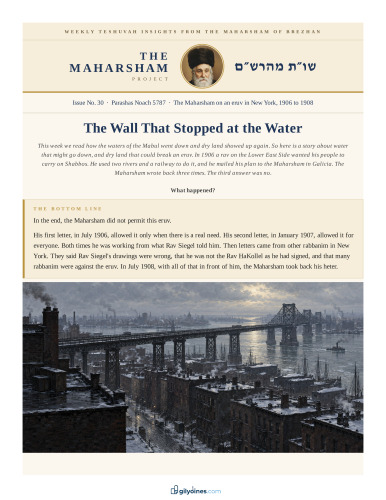
Look at a map of Manhattan. The East River runs down the east side. The harbor sits at the bottom, at South Ferry. The
Harlem River runs across the top. That is water on three sides. For the fourth side, Rav Siegel looked up. The Third Avenue
El, the elevated train, ran on iron pillars from South Ferry, up the Bowery and Third Avenue, all the way to the Harlem River.
In hilchos eruvin, two posts with a beam across the top count as a doorway, a tzuras hapesach. A doorway closes a side. So
every pair of El pillars with the track on top was a doorway, one after another, for miles. Three rivers and one railway. A
complete enclosure.
He rented the area from the city for ten years and made eruvei chatzeiros every erev Shabbos. In 1907 he printed the whole
plan in a sefer, Eruv v'Hotza'ah, together with letters of approval from four gedolim in Europe. The first letter was from the
Maharsham.
The question turned on one word: שרטון, shirton. Silt. Water can serve as a wall. But water can also pull back and leave dry
ground behind.
T H E M A H A R S H A M ' S A N A LY S I S ✦
1. Can a River Be a Wall?
The Gemara (Eruvin 8a) talks about an alley with the sea at one end. Rebbi would not permit it. His worry: one day the sea
may throw up sand, dry ground will form where the water was, and the alley will be open. People will keep carrying and
nobody will notice. Mareimar, in Sura, put up nets on the water side of the alleys for exactly this reason: חיישינן שמא יעלה
הים שרטון, "we worry that the sea may throw up silt."
Rav Siegel had an answer. The Rivash says this worry is only about the sea, not rivers, and the Magen Avraham (Orach Chaim
363:31) agrees. Manhattan's walls were rivers. So there should be no problem.
The Maharsham was not convinced. Tosafos writes that rivers also wash up mud, רפש וטיט. The Taz (Orach Chaim 357)
worries about mud building up even in a pit. And the Ritva, explaining how the Gemara (Eruvin 24b) can count a riverbank as
a wall, gives one reason: הנהר היה קצר, that river was narrow. Which means a wide river would be a problem. So the
Maharsham asks two questions about New York. ומי יודע אם בנ"ד הם קצרים כ"כ, who knows if these rivers are that narrow?
וגם מאן מפיס לדעת איזהו שיעור קצר בזה, and who can say how narrow is narrow? He leaves both questions open.
2
Anyone who has taken the ferry knows these are not lazy country streams. The East River and the Harlem River rise and fall
with the tide twice a day. The Maharsham never saw them. He was careful anyway.
2. The Two Corners
Now picture it from above. The East River on the right. The El on the left, running
north to south. The Harlem River across the top, the harbor across the bottom. Where
exactly does the El end? The Maharsham writes:
אבל אינה הולכת ע"ג הנהרות רק עד הנהרות ולא עד בכלל
"But it does not run over the rivers. It goes up to the rivers, and not into them."
That was the problem. The only man-made wall in the whole eruv ended exactly
where the water began. If silt ever built up at those two spots, there would be a gap:
יהי' שם,אם יעלו הנהרות שרטון בצד הדרומי והצפוני דהיינו נעשה שם קרקע
ויהי' נאסר,מקום פתוח מצד המחיצה בצד צפון ובצד דרום בלא שום מחיצה
הטלטול בכל חלק העיר המזרחית מפני מקומות הפתוחים בזויות הצפוני
והדרומי
"If the rivers throw up silt on the south side and the north side, so that dry land forms there, there
will be an open place next to the wall, north and south, with no wall at all. Then carrying will be
forbidden in the whole eastern part of the city, because of the open places at the northern and
southern corners."
One open corner, and the whole eruv falls. To answer that, you do not need a better
sevara. You need a better map.
3. Why He Permitted Anyway
So why did he permit it at all? Because the silt worry is derabbanan, and the poskim
are split on it. Rabbeinu Chananel and the Rambam read the Gemara so that we do not
worry about silt at all. Most other Rishonim say we do. And there is a second
machlokes about whether rivers are included. The Maharsham writes והוא העיקר, The map printed in Rav Siegel's sefer, 1907: זה
צורתה של העיר הלוטה פה, "this is the shape of
"this is the main point": when a derabbanan is evenly split, we go with the kula. With
the city enclosed here." The East River on the
doubts like these piled up, he says, it is close to a sfek sfeika. right, the Hudson on the left, South Ferry and
New York Bay at the bottom. The line running
down the island is the El. Drawings like this are
He adds the Or Zarua, quoting the Behag: a city surrounded by rivers, מתא דהדרא
what the Maharsham had on his desk in Berezhan.
לה נהרתא, needs nothing more. The East Side had water on three sides out of four.
4. Walls Made by Heaven
One more question. Nobody built these rivers. They are mechitzos b'yedei shamayim, walls made by Heaven. And New York
was a giant city. Can walls like that close in hundreds of thousands of people?
3
The Maharsham answers from the Rokeach. On the Shabbos of Matan Torah, Klal Yisrael walked twelve mil back to the camp.
How was that allowed? Because the ananei hakavod surrounded them, and the clouds counted as walls. Walls from Heaven,
with six hundred thousand people inside, still made a closed space.
The Ramban says a wall made by Heaven only counts if people inside can see it. The Maharsham answers that the Ramban
means the ocean, which you cannot reach on Shabbos. These rivers you can see, וגם יכולים להגיע לשם ביום ש"ק ולראות
המחיצות, and you can even walk over to them on Shabbos.
He ends the first letter like this:
אבל. אבל בעל נפש שיוכל ליזהר בזה אשרי חלקו,סוף דבר כי יש מקום להתיר הטלטול בצד המזרח של העיר נויארק
ויפה הורה הרב הגאון נ"י,ע"פ ההלכה בשעת הדחק בזה יש להמקילים ע"מ שיסמכו
"In the end, there is room to permit carrying on the eastern side of New York. But a baal nefesh who can be careful about this, fortunate is his
portion. Still, by the halacha, when there is a real need, those who permit have what to rely on. And the Rav, the Gaon, ruled well."
He signed it in Berezhan on 19 Tammuz 5666, July 12, 1906.
5. The Second Letter
Rav Siegel's sefer prints a short note between the two letters. It says the Maharsham had misunderstood. He thought the El
stopped at the Harlem River, when really it went over the river to the other side. That, says the note, is why he only allowed it
when there is a real need.
So Rav Siegel wrote back with two facts. The El crosses the Harlem River. And at South Ferry, where it ends, יש שם מחיצה
קבועה העשויה בידי אדם, there is a fixed partition made by people. If both were true, neither corner depended on the water
anymore.
, וכפי שהציע הוא לפני מצב הענין במה שנתברר לפניו,הנה אמת נכון הדבר כי אח"ז הגיעני מכתב מהרב הגאון הנ"ל
וגם בעל נפש יוכל לסמוך על זה,ראיתי כי ע"פ הצעת הדברים ההיתר ברור גם שלא בשעת הדחק
"It is true that afterward a letter reached me from the Rav, the Gaon, and from the way he laid out the facts for me, I saw that the heter is clear
even without a real need, and even a baal nefesh may rely on it."
He signed it on Sunday night of parashas Bo 5667, January 13, 1907, six months after the first letter.
Look at his words: ע"פ הצעת הדברים, "from the way the facts were laid out." The rivers had not moved since July. The El
had not moved. What changed was the letter on his desk. Part of it we can check today. The railway bridge over the Harlem
River, carrying El trains into the Bronx, opened in 1886, twenty years before the first letter. The partition at South Ferry is
harder. The sefer does not say what it was, and we have not been able to find out.
6. The Third Letter
Not everyone in New York was happy with Rav Siegel's eruv. Rav Yehuda Dovid Bernstein wrote against it. So did Rav Azriel
Herman, who had gotten semichah from the Maharsham himself. Letters went out to Berezhan.
On 23 Tammuz 5668, July 22, 1908, almost exactly two years after his first letter, the Maharsham wrote again. He had trusted
Rav Siegel, he says, who signed as the Rav HaKollel, and all the drawings of New York he had sent. But since then, letters
from several rabbanim had shown him the drawings were wrong. They told him Rav Siegel was not the Rav HaKollel, and
4
that many rabbanim opposed the eruv. So, he writes, out of yiras Shamayim, he takes back his heter to carry in that part of
New York.
The title itself was a sore point in those years. In 1888 a group of New York shuls brought Rav Yaakov Yosef from Vilna to be
Chief Rabbi. In 1892 twenty Polish shuls on the Lower East Side named Rav Siegel their Rav HaKollel. Others said the title
was not his. Sitting in Berezhan, the Maharsham could only go by the letters in front of him, and these letters told a different
story.
Rav Herman wrote that he kept the Maharsham's letter for fifteen years. According to the editors who later printed it, the letter
was found again in 2000.
Many people on the East Side kept carrying on Rav Siegel's heter for decades anyway. In 1949 Rav Yosef Eliyahu Henkin
wrote that the ten-year lease was long over, and that changes to the waterfront and the El had ended the eruv. The Third
Avenue El in Manhattan came down in the 1950s.
A P O S E K W H O N E V E R S AW N E W Y O R K
The Maharsham never came to America. He never saw the East River, never stood under the El, never walked down Henry Street. All he knew
about Manhattan came in the mail: a letter and a folding map, sent to a small town in Galicia. And he still wrote about the corners of the Lower
East Side like a man standing on them. Where does the track meet the water? What will the tide leave behind? Can a Yid walk down to the river
on Shabbos and see it?
And his letter did not stay in Berezhan. When Toronto built its eruv in 1921, its rav, Rav Yehuda Leib Graubart, quoted it. In the 1950s, when
the Shotzer Rebbe, Rav Yosef Dovid Moskowitz, worked on an eruv around all of Manhattan, he quoted the Maharsham on rivers you can see
and reach. Rav Menachem Kasher quoted him on silt and on a city ringed by rivers. More than a hundred years later, anyone who studies how
New York got its eruv still runs into the Rav of Berezhan.
THE P'SAK
First letter, July 1906. There is room to permit carrying on the East Side. A baal nefesh who is careful is
praiseworthy. When there is a real need, those who permit have what to rely on.
Second letter, January 1907. Going by Rav Siegel's description, וגם בעל נפש,ההיתר ברור גם שלא בשעת הדחק
יוכל לסמוך על זה. The heter is clear even without a real need, and even a baal nefesh may rely on it.
Third letter, July 1908. His final word. After hearing from other rabbanim that the drawings were wrong and that
many opposed the eruv, he took back his heter. He did not permit the eruv.
W H Y IT M AT T E R S ✦
A psak rests on a picture of the facts, and the Maharsham was open about which picture he had. In 1907 he wrote that he was
going "by the way the facts were laid out." In 1908 he wrote that he had trusted the drawings he was sent. Each letter tells you
exactly what it stood on.
5
That is part of what makes these three letters worth reading a century later. A gadol in Berezhan, working from paper and a
folding map, kept his learning steady and let his answer follow the best information he had. When better information came, he
said so, and he said why.
KEY TERMS Sha'as hadchak · שעת הדחקA pressing need, when one may rely on a
heter he would not rely on otherwise.
Shirton · שרטוןSilt that water leaves along the shore. It can make a
wall of water too shallow, or turn it into dry ground. Baal nefesh · בעל נפשA person who is careful beyond the halacha for
himself.
Tzuras hapesach · צורת הפתחThe form of a doorway: two uprights
with something across the top. It closes a side without a solid wall. Sfek sfeika · ספק ספיקאA doubt on top of a doubt, where halacha
permits more readily.
COMING NEXT WEEK
Winter 1904. Jewish soldiers are being rushed to the front, and their wives must not be left agunos. In the
hurry, the sofer and witnesses waited in the next room. But they knew the husbands' condition. Does that
undo every get?
W H O WA S THE MAHARSHAM?
Rabbi Shalom Mordechai HaKohen Schwadron, ben HaRav Moshe (1835–1911), served as the Rav of Brezhan in Galicia for
thirty years, from 1881 until his passing. He is best known for his Shut Maharsham, thousands of teshuvos on every area of
halachah, and his Da'as Torah commentary on Shulchan Aruch. Regarded as one of the foremost poskim of his generation, his
piskei halachah are cited to this day.
SOURCES ✦
SOURCE WHAT I T S AY S WHAT I T D OE S HE R E
עירובין ח ע"א Rebbi neither permitted nor forbade an alleyway closed by the sea, for The source of the silt concern.
fear of silt. Mareimar closed Sura's alleyways at the water with nets.
ריב"ש סי' ת"ה; מג"א The silt concern applies to the sea, not rivers. Rav Siegel's support, and the
ל"א:או"ח שס"ג Maharsham's first target.
תוספות; ט"ז או"ח שנ"ז Rivers throw up mud and clay; mud may rise even in a pit. Proofs that rivers silt too.
ריטב"א עירובין כד ע"ב A riverbank counts as a wall there because that river was narrow. A wide river raises the concern. Leaves
New York's rivers in doubt.
רוקח סי' קע"ח The ananei hakavod were walls at Matan Torah. Walls made by Heaven count, even
around six hundred thousand.
,אור זרוע הל' עירובין A city ringed by rivers needs no further tikkun. Rivers as walls of a city.
בשם בה"ג
רמב"ן A wall made by Heaven must be visible. Answered: said of the ocean, not of
rivers one can see and reach.
6
THE LETTERS. The first two letters: עירוב והוצאה, Rav Yehoshua Siegel, New York 5667 (1907), with the publisher's note between them. The 1908
letter: printed in Kol Zvi 7 (5765), pp. 49-50, and in Kovetz Shu"t b'Inyanei Eruvin b'Artzos HaBris; cited and translated in Adam Mintz, Halakhah in
America: The History of City Eruvin, 1894–1962 (NYU dissertation), p. 272, which is also the source for Toronto, Rav Moskowitz and Rav Kasher. The
Harlem River bridge: Suburban Rapid Transit Company, opened 1886.
R E C E I V E T H E M A H A R SH A M P R O J E C T E V E RY W E E K
Scan the QR code or visit kechnia.org/maharsham to subscribe. Free weekly delivery to your inbox.
The rivers stayed where they were. The letters on his desk kept changing.
This English adaptation with explanatory commentary is presented for Torah study and enrichment only. It is not intended as halachah l'maaseh, and it is not a
psak about any eruv today. The translator has made every effort to render the Maharsham's words faithfully, but this English adaptation may contain errors or
imprecisions. For any practical halachic question, consult your own Rav.
The Maharsham Project · kechnia.org/maharsham · · לעילוי נשמת הגה״ק רבי שלום מרדכי בן רבי משה הכהן זצללה״הinfo@kechnia.org
7