
Lamdanim Gilyon - English — Lech Lechu (2026-10-19)
נדבת לז"נ רב גדלי' בן רב שמעון מאקס זצ"ל
HASHK AFAH SPONSOR TEXT 646-598-4703 TO SPONSOR Y E A R LY S P O N S O R דקות בעיון כל יום15 הוא היה רגיל לומר צריך כל אדם ללמוד לכה"פ
Are you a
HASHKAFA FROM HG"R GERSHON RIBNER SHLITA
The Israeli Government’s Power Over
Lamdan?
Yeshivos That Accepted Financial Assistance
QUESTION
?
We keep hearing that the yeshivos and kollelim in Eretz Yisrael are in a THIS WEEK'S LIVE SHAILA
desperate financial situation since the state ceased funding, to the point ל ך ת ש פ " ז לפ " ק-ל ך
that some yeshivos are at risk of closing entirely. This seems to vindicate
the position of the Satmar Rav, that we should never have taken the
government's money in the first place. How does one defend the position PA R S H A H S P O N S O R Sponsored by Chavra D’Hilchisa
of the other gedolim in light of the current dire situation? Furthermore,
should the mosdos take money in the future if the opportunity arises?
ANSWER
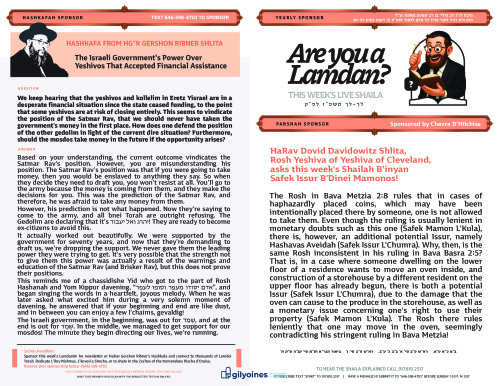
HaRav Dovid Davidowitz Shlita,
Based on your understanding, the current outcome vindicates the
Satmar Rav’s position. However, you are misunderstanding his Rosh Yeshiva of Yeshiva of Cleveland,
position. The Satmar Rav’s position was that if you were going to take asks this week's Shailah B’inyan
money, then you would be enslaved to anything they say. So when Safek Issur B'Dinei Mamonos!
they decide they need to draft you, you won’t resist at all. You’ll go to
the army because the money is coming from them, and they make the
decisions for you. This was the prediction of the Satmar Rav, and The Rosh in Bava Metzia 2:8 rules that in cases of
therefore, he was afraid to take any money from them. haphazardly placed coins, which may have been
However, his prediction is not what happened. Now they’re saying to
come to the army, and all bnei Torah are outright refusing. The intentionally placed there by someone, one is not allowed
Gedolim are declaring that it’s !יהרג ואל יעבורThey are ready to become to take them. Even though the ruling is usually lenient in
ex-citizens to avoid this. monetary doubts such as this one (Safek Mamon L'Kula),
It actually worked out beautifully. We were supported by the there is, however, an additional potential Issur, namely
government for seventy years, and now that they’re demanding to
draft us, we’re dropping the support. We never gave them the leading Hashavas Aveidah (Safek Issur L'Chumra). Why, then, is the
power they were trying to get. It’s very possible that the strength not same Rosh inconsistent in his ruling in Bava Basra 2:5?
to give them this power was actually a result of the warnings and That is, in a case where someone dwelling on the lower
education of the Satmar Rav (and Brisker Rav), but this does not prove floor of a residence wants to move an oven inside, and
their positions.
This reminds me of a chassidishe Yid who got to the part of Rosh construction of a storehouse by a different resident on the
Hashanah and Yom Kippur davening, “”אדם יסודו מעפר וסופו לעפר, and upper floor has already begun, there is both a potential
began singing the words in a heartfelt, joyous melody. When he was Issur (Safek Issur L'Chumra), due to the damage that the
later asked what excited him during a very solemn moment of oven can cause to the produce in the storehouse, as well as
davening, he answered that if your beginning and end are like dust,
and in between you can enjoy a few l’chaims, gevaldig! a monetary issue concerning one's right to use their
The Israeli government, in the beginning, was out for ש ַמד, ָ ׁ and at the property (Safek Mamon L'Kula). The Rosh there rules
end is out for ש ַמד.
ָ ׁ In the middle, we managed to get support for our leniently that one may move in the oven, seemingly
mosdos! The minute they begin directing our lives, we’re running. contradicting his stringent ruling in Bava Metzia!
Zechus Harabbim! 'ביאור הגר"א חו"מ סי' קנ"ה ס"ק ח 'רא"ש פ"ב סי' ו ,רא"ש פ"ב סי' א' ב"ב כ' ע"ב ,ב"מ כ"א ע"א
Sponsor this week’s Lamdanim Inc newsletter or HaRav Gershon Ribner’s Hashkafa and connect to thousands of Lomdei
Torah. Dedicate L’iluy Nishmas, L’kovod a Simcha, or to share in the Zechus of the tremendous Rischa d’Oraisa.
Reserve your sponsorship today! (646) 598-4703
FOR COMMENTS OR QUESTIONS ON THE HASHKAFA MIMEON KODESH, TEXT 848-216-6466
TO HEAR THE SHAILA EXPLAINED CALL 917.810.2517
WANT TO BE MEHANEH YOUR OILAM WITH THIS NEWSLETTER? TEXT 646-598-4703 TO SUBSCRIBE TEXT "START" TO 917.810.2517 | HAVE A MEHALECH? SUBMIT IT TO "646-598-4703" BEFORE SUNDAY 1:30 P. M. EST
SEFER SPONSOR SEFER SHEMOS IS SPONSORED ר' חיים צבי בן ר' משה
Recent week's question & answer
“Can I Have My Money Back? A Lender’s Dilemma” (Mishmeres Chaim)
QUESTION
In a case where an individual is Toveiah money from someone who does not have
the ability to pay the loan back (and the lender is aware of this), the Halacha is
that the lender violates the Lav of “Lo Sihyeh Lo Kanoshe”- “You should not be an
oppressor to him”. What is unclear is that the primary Halachic commentators
(Chinuch; Rambam; S.A.) do not discuss a case where the lender is in doubt
whether or not the borrower has the requisite funds to pay back the loan. This
would seemingly indicate that a lender would not violate the Lav of “Lo Sihyeh” if
he is Toveiah the borrower in such a scenario. The question then becomes, that
seemingly such a situation of Safek should be deemed as a Safek Deoraisah
L’Chumrah situation, since there is a definite possibility that the borrower does
not have the money to pay back. So why then does the Shulchan Aruch not clarify
the ruling in such a case and Paskin L’Chumrah that the Malveh can’t be Toveiah
from the Loveh?
ANSWER
The violation of the Issur is not defined as the mere fact of claiming money from
a borrower in a situation where he does not have money to pay back. Rather, the
geder of the Issur of “Lo Sihyeh Lo Kenoshe” is when the lender knows and is
aware of the fact that the borrower does not have the money, and he
subsequently claims money from the borrower to oppress him and cause him
pain. Thus, if the situation is a situation of Safek, then definitively the lender is
not knowingly being Toveiah the borrower to oppress him and cause him pain,
even if the situation is one where the borrower does not actually have the money
to pay back! (This is how the Mishmeres Chaim understands the geder of the Issur.
The Minchas Chinuch however remains with the simplistic understanding of the
geder of the Issur; that the violation of “Lo Sihyeh” is based on being Toveiah from
the borrower in a case where he doesn't have the money, which should also apply
in a scenario of Safek.)
אות י"ג,ענינים שונים בחושן משפט ,'משמרת חיים חלק ב .רמב"ם הל' מלוה ולוה פ"א ה"ב–ג' שו"ע חו"מ סי' צ"ז ס"ב .ב"מ ע"ה ע"ב
Halacha
Highlights
When making a ברכהon thunder and lightning, it must be said within תוך כדי
דיבורof hearing the thunder or seeing the lightning.
שו"ע או"ח סימן רכז מ"ב ס"ק יב
Mussar
Moment
THE
LOMDUS SPONSOR TEXT 646-598-4703 TO SPONSOR
"There is a trace of גאוהin telling someone that I cannot be disturbed and he must call only when
Are you a
FOLLOW US
convenient for me. That is not for me."
Rav Moshe Feinstein Zt”l -
Lamdan?
TO SPONSOR A SHAILA LIELUEY NISHMAS
OR REFUAH SHELEIMA TEXT 646.598.4703