
Clarity for Teens - English — Lech Lechu (2026-10-19)
WEEKLY THOUGHTS • PARSHAS LECH LECHA
PARSHAS LECH LECHA
WHY BOTHER? WHO CARES?
— ❦ —
The Medrash
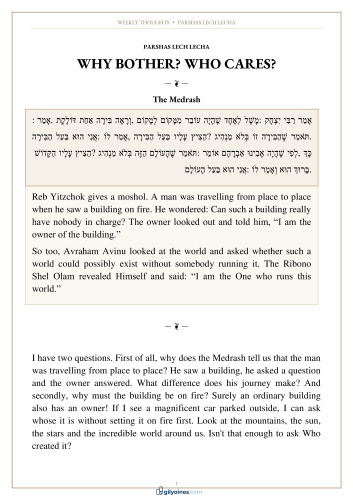
: אָ מַ ר. וְ ָראָ ה בִּ ָירה אַ חַ ת ּדֹולֶקֶ ת, מָ שָ ל לְ אֶ חָ ד שֶ הָ יָה עֹובֵ ר ִּממָ קֹום לְ מָ קֹום: אָ מַ ר ַרבִּ י יִּ צְ חָ ק
אֲנִּי הּוא בַ עַל הַ בִּ ָירה: אָ מַ ר לֹו, ת ֹאמַ ר שֶ הַ בִּ ָירה זֹו בְ ל ֹא מַ נְ הִּ יג ?הֵ צִּ יץ ָעלָיו בַ עַל הַ בִּ ָירה.
ת ֹאמַ ר שֶ הָ עֹולָם הַ זֶה בְ ל ֹא מַ נְ הִּ יג ?הֵ צִּ יץ ָעלָיו הַ קָ דֹוש: לְ פִּ י שֶ הָ יָה אָ בִּ ינּו אַ בְ ָרהָ ם אֹומֵ ר, כְָך
אֲנִּי הּוא בַ עַל הָ עֹולָם: בָ רּוְך הּוא וְ אָ מַ ר לֹו.
Reb Yitzchok gives a moshol. A man was travelling from place to place
when he saw a building on fire. He wondered: Can such a building really
have nobody in charge? The owner looked out and told him, “I am the
owner of the building.”
So too, Avraham Avinu looked at the world and asked whether such a
world could possibly exist without somebody running it. The Ribono
Shel Olam revealed Himself and said: “I am the One who runs this
world.”
— ❦ —
I have two questions. First of all, why does the Medrash tell us that the man
was travelling from place to place? He saw a building, he asked a question
and the owner answered. What difference does his journey make? And
secondly, why must the building be on fire? Surely an ordinary building
also has an owner! If I see a magnificent car parked outside, I can ask
whose it is without setting it on fire first. Look at the mountains, the sun,
the stars and the incredible world around us. Isn't that enough to ask Who
created it?
1
WEEKLY THOUGHTS • PARSHAS LECH LECHA
I once heard a story about a school inspector who visited a classroom and
complained about the pictures of the days of Creation hanging on the walls.
Why, he asked, were these young children being taught that Hashem made
the world? Why not leave them to decide for themselves when they grow
up? I don't know whether the story happened, so take it as a moshol.
The teacher replied, ‘You know, yesterday I left the classroom completely
empty. I locked the door and went home. When I returned this morning, all
these beautiful pictures were hanging here. I haven't the faintest idea who
painted them or who put them up. Apparently, they just appeared by
themselves.’ The inspector wasn't going to accept that explanation for a few
pictures. So why accept it for the entire world those pictures describe?
That is a very good moshol about recognising a Creator. But it only makes
my question stronger. If the building itself tells us there is an owner, why
does our Medrash specifically choose a burning building?
Last week someone asked me a question which stayed with me all week.
Then, at a shiur on Tuesday evening, the girls had sent in questions
beforehand, and one of the strongest was almost exactly the same. Why
does connecting to Hashem have to be so difficult? If Hashem wants us
close to Him, why didn't He make us naturally feel that closeness? Why
must we work so hard to find it? And what about someone who really tries,
davens, learns and works on himself, but instead of feeling connected, feels
burnt out? Has he got something wrong?
The Building That Made Him Stop
Perhaps the burning building is the beginning of the answer. But first, we
need to notice something about the man travelling.
Think how many buildings you pass when you drive through town.
Hundreds. Do you stop and study each one? Of course not. A building,
another building, another building. You are on your way somewhere. Near
the station in Manchester there is a building which, to me, looks like a piece
of cheese. Yellow, triangular, with holes in it. I have no idea what the
2
WEEKLY THOUGHTS • PARSHAS LECH LECHA
architect had in mind, and if the architect is reading this, please don't take
offence. But I remember that building. Why? Because buildings do not
usually look like pieces of cheese! Something different makes you stop and
notice.
A burning building does that far more powerfully. Suddenly the traveller
can no longer walk past as though nothing is happening. ‘One second!
What's going on here? Who is in charge? Why is nobody doing anything?’
The fire didn't create the owner. The owner was there all along. The fire
made the traveller stop long enough to look for him.
Now perhaps we can understand why he was travelling from place to place.
He had somewhere to go. Life was moving. He could have carried on. But
something didn't make sense to him, and he made a choice: he stopped to
ask. Avraham Avinu saw a world in which people worshipped things they
had made themselves. He understood that there must be something much
greater, and he wasn't prepared simply to shrug his shoulders and move on.
The question mattered enough to him to search for an answer. I am not
suggesting this one picture tells us the entire history of Avraham's search. I
am looking at the lesson the Medrash gives us.
You could walk past a man in the street building a tower out of three
thousand paper cups and think, ‘People are weird. He has obviously got
nothing better to do.’ Or you could ask him why. It might turn out that the
whole reason is to get into the Circle magazine! But at least, having asked,
you know. Not everything unusual needs a deep investigation. Yet if we go
through life never asking why, we can miss the very things that matter
most.
And sometimes our own lives contain an interruption. Something doesn't go
the way we wanted. Our first thought is, ‘Something has gone wrong with
the plan. Now I have to figure out how to find Hashem despite it.’ I would
never claim to know why another person is suffering or pretend we can
explain Hashem's reasons for somebody else's pain. But in our own avodah,
a difficulty can sometimes make us ask a question we never bothered
3
WEEKLY THOUGHTS • PARSHAS LECH LECHA
asking while everything was comfortable. The difficulty is real; so can the
opening be. The fire might be the very thing that makes us notice the Baal
Habirah.
But asking Who is behind the building is only the start. We also need to
know what the building is for. A person could spend a lifetime studying
every brick, window and staircase. He could become the greatest expert in
the world on how it was built. Yet he might never stop to ask why it is
there. We have become very good at learning how the world works and
how to make our lives more comfortable. But do we understand what our
lives are actually for?
An Hour for Thirty Seconds
That brings me to a story from this Chol Hamoed. I took my children to
Gulliver's World. There was a ride where you sit in a little rubber dinghy
and slide down a chute. Not across the English Channel, just down a slide.
The entire adventure lasts about thirty seconds and, if you are lucky—or
unlucky, depending on your perspective—you get a little wet.
We saw the queue and thought, ‘With so many people waiting, it must be
good.’ So we joined. What we hadn't realised was that the queue went
around one corner, then another, then another. You couldn't even see how
many people were in front of you. Nearly an hour later we finally reached
the top and thought, ‘Is that it? All that waiting for this?’ But at that stage,
walking back down past everyone would have been even more
embarrassing. So down the slide we went.
Now imagine that the same hour-long queue leads to the most unbelievable
experience imaginable. Perhaps a ride taking you skydiving over Niagara
Falls, something people would happily pay hundreds of pounds for. The
queue is exactly the same length. The people in front still seem to have
forgotten how to walk. Yet suddenly you would be delighted to stand there.
What changed? Not the waiting. You know what you are waiting for.
4
WEEKLY THOUGHTS • PARSHAS LECH LECHA
And imagine someone who enters the park without understanding a word of
the language. He can't read the signs. He sees people being thrown into the
air, screaming their heads off, with terror written all over their faces—and
you are trying to persuade him to join them! Why on earth would he
volunteer? Until he understands the attraction, all he can see is the effort,
the waiting and the screaming.
Isn't this sometimes how a person looks at Yiddishkeit? We speak endlessly
about connecting to Hashem, working on ourselves and strengthening our
relationship. But someone is asking a much more basic question: ‘Why
should I want that relationship in the first place? Don't tell me HOW to
connect until I understand WHY I should bother.’ If he has no idea what all
the effort is leading towards, how can we expect him to be excited by the
queue?
What Are We Actually Working Towards?
To understand what we are working towards, let us go back to something
we discussed at the end of Parshas Nitzavim. Teshuvah was not a loophole
Hashem introduced after His original plan went wrong. Chazal tell us that
teshuvah was created before the world. Hashem knew exactly what kind of
human being He was creating: someone with a yetzer hora, someone who
would struggle, sometimes fall, and need to get up again. That was not a
surprise in the system. It was part of the plan all along.
Why? Because a human being can reach a moment when he says, ‘Enough.
I am choosing Hashem.’ Not because it is the easiest thing to do, not
because there is nothing else he wants, but precisely because he has another
option and chooses Hashem anyway. If we had no conflicting desires and
no choices to make, where would that special moment be? A malach
doesn't face that choice. We do. That is our greatness.
So perhaps we have been looking at a nisayon from the wrong side. We see
the thing we want and say, ‘Oh no. Now I've got to tell myself no again.’
No to the screen, no to the group, no to the hamburger, or whatever it may
be. But saying no is not the main attraction. You have been given the
5
WEEKLY THOUGHTS • PARSHAS LECH LECHA
chance to say YES to Hashem! The temptation is not the point of the
moment. The choice is. Of course, we must never go looking for nisyonos,
and we must stay away from situations that put us in danger of falling. But
when a nisayon comes, it does not mean the relationship has failed. It is a
chance to choose that relationship.
That is the meaning of ‘ ’ובחרת בחייםat the end of Nitzavim. The Torah does
not promise that there will never be another struggle. It tells us to choose.
Each genuine yes, each time we get up again, each time we could go one
way and decide to go another, is part of why Hashem made us human in the
first place. We weren't supposed to be malachim. We were given something
a malach does not have.
A Conversation in the Quiet Carriage
I want to tell you about a conversation I had on a train, because it brings us
back to the other part of Avraham Avinu's journey: being prepared not only
to ask, but to follow where the answer leads.
I have a habit of asking people these questions on trains, or anywhere I get
to spend time with random human beings. Purely for their sake, of course,
so they shouldn't leave this world without ever thinking about it. With a
small benefit for me as well... If you sit beside me expecting two hours of
absolute peace, you may discover you've bought the wrong ticket. Once I
paid extra for a quieter carriage. The man beside me had apparently done
the same. Little did he know that I had paid extra for the opportunity to
disturb his peace of mind.
I had just finished telling my wife over the phone that I had actually caught
the train—even though three minutes before departure I was still in a taxi—
when a random goy asked whether I was using a Fig phone. I was surprised
he recognised it. He explained that he worked near the Jewish community
and had become curious about the people he saw. Why did they dress
differently? Why did they live differently? Instead of deciding they were
strange, he wanted to understand.
6
WEEKLY THOUGHTS • PARSHAS LECH LECHA
He had researched the subject, watched material and learned a surprising
amount, mainly about Boro Park. His approach was simple: if you don't
understand someone, ask before judging. We talked for a long time about
what he had discovered, what he believed and what prevented him from
taking his questions further.
He explained that religion had caused conflict between his parents when he
was young. It had therefore become emotionally difficult for him to go near
the subject. Even when he was interested in an answer, something held him
back from following it. I wasn't going to sort out his entire history in a train
journey. But I was left with an important thought: it is possible to ask
excellent questions and still find it difficult to allow an answer to change
your life.
We exchanged emails afterwards, and I sent him some material. He wrote
back to say he had enjoyed the conversation and was pleased that I had got
the chance to ask ‘a goy’ how he lives his life. He really had thought about
things that many people never stop to consider. Yet there are two stages:
asking what is true, and being willing to do something about what we find.
And that applies to us as well. Sometimes ‘Why?’ is a real question. Other
times, ‘Why?’ is another way of saying, ‘I don't want to.’ You ask, I
answer, you ask again, and there will never be a satisfactory answer
because you weren't actually searching for one. Avraham didn't stop at
‘There is probably someone in charge, never mind.’ He searched, and the
answer mattered to him.
Have Our Answers Grown Up?
There is another problem. Much of our Yiddishkeit was explained to us
when we were little children. We learned about Shabbos, Pesach, Purim,
davening and mitzvos in a way a child could understand—and rightly so.
But we have grown up. Our questions are bigger. Have our answers grown
with us?
7
WEEKLY THOUGHTS • PARSHAS LECH LECHA
I have learned with people who came to Torah later, including bochurim
who didn't have the same years of learning as children. They sometimes ask
me questions on something I have read dozens of times, and I realise that I
never thought of the question. I first learned it as a child and had carried
that explanation ever since. They are coming to it with an older mind.
Perhaps I need to do the same.
That does not mean reopening every obligation whenever it doesn't suit us.
It means asking deeper questions. Not simply ‘Do I have to keep Shabbos?’
but ‘Why do I keep Shabbos? What is Shabbos doing for me? What does it
mean to be a Yid who keeps Shabbos?’ Not merely ‘Why must I be
mechabed my parents?’ but ‘What is this mitzvah teaching me, and what
am I choosing when it is difficult?’
Because if the only explanation for my whole life is ‘That's what we do,’
then when a nisayon comes, ‘Who cares?’ can sound like a very good
argument. But if I understand why I care, I have something real to bring
into that choice. I am not fighting my desire with a rule I have never
thought about. I know Whom I am choosing, and why that choice matters.
Don’t Just Carry the Question
So here's something practical. Take a pen and a piece of paper and write
down the question you are actually carrying. ‘Why don't I feel connected?
What does connection mean? Why am I keeping Shabbos? What am I here
for? Why should I care?’ Don't leave it as a vague cloud over your whole
life. Give it words. Learn about it. Speak to somebody who can help you
understand it. Not every question is solved in a single conversation. And
don't outsource your whole understanding of life to whatever another
person—or a machine—happens to tell you. Use the mind Hashem gave
you.
Each person may have a different burning building. For one, it is an
emunah question. For another, an experience that shakes him. For
somebody else, it is the feeling that he is doing everything he has been told
8
WEEKLY THOUGHTS • PARSHAS LECH LECHA
to do but has forgotten what it is all for. We don't all have to stop for the
same reason. What matters is what we do once we have stopped.
Back to the Burning Building
Now we can return to the Medrash. Why a traveller? Because he could have
kept walking. Why a burning building? Because sometimes it takes
something unusual, uncomfortable, or difficult to make a person stop and
notice what was there all along. But Avraham Avinu didn't only notice the
fire. He wanted to know the Baal Habirah. And once he discovered Who
was behind the world, that discovery gave direction to his life.
The same is true for us. We can spend our lives walking past, keeping the
rules, standing in the queue, and occasionally asking, ‘Why bother? Who
cares?’ Or we can stop long enough to find out what the journey is for.
When we understand that the entire purpose includes the opportunity to
choose Hashem, the effort begins to look different. The queue may still be
long. The nisayon may still be difficult. We may not always feel the
closeness we would like. But we know what we are choosing, and Who we
are choosing.
Perhaps the question is not only ‘Why does Hashem make it so hard to
connect?’ Perhaps we also need to ask, ‘What if the very effort of turning
towards Him is part of the connection?’ That does not explain every
difficulty or make burnout something to ignore. It does remind us that a
genuine search, a moment of choice and a fresh beginning all have meaning
even when we cannot yet feel the result.
Avraham Avinu didn't become Avraham Avinu by continuing to walk. He
stopped, he asked, and he searched. The question was not the end of his
relationship with Hashem. It was the beginning. And when the next nisayon
comes, don't only ask what you must say no to. Remember what you are
getting the chance to say yes to. Because that was the plan all along.
— ❦—
9