
Beis Horaah — Vayeru (2026-10-26)
בית הוראה שערי עזרא
Bet Horaah Z M A N I M · N E W YO R K
Shaare Ezra
Candle Lighting 5:36pm
Shabbat Ends 6:36pm
R”T 7:05pm
The Weekly Halacha Newsletter of Rabbi Shay Tahan
VOLUME 3 · ISSUE 75 Parshat Vayera 2 0 C H E S H VA N 5 7 8 7 · O C T O B E R 3 1 , 2 0 2 6
Halacha Question? WhatsApp 347-666-3467 · askhalacha1@gmail.com · 2,000+ classes: Rabbishaytahan.com
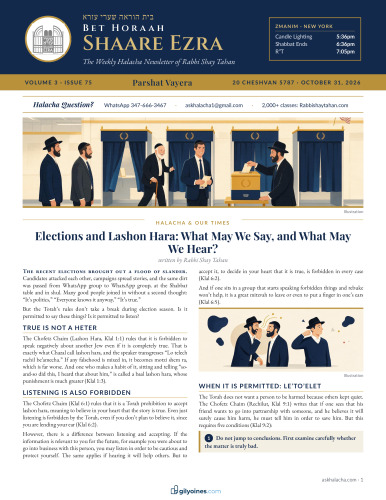
Illustration
HALACHA & OUR TIMES
Elections and Lashon Hara: What May We Say, and What May
We Hear?
written by Rabbi Shay Tahan
The recent elections brought out a flood of slander. accept it, to decide in your heart that it is true, is forbidden in every case
Candidates attacked each other, campaigns spread stories, and the same dirt (Klal 6:2).
was passed from WhatsApp group to WhatsApp group, at the Shabbat And if one sits in a group that starts speaking forbidden things and rebuke
table and in shul. Many good people joined in without a second thought: won’t help, it is a great mitzvah to leave or even to put a finger in one’s ears
“It’s politics,” “Everyone knows it anyway,” “It’s true.” (Klal 6:5).
But the Torah’s rules don’t take a break during election season. Is it
permitted to say these things? Is it permitted to listen?
TRUE IS NOT A HETER
The Chofetz Chaim (Lashon Hara, Klal 1:1) rules that it is forbidden to
speak negatively about another Jew even if it is completely true. That is
exactly what Chazal call lashon hara, and the speaker transgresses “Lo telech
rachil be’amecha.” If any falsehood is mixed in, it becomes motzi shem ra,
which is far worse. And one who makes a habit of it, sitting and telling “so-
and-so did this, I heard that about him,” is called a baal lashon hara, whose Illustration
punishment is much greater (Klal 1:3).
WHEN IT IS PERMITTED: LE’TO’ELET
LISTENING IS ALSO FORBIDDEN
The Torah does not want a person to be harmed because others kept quiet.
The Chofetz Chaim (Klal 6:1) rules that it is a Torah prohibition to accept The Chofetz Chaim (Rechilut, Klal 9:1) writes that if one sees that his
lashon hara, meaning to believe in your heart that the story is true. Even just friend wants to go into partnership with someone, and he believes it will
listening is forbidden by the Torah, even if you don’t plan to believe it, since surely cause him harm, he must tell him in order to save him. But this
you are lending your ear (Klal 6:2). requires five conditions (Klal 9:2):
However, there is a difference between listening and accepting. If the
1 Do not jump to conclusions. First examine carefully whether
information is relevant to you for the future, for example you were about to
go into business with this person, you may listen in order to be cautious and the matter is truly bad.
protect yourself. The same applies if hearing it will help others. But to
askhalacha.com · 1
B E T H O R A A H S H A A R E E Z R A · PA R S H AT VAY E R A · V O L . 3 , I S S U E 7 5
2 Do not exaggerate. Tell it no worse than it actually is. WHAT THIS MEANS FOR ELECTIONS
3 Intend only to help, to prevent the harm, and not out of
hatred for the other person. Included in this, first think whether
telling will actually accomplish anything. If the listener won’t heed
you and will partner with him anyway, and later, when they
quarrel, will say “so-and-so was right about you,” there is no heter
at all.
The elections will pass. The words we spoke, and
the ones we listened to, remain.
Title page of the sefer Chofetz Chaim, first edition, 1873 · Public domain
Choosing a leader is, in a sense, entering into a partnership with him. We
4 If the benefit can be achieved without revealing anything
place our community’s interests in his hands. So there can be real to’elet in
negative, it is forbidden to tell. warning people about a candidate, if one truly knows something that would
harm the public. But all the conditions apply: know it firsthand or verified,
5 The telling may not cause the person actual harm. Losing the examine it carefully, don’t exaggerate, speak only to protect and not out of
benefit the other would have given him is permitted, but causing party hatred, say only what is necessary, and stay within the truth. Spreading
him real damage requires further conditions, and certainly no a story you saw forwarded, mocking a candidate, or repeating rumors to
harm beyond what halacha would impose. make “our side” look good does not meet these conditions. That is plain
lashon hara, and often motzi shem ra.
In Lashon Hara (Klal 10:1-2), the Chofetz Chaim adds that one who saw
The requirement of firsthand knowledge also includes hearing on line a
someone wrong his fellow may publicize it to help the victim and to
speech in which he made a promise that could potentially harm our
denounce the act. The conditions there include: he saw it himself rather
community, or the like. Also, if he has a record of engaging in behavior that
than heard it, he first rebuked the wrongdoer gently, he does not exaggerate,
is harmful to our way of life, this may be relevant as well. Furthermore, the
his intent is to help and not to enjoy the other’s shame, there is no other
requirement to rebuke him first may not apply in this case, assuming that he
way, and no harm results beyond what beis din would rule. And if the
would not listen anyway (Klal 10:7).
speaker is guilty of the same sins himself, it is forbidden, because his intent is
not for good but to gloat (Klal 10:3). The same goes for listening. A voter who wants to know relevant facts
about a candidate in order to vote responsibly may listen, in order to be
THE TZIYURIM careful. But he may not accept as fact everything he hears, and he must not
At the end of Hilchot Rechilut, the Chofetz Chaim brings Tziyurim, sit and enjoy an hour of political gossip.
practical cases. In the first: you see Reuven wanting to go into business with Another heter is when the candidate is a wicked person who doesn’t believe
Shimon, who doesn’t know him, and you know well that Reuven doesn’t in hashem or the torah. Or if he vows to fight the torah and the yeshiva
care about other people’s money. Warn Shimon beforehand. This is not system (klal 7:5 and Tshuvot vehanagot 3:478).
lashon hara, but all the conditions of Klal 9 must be met. The elections will pass. The words we spoke, and the ones we listened to,
remain. May we merit to guard our mouths and our ears, and to see true
leaders who bring blessing to Klal Yisrael.
Rabbi Shay Tahan is the Rosh Kollel of Kollel Shaarei Ezra located in Bnei
Yosef, on Avenue P and Ocean Parkway, and he is the head of the Bet-Horaha
Arzei Halevanon. You can hear Rabbi Tahans classes at Torahanytime.com
and in Askhalacha.com.
Originally published in The Jewish Vues, October 28 – November 3, 2026.
*To receive the weekly newsletter please email us at askhalacha1@gmail.com
THE TORAH’S OPINION ON VOTING
Does My Vote Really Matter If Hashem Decides?
written by Rabbi Shay Tahan
Whenever there is an election, we need to understand
what our role in it is. Is there any reason to go out and vote? Or maybe it is a EVEN THE MAN AT THE WELL IS APPOINTED
waste of time, because everything is already decided above, and Hakadosh FROM HEAVEN
Baruch Hu decides exactly who will be in charge for the next four years. Do The Gemara speaks about the “resh garguta,” the one appointed over the
we have any say in the matter at all? well, deciding who draws water today and tomorrow. Even such a small
At first glance, Chazal seem to give two answers that we must reconcile. position is appointed by Hakadosh Baruch Hu. As the pasuk says, “Lecha
Hashem hamamlacha, vehamitnasei lechol lerosh” — You appoint every
appointee, even over small things.
askhalacha.com · 2
B E T H O R A A H S H A A R E E Z R A · PA R S H AT VAY E R A · V O L . 3 , I S S U E 7 5
The Yalkut Reuveni, at the end of Parashat Pinchas, brings that we cannot city and put in a new one. The new rabbi was a chashuv rabbi, a dayan,
appoint a leader over the public down here unless he was first announced knowledgeable and fit for the job. But since he was appointed by the
above in Heaven. On the pasuk “Yifkod Hashem… ish al ha’eda,” Hashem is government and not by the people, the Chatam Sofer says he did two evil
the One who appoints a leader over the congregation. Every position of things: he took a position of leadership against the will of the community,
authority a person holds is from Hashem. That is why, when we see a king, and he pushed out the previous rabbi. For each of these he is disqualified
even a non-Jewish king, we make the bracha “shenatan mikvodo levasar from leading and from ruling.
vadam” — Hashem gave from His honor to a human being. The Chatam Sofer brings the frightening words of the Maharam about
The Gemara in Brachot (55a) says in the name of Rabbi Yochanan that someone who takes authority without the people’s will, or through officials.
there are three things Hakadosh Baruch Hu announces Himself: famine, Who can appoint a leader? The people.
plenty, and a good leader. A good leader we learn from the pasuk “Re’eh The Chatam Sofer adds a second condition. The leader must be someone
karati veshem Betzalel” — Hashem called up Betzalel to oversee the building fitting, a righteous person with the right qualities. Sometimes the public
of the Mishkan. picks someone who is comfortable for them, who will tell them everything
is permitted. That is no good. And sometimes a person is great and
righteous, but the people are not interested in him. That is also no good.
Two things are needed together: the majority of the public wants him, and
he is worthy. And it goes by majority, because you will never have everyone
agree.
An example is Yehoshua ben Gamla. The Gemara in Bava Batra (21a)
remembers him for the good: if not for him, Torah would have been
Wooden ballot box · National Museum of American History, Smithsonian · Public domain forgotten from Yisrael, because he established teachers for the children. Yet
the Chatam Sofer discusses how he obtained his position through the king
If that is the case, it seems there is no need to vote at all. Hashem has already rather than the people. Even great personal merit does not erase the
decided. question of how a leader is appointed.
“UNLESS HE CONSULTS WITH THE David Hamelech, too, did not take the kingship until the nation came to ask
COMMUNITY” him to lead. The Urim VeTumim warns of the damage caused when
someone takes authority over a community without its will.
But look at the very next line in the same Gemara. Rabbi Yitzchak says: “Ein
maamidin parnas al hatzibur ela im ken nimlachin batzibur” — we do not EVEN MOURNERS MUST GO OUT
appoint a leader over the community unless we consult with the
community first. So we have two sides. Hakadosh Baruch Hu decides who should lead, but
even after He decides, the nation has the last word. That is how Hashem
Here is an explicit source that you have to ask the people. And how do you made it, and that is what He wants. Only if a person is completely
ask the people? How do you ask 300 million people what their opinion is? disqualified, and Hashem does not want him at all, can the people not
You vote. That is the way. change that.
The Gemara learns this from Betzalel. Hashem told Moshe Rabbeinu, “See, This is so serious that when Chacham Ovadia Yosef was asked, halacha
I have called Betzalel.” Later Moshe tells the people, “See, Hashem has called lemaaseh, whether avelim during the seven days of shiva may go out to vote,
Betzalel.” Why does the Torah need to tell us that Moshe informed the he ruled that they must go out and vote. He said the same about avreichim
people? Of course a leader’s people are informed; otherwise how would he who had accepted a taanit tzibbur. They must go and vote. And it is known
lead? Rather, Chazal explain that there was a back and forth here. Hashem that in Eretz Yisrael, before elections, the rabbanim say it is a mitzvah to
asked Moshe: Is Betzalel fitting in your eyes? Moshe, in his humility, vote, and the people listen.
answered: If he is fitting in Your eyes, certainly in mine. Hashem said: Go
and ask the people. And Moshe asked Am Yisrael: Is Betzalel fitting in your YOUR VOTE IS COUNTED EITHER WAY
eyes? And they answered: If he is fitting before Hashem and before you,
Some say: the result in my area is clear, so my vote will not change anything.
certainly before us.
But the government sees how many people voted in each area. If Jews come
Think about it. Hakadosh Baruch Hu Himself wanted Betzalel, and out in masses, officials take them into account. If they see that Jews do not
Betzalel was a tzaddik who knew how to combine the letters with which the vote, they can ignore them. That affects how decisions are made toward our
world was created. Still, Hashem consulted with Moshe, and Moshe communities.
consulted with the people.
So on Election Day, every person should make a wise decision, go out and
So the answer to the contradiction, as brought in the Ein Yaakov, is this: vote for those who are good for Am Yisrael, who do for Am Yisrael and do
even though the man over the well is appointed from Heaven, we still need not endanger Am Yisrael, and for what is good for his family and his kehil‐
the consent of the public, just as with Betzalel. If the people say yes, he is lah.
appointed. If they say no, even though Hashem wanted him, he does not get
Chazak u’baruch.
the job. It needs to be approved by Hakadosh Baruch Hu and by Am Yis‐
rael. Rabbi Shay Tahan answers halachic questions at askhalacha.com.
Watch the full class, “What Is the Torah’s Opinion on Voting?”: https://
THE CHATAM SOFER: A LEADER WITHOUT THE youtu.be/yTeLQMHWuco
PEOPLE IS INVALID
This principle appears in several sefarim. The Chatam Sofer, in Choshen
Mishpat, discusses a case where the government removed the old rabbi of a
askhalacha.com · 3
B E T H O R A A H S H A A R E E Z R A · PA R S H AT VAY E R A · V O L . 3 , I S S U E 7 5
FROM OUR ARCHIVE
The Torah’s Outlook on Elections
written by Rabbi Shay Tahan
We understand the importance of casting a ballot on Mishkan was at Shiloh, there was no king, because there was no consent of
Election Day, but not everyone is familiar with the Torah’s perspective. the people, that is, because there was no consent of the people.”
Should people voice their opinion on who should be their leader? If The Gemara Yerushalmi (Sanhedrin 2:6) further emphasizes this point,
Hashem governs everything in the world and His decisions are stating that Hashem removed Himself from the decision-making process,
unchangeable, is there a need for us to vote? underscoring the nation’s responsibility to appoint their leader.
In recent days, I’ve heard many explain the Torah’s view on this matter as
similar to any other situation: while Hashem runs the world and has already DOES HASHEM GET’S INVOLVED?
decided who will be elected as mayor, we are still obligated to make our Yet, the Gemara (Bava Batra 91b) says that even the lowest-level authority,
hishtadlut (effort). They claim that our effort has no connection to the such as a water supervisor, is appointed by Heaven:
outcome of the election. In this article, I will explain why this approach is מֹוקמִ י לֵיה
ְ ״וְהַ ּמִ ְתנַּׂשֵ א לְ כ ֹל לְ ר ֹאׁש״… אֲפִ יּלּו ֵריׁש ּג ְַרּגּותָ א מִ ּׁשְ מַ ּיָא
mistaken and that Hashem does not pre-determine the results; rather, our
This might imply that Hashem alone appoints leaders. The Iyun Yaakov
actions have a direct impact on the outcome of the election.
reconciles this by explaining that while Hashem chooses the next leader, the
IS VOTING A TORAH CONCEPT? people’s approval is still required. Leadership is thus a partnership between
Divine will and the people’s choice.
Let’s delve deeper. The Gemara (Sanhedrin 26a) recounts the story of
Shebna, a minister in King Hezkiah’s court, who was a prominent figure
with considerable influence. Shebna would teach Torah to a crowd of
130,000 followers, surpassing King Hezkiah’s audience of 110,000. When
king Sancheriv besieged Yerushalayim, Shebna wrote a surrender note, shot
it over the wall with an arrow, and it read: “Shebna and his camp have
appeased Sancheriv and are ready to surrender; Hezkiah and his camp have
Illustration not appeased him.
Let’s first examine where a Torah source for voting might be found — or
whether voting is truly a modern concept, primarily secular in nature, since
some argue that Hashem ultimately decides who will lead the city.
The Torah clearly advocates for the concept of ‘We the People’ choosing our
leader, as seen in Berachot (55a): Hashem said to Moshe: “Is Betzalel a
suitable choice in your eyes?” Moshe responded: “Master of the universe, if
he is suitable to You, then certainly to me.” Hashem instructed Moshe to
also consult the people, who ultimately confirmed their approval. Even New York City Hall · Photo: Nielsoncaetanosalmeron · CC BY 4.0
though Hashem had chosen Betzalel, He deferred to the will of the people,
demonstrating a clear endorsement of their involvement in leadership Upon hearing this, Hezkiah feared that the majority stance might sway
selection. This concept, now known as an election, is fundamental to a Hashem’s will, causing even those who resisted to fall into the hands of the
Torah-based society. Assyrians. But the prophet Yeshaya reassured him with the words: “Say not:
A conspiracy, concerning all of which this people say: A conspir‐
Our sages derive from this that a leader should not be appointed over the acy” (Yeshaya 8:12). The prophet’s message clarified that a conspiracy of
people without first consulting them. wicked people does not count as a legitimate majority. Thus, despite their
The method for determining a public decision is also discussed in the torah, numbers, Shebna’s supporters were disregarded as the “majority” in the eyes
as the concept of voting is reflected in the pasuk: of Hashem.
“( ”לִ ְנט ֹת ַאח ֲֵרי ַרּבִ ים לְ הַ ּט ֹתShemot 23:2). Commentaries explain that since Hashem often sides with the majority
For example, in a Beit Din, when the dayanim (judges) are in dispute over a opinion, Hezekiah feared that Hashem might side with the majority here as
verdict, the final decision is determined according to the majority opinion. well. However, the prophet reassured him that Hashem does not side with
This principle shows that following the majority is an accepted method for the wicked. This highlights the importance of voting, as only the majority
resolving communal or legal decisions, which parallels the concept of voting vote of Klal Yisrael truly holds weight in Hashem’s consideration.
in a public context.
THE GEDOLIM’S RULING
Another example can be found in the 300-year delay in appointing Shaul
Hamelech as king. Although the Torah mandates appointing a king upon Rabbi Moshe Sternbuch (Tshuvot Vehanhagot 2, 140) recounts a rabbinic
entering the Land of Israel, the Netziv (Haamek Davar on Dvarim 17:14) meeting held before the establishment of the State of Israel, where the
explains that the appointment was postponed because the nation was not rabbis gathered to discuss and cast their opinions. He describes how Rav
yet willing. This reinforces the principle that a leader should only be Elchanan Wasserman and Rav Aharon Kotler wanted to leave the meeting,
appointed with the people’s consent. but Rav Chaim Ozer urged them to stay. When Rabbi Avraham Kalmenov‐
itz questioned why their presence mattered, given that their vote would
He writes: “It is not possible to command the appointment of a king as long
likely have little impact on those establishing the state, Rav Chaim Ozer
as it is not with the consent of the people… The Sanhedrin does not issue a
explained that in Hashem’s eyes, only the opinions of the righteous truly
decree (for appointing a king) until the people declare that they want a
matter, as we see from the Gemara’s account of King Hezekiah.
king’s leadership. For this reason, during the three hundred years that the
askhalacha.com · 4
B E T H O R A A H S H A A R E E Z R A · PA R S H AT VAY E R A · V O L . 3 , I S S U E 7 5
We learn from this the importance of the Jewish vote in Hashem’s eyes, as A democratic system safeguards the freedoms we enjoy. One of the most
only those opinions truly matter to Him. fundamental responsibilities of each individual is to register and vote.
The obligation to vote is also mentioned in a letter from Rabbi Moshe Therefore, I urge all members of the Jewish community to fulfill their duty
Feinstein, dated October 3, 1984. He writes: “Upon reaching the United by registering as soon as possible and by voting. Through this, we can
States, Jews found a safe haven. The rights guaranteed by the U.S. express our gratitude and contribute to the continued security of our com‐
Constitution and the Bill of Rights have allowed us the freedom to practice munity.
our religion without interference and to live safely in this republic. Signed: M. Feinstein”
A fundamental principle of Judaism is hakaras hatov—recognizing the In conclusion, selecting a leader is a godly act. Hashem determines the
benefits we have received and expressing our gratitude. Therefore, it is potential leader but waits for the people’s approval, making our vote a
incumbent upon each Jewish citizen to participate in the election process as crucial part of this sacred partnership.
an expression of appreciation. Originally published in The Jewish Vues; also published in 5TownsCentral.
More from Rabbi Tahan on the Elections
ARTICLE · JUNE 2025 CLASS CLASS
How Mamdani Got Elected: Wake Who Picks the Rabbi? Majority What Is the Torah’s Opinion on
up call; Laziness at the Ballot Box Rule in Shul According to Halacha Voting?
askhalacha.com/?p=15943 askhalacha.com · Videos youtu.be/yTeLQMHWuco
About Shaare Ezra
Shaare Ezra is a one of a kind, multi-faceted organization that’s there for the community. Under the
Halacha Question?
W H AT S A P P
leadership of HaRav Shay Tahan שליט״א. Shaare Ezra feels that proper Halachic guidance should be
347-666-3467
accessible to everyone, therefore we offer the community the opportunity to call, text, WhatsApp, or
EMAIL
e-mail any halachic questions they may have, through the Bet Horaah, where qualified, trained and askhalacha1@gmail.com
ordained Rabbis are available to answer your questions in English, Hebrew and Russian. Shaare Ezra
Over 2,000 classes can be found at
is from the community—for the community.
Rabbishaytahan.com
Now you can also download our newsletters from the following websites: Shiurenjoyment, Dirshu, Ladaat, Gilyonos, Kol Halashon, Parsha Sheets, Chidush,
Shareplus. Prog.
ASK HALACHA · ENGLISH
Ask the Rabbi Online
Halacha answers, classes, articles and videos by
Rabbi Shay Tahan — all in one place. Have a
question? Ask it on the site.
askhalacha.com
ASK HALACHA · РУССКИЙ
Галаха на русском языке
Ответы раввина Шая Тахана на вопросы по
галахе — теперь и на русском. Задайте свой
вопрос раввину на сайте.
askhalacha.com/category/russian
askhalacha.com · 5