
Olas Shabbos Minkatch - English — Vayeru (2026-10-26)
:
ב”ה
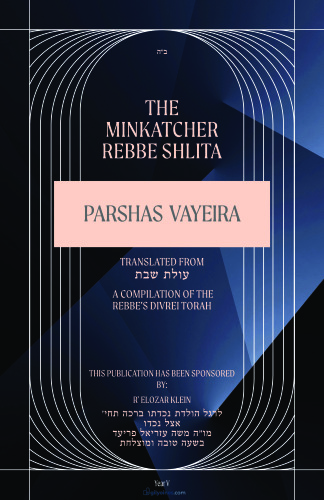
THE
MINKATCHER
REBBE SHLITA
PARSHAS VAYEIRA
TRANSLATED FROM
עולת שבת
A COMPILATION OF THE
REBBE’S DIVREI TORAH
THIS PUBLICATION HAS BEEN SPONSORED
BY:
R' ELOZAR KLEIN
'לרגל הולדת נכדתו ברכה תחי
אצל נכדו
מו"ה משה עזריאל פריעד
בשעה טובה ומוצלחת
Year V
PARSHAS VAYEIRA
ֵּאֹלֵנֵ י ַַמ ְְמ ֵֵרא ְְוהּוא
ֵ ַַוֵּי ָָּרא ֵֵא ָָליו ד׳ ְּב
.ֹי ֵֹׁׁשב ֶּּפ ַַתח ָָהֹא ֶֶֹהל ְּּכֹחֹם ַַהּיֹום
And Hashem appeared to him by the plains
of Mamre; he was sitting at the entrance
of the tent in the heat of the day.
(Bereishis 18:1)
WORDS THAT CARRY THE
SHECHINAH
Parshas Vayeira opens with Hashem’s revelation to Avraham Avinu in the
plains of Mamre. Rashi explains that Mamre “was the one who gave him
counsel regarding undergoing the bris milah; therefore, Hashem revealed
Himself in his portion.”
Yet this explanation raises a deeper question. Why did Mamre’s advice
determine the very place where the Shechinah would be revealed? What was
it about his counsel that made his portion a fitting place for such a revelation?
Moreover, the Midrash Tanchuma (Vayeira, 3) relates that Mamre was not the
only one whose advice Avraham sought. He also consulted Aner and Eshkol,
2 The Minkatcher Rebbe on Parshas Vayeira
who counseled him against undergoing bris milah because of the danger
involved. Only Mamre advised him to proceed, and indeed, Avraham followed
that advice.
But how did Avraham discern that Mamre’s advice was ultimately correct? If
he was uncertain enough to consult his companions, what led him to heed
Mamre’s counsel over the others?
Twenty-Two Letters
The foundation for understanding these questions can be better understood
through the Noam Elimelech’s elaboration of this pasuk.
When Hashem desired to create the world in order to bestow goodness upon
His creations, a fundamental question arose. How could finite beings exist in
the presence of an infinite Creator? The light of the Ein Sof, blessed be He, is
without limit, and nothing can exist independently within His infinite revelation.
Therefore, to make room for creation, Hashem concealed His infinite light
through the process known as tzimtzum, thereby allowing created beings to
exist as seemingly distinct entities in this world. Through this concealment, a
world could emerge in which Hashem’s presence was not openly apparent,
yet which remained entirely dependent upon Him for its existence. This yesod
is explained in the holy Zohar (3:204b) and Eitz Chaim (Shaar I, 2).
But if so, we are left to wonder where, so to speak, Hashem concealed His
holy light. Within what did He enclose the radiance of His kedushah?
The Noam Elimelech writes that he heard from his Rebbe, the Maggid of
Mezeritch, that Hashem concealed Himself within the letters of the holy
Torah. This means that the Torah is not merely a revelation of divine wisdom;
Hashem is in its very letters.
In fact, the Maggid of Mezeritch adds that the word כביכול, which Chazal use
in many places when speaking of HaKadosh Baruch Hu (see Eruvin 22a and
elsewhere), can be read as כ״ב יכול, alluding to the Torah's twenty-two oisios
Translated and Published ( פרשת וירא תשפ"זYear V) 3
that provide the means through which HaKadosh Baruch Hu makes Himself
accessible within creation.
Furthermore, the Noam Elimelech adds that when a tzaddik learns Torah
lishmah, for Hashem’s sake, with kedushah, teharah, and deveikus, he
continues to bring Hashem into the Torah’s letters. The words that emerge
from his mouth draw that concealed presence into revelation, and become a
dwelling place for the Shechinah.
It is upon this yesod, writes the Noam Elimelech, that we can comprehend
the depths of the words, וירא אליו ד׳ באלוני ממרא. The name ״ממרא״is
associated with the lashon of אמירה, utterance or speech, while ״באלוני״is
from the lashon אילן, a tree, alluding to the holy Torah, whose mitzvos are like
branches extending from it.
The phrase ״באלוני ממרא״can therefore be understood as referring to the
“tree of utterances,” the sacred words of Torah through which a tzaddik
draws the presence of HaKadosh Baruch Hu into creation.
In this sense, because Avraham Avinu learned Torah with holiness, purity, and
deveikus, his words became a vessel for the Shechinah. Through the sacred
“tree of his utterances,” through the holy words of Torah that Avraham spoke,
he brought Hashem into a state of revelation in this world.
Counsel Rooted in Torah
With this understanding, we can return to Rashi’s explanation and begin to
appreciate the connection between Mamre’s counsel and the revelation of
Hashem in his portion.
The distinction between Mamre’s advice and that of Aner and Eshkol was not
simply a matter of which friend offered the more convincing argument. At its
core, the question was which counsel reflected the true ratzon Hashem.
Avraham Avinu recognized that Mamrei’s counsel was rooted in the Torah
HaKedoshah, where Hashem Himself dwells in every letter. He perceived
4 The Minkatcher Rebbe on Parshas Vayeira
Hashem in Mamre’s words, just as he perceived Him in the words and letters
of the Torah he had learned. Thus, Avraham knew that Mamrei’s counsel was
the true ratzon Hashem, and the one he must act upon.
This is why the place associated with Mamre’s words of encouragement
toward a mitzvah became a place associated with the revelation of Hashem—
because Mamre’s counsel, like the Torah, had itself been a dwelling for the
Shechinah.
A Sign for His Children
Perhaps this same principle can illuminate Rashi’s comment on the words that
follow, והוא יושב פתח האהל. Rashi notes that the word is written ישב, without
a vav, and explains:
He wished to stand up. The Holy One, blessed be He, said to him, שב
ואתה סימן לבניך,“ – ואני אעמודSit, and I will stand. And you are a sign for
your children, for in the future I will stand in the assembly of the dayanim
while they sit in judgment.” As it says (Tehillim 82:1), אלקים נצב בעדת
ל-“ – אG-d stands in the Divine assembly.”
At first glance, the connection is difficult to understand. What does Avraham
Avinu sitting at the entrance of his tent have to do with judges sitting in a Beis
Din, examining a case and rendering a decision? Why should Avraham’s
posture become a sign for generations of Jewish judges?
In light of the principle we’ve established, we can understand that the Torah
is not merely a body of laws that human beings study and apply. Its letters
contain Hashem’s infinite light, otherwise concealed within creation. When
Yidden engage in Torah with holiness and toil to uncover its truth, they
participate in bringing Hashem into those oisios.
This is especially significant in a Beis Din, where dayanim are tasked to
examine the halachos of Torah, deliberate with integrity, and arrive at a ruling
that reflects the truth of Hashem’s Torah. The dayanim are not merely applying
a legal process; they are engaging with the very words of Torah that contain
Translated and Published ( פרשת וירא תשפ"זYear V) 5
Hashem’s presence. And when they do so faithfully, their deliberations
become a setting in which the Shechinah is revealed.
This is what Hashem conveyed to Avraham Avinu with the words, שב ואני
ואתה סימן לבניך,אעמוד. The presence of the Shechinah there became a sign
for future generations that when Yidden and dayanim sit together to clarify
the truth of Torah, ל-—אלקים נצב בעדת אthey participate in the revelation of
Hashem’s presence through the Torah they study and apply.
Moreover, this lesson extends beyond the courtroom as well. The truth is that
wherever and whenever Yidden learn Torah lishmah, with hasmadah, humility,
and a genuine desire to understand the will of Hashem, their words become
vessels for the Shechinah—just like at the time of creation. Whether in a Beis
Din, a beis midrash, or any yiddisher home, Torah learned with sincerity and
devotion creates an opportunity for the concealed presence of Hashem to
become more openly revealed.
The Speech of Shabbos
The same principle can help us appreciate the ma’aleh of speaking Divrei
Torah on Shabbos.
The Navi says (Yeshayahu 58:13), וקראת לשבת עונג וגו׳ וכבדתו מעשות דרכיך
“ – ממצוא חפצך ודבר דברAnd you shall call Shabbos a delight… and you shall
honor it by not following your own ways, by not pursuing your own affairs, and
by not speaking idle words.”
On the last words of the pasuk, Chazal (Shabbos 113b) darshen שלא יהא
“ – דבורך של שבת כדבורך של חולYour speech on Shabbos should not be like
your speech on a weekday.”
When Klal Yisrael learn Torah lishmah on any given day, their words become
a means of drawing down His light and creating a place for hashra’as
haShechinah. But on Shabbos, this opportunity takes on special significance
because the kedushah of the day itself elevates our avodas Hashem.
6 The Minkatcher Rebbe on Parshas Vayeira
Thus, when Chazal said we are to guard our speech on Shabbos, they
were teaching us not only to refrain from weekday conversation, but also to
recognize the unique potential of our words on this holy day to be elevated and
transformed into vessels for Hashem. When we devote our words to Torah on
Shabbos, we reveal the divine presence concealed within them. By directing
our conversations toward matters befitting the day, we transform them into a
means of gilui haShechinah.
This also offers a deeper understanding of the promise (Shabbos 118a), כל
“ – המענג את השבת נותנין לו נחלה בלי מצריםWhoever delights in Shabbos is
given an inheritance without boundaries.” How does the joy of Shabbos lead
to a gift that transcends limitation?
The Shulchan Aruch (see Orach Chaim 290:2) teaches that limud Torah is
one of the greatest forms of Oneg Shabbos. Thus, one who finds delight
in Shabbos through the study of Torah is promised “an inheritance without
boundaries,” because the words of Torah that leave his mouth amid the
kedushah of Shabbos become a vessel for drawing in the light of the Ein Sof,
which has no limit or measure.
In fact, this is the deeper significance of the minhag of tzaddikim to impart
Divrei Torah to their kehillah, particularly on Shabbos. The holiness of the day
elevates their speech, and the Torah they share becomes a vessel through
which the light of Hashem can enter the hearts of those who hear it.
This is perhaps why the Navi declares (Yeshayahu 40:8), ודבר אלקינו יקום
“ – לעולםThe word of our G-d shall stand forever.” Ordinary words are fleeting.
They are spoken, heard, and soon forgotten. But when devarim have Elokeinu
within them, they never change or disappear.
The same can be said of the words spoken in every home, around every
Shabbos table. Whether it’s a deep vort on the Parshah, or even the simple
“parshah sheilos” a young child brings home from cheder, when they are
aimed at the truth of Torah, they become —דבר אלקינוwords that hold
Hashem, words through which the Shechinah can find a dwelling place,
Translated and Published ( פרשת וירא תשפ"זYear V) 7
words that carry the enduring truth of Torah into the lives and hearts of those
who hear them.
May it be the will of our Father in Heaven that our words, on Shabbos and
throughout the week, become words that hold His light. May the sayings of
our mouths bring Him nachas, and awaken our hearts to serve Him in truth
and b’sheleimus, until we merit the Geulah Sheleimah, with the arrival of ben
Dovid, speedily in our days, through His abundant mercy and kindness.
To receive our translations of Olas Shabbos directly to your inbox,
please email ‘Munkatch’ to: torah.subscribers@gmail.com
For sponsorship opportunities or to dedicate this publicationin honor of a
loved one, celebration, or Yahrtzeit, etc. please click on the link below.
https://tapcube.co/TORAH
8 The Minkatcher Rebbe on Parshas Vayeira