
Clarity for Teens - English — Vayeru (2026-10-26)
WEEKLY THOUGHTS • PARSHAS VAYEIRA
PARSHAS VAYEIRA
Nisoyon on the horizon!
— ❦ —
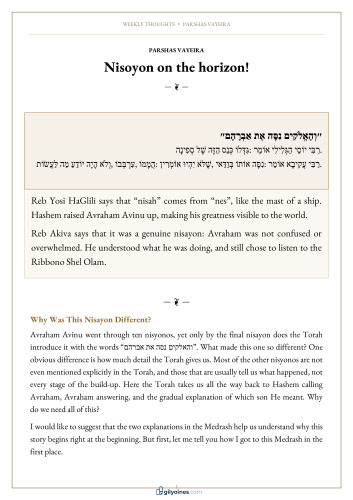
״וְ הָ אֱ ֹלקִ ים נִ סָ ה אֶ ת אַ ְב ָרהָ ם״
גִ ְדלֹו כְ נֵס הַ זֶׁה שֶׁ ל ְספִ ינָה: רבִ י יֹוסֵ י הַ גְ לִ ילִ י אֹומֵ ר.ַ
וְ ל ֹא הָ יָה יֹודֵ ַע מַ ה ַלעֲׂשֹות, עִ ְרבְ בֹו, הֲמָ מֹו: אֹומ ִרין
ְ שֶׁ ל ֹא יִ הְ יּו, נִ סָ ה אֹותֹו בְ וַדַ אי: רבִ י עֲקִ יבָ א אֹומֵ ר.ַ
Reb Yosi HaGlili says that “nisah” comes from “nes”, like the mast of a ship.
Hashem raised Avraham Avinu up, making his greatness visible to the world.
Reb Akiva says that it was a genuine nisayon: Avraham was not confused or
overwhelmed. He understood what he was doing, and still chose to listen to the
Ribbono Shel Olam.
—❦—
Why Was This Nisayon Different?
Avraham Avinu went through ten nisyonos, yet only by the final nisayon does the Torah
introduce it with the words “”והאלקים נסה את אברהם. What made this one so different? One
obvious difference is how much detail the Torah gives us. Most of the other nisyonos are not
even mentioned explicitly in the Torah, and those that are usually tell us what happened, not
every stage of the build-up. Here the Torah takes us all the way back to Hashem calling
Avraham, Avraham answering, and the gradual explanation of which son He meant. Why
do we need all of this?
I would like to suggest that the two explanations in the Medrash help us understand why this
story begins right at the beginning. But first, let me tell you how I got to this Medrash in the
first place.
1
WEEKLY THOUGHTS • PARSHAS VAYEIRA
A Message on Monday Evening
On Monday evening I received a message from one of my previous talmidim. “Have you
written this week’s piece yet?” Obviously, I answered no. It was only Monday! He suggested
that I look up the Medrash on “”והאלקים נסה את אברהם, as the Torah was discussing nisyonos
and he was sure I would find something interesting.
So I looked it up, and yes, it caught my attention. Even though the other five messages he
sent me that day had been ignored, this one actually got an answer! I thought I would use
this week’s piece to answer a few of his questions, without spelling them all out.
What Changed at the Akeidah?
The ten nisyonos built up to the moment when Hashem told Avraham, “ כי עתה ידעתי כי ירא
”אלקים אתה. Many meforshim ask what “”עתה, now, means. Did Hashem not know before
this how devoted Avraham was? Something about this nisayon became such an
extraordinary symbol of strength that until today we mention the zechus of Akeidas
Yitzchok when blowing the shofar and asking Hashem for rachamim.
Even the Arabs recognise the significance of this event. About eight years ago I visited the
British Museum, and there was an exhibition connected with an Arab religious figure.
Excuse me for not remembering his name! Among the exhibits I saw with my own eyes was a
gold model depicting what they called Akeidas Yishmael. The ram was caught in thorns, and
Yishmael was on the mizbeiach. Putting aside the rather obvious disagreement about who
was actually there, why is it specifically this nisayon that became so prominent that another
religion has its own version of the story? They did not adopt Avraham’s other nine nisyonos
in the same way. Why does this one stand out like the mast of a ship?
Rashi, on “”כי עתה ידעתי, explains: “ מעתה יש לי מה להשיב לשטן ולאומות התמהים מה היא חבתי
יש לי פתחון פה עכשיו שרואים כי ירא אלקים אתה, אצלך.” Hashem was saying that now He had an
answer to those who questioned why Avraham was so beloved. The whole world could see
his devotion. The Akeidah was not only a private step in Avraham’s avodas Hashem. It was a
moment that would make his greatness known to the world, and we as his descendants
continue to mention that zechus.
2
WEEKLY THOUGHTS • PARSHAS VAYEIRA
Could Knowing the Outcome Make It Easier?
But this creates a problem. If the purpose was for everyone to see just how devoted Avraham
was, the decision had to be a real one. Suppose Avraham understood how much depended
on it: what it could mean for his descendants, how it would be remembered for generations,
and the strength of the example it would set. Would that knowledge not make the nisayon
easier? Sometimes the weight of the outcome is itself such a powerful push that the other
option seems almost impossible.
Imagine the police chasing someone at high speed. Every extra minute he manages to get
away can make it harder for him to give up, because he has already invested so much in
escaping. I doubt that argument would get him very far in court, but you get the point!
Sometimes knowing how much is at stake almost blinds us to the option of turning around.
Could somebody claim that the greatness of the outcome made Avraham’s choice less of a
choice?
Perhaps this is why Reb Akiva insists “”נסה אותו בודאי. It was a true nisayon. Avraham was
not rushed, confused or carried along without knowing what he was doing. Whatever he
could understand about its meaning, he still had to make a genuine decision. Knowing why
the right choice matters does not automatically remove the struggle of making it.
Why a Ship’s Mast?
Now let us return to Reb Yosi HaGlili. Why compare this to the mast of a ship? Plenty of
things are tall. A mountain, for example. Yet something rather fascinating happens when
you climb a mast. Standing on the deck, your view is limited by the horizon. From roughly
two metres above sea level, the horizon is about three nautical miles away. From seven metres
above sea level it is about five and a half nautical miles away. Nothing about the sea has
changed, but the higher you climb the further you can see.
Avraham had already climbed through nine nisyonos. Each one had raised him higher. By
the time of the Akeidah he was looking at the world from a different vantage point. Perhaps
things that once seemed impossible were now much clearer to him. Yet Reb Akiva tells us
that even at this height it remained “”נסה אותו בוודאי. He still had to choose. Having greater
clarity does not mean there is no longer any nisayon.
The Bochur Who Wanted Me to Convince Him
Let me go back to the bochur who suggested this Medrash. He once sent me a message —
and please do not turn red if you are reading this in public, because nobody knows who you
3
WEEKLY THOUGHTS • PARSHAS VAYEIRA
are! He wanted to stop doing something he felt was wrong. I asked him whether he actually
wanted to stop. He said he was not sure, and wanted me to convince him.
I told him that I have more or less given up making decisions for teenagers. Not because I do
not care. Quite the opposite. If a decision does not come from somewhere deep inside the
person, it rarely lasts. I can explain, inspire, or try to give the most powerful vort. I can help
someone understand what is at stake and see further ahead. But none of that takes away the
actual crunch of the nisayon. I can help you want to fight. I cannot do the fighting for you.
And this is perhaps where both explanations of the Medrash come together. Reb Yosi
HaGlili is telling us about climbing higher and gaining a clearer view. Reb Akiva reminds us
that even from that height a nisayon remains a real choice. You can have all the clarity in the
world and still find the right decision difficult. That does not mean the clarity failed. It
means you are facing a nisayon.
You Still Have to Sail the Ship
A ship’s mast is not only there to give someone a better view. It supports the sails that allow
the ship to use the wind. The same wind that places pressure on the mast can be the force
that propels the ship forward, provided the sails are set properly. The storm has not
disappeared. The sailor has learnt how to work through it.
That is what I would like to tell the bochur who sent me that message, and any other bochur
facing a difficult nisayon. Perhaps from where I stand I can see beyond part of the teenage
storm that seems endless to you. I can tell you that there is life beyond it, and that what feels
overpowering today will not necessarily always feel like that. But you are still the one
standing on the ship, and you still have to choose what to do with the sails.
The goal is not to reach a point where we never face another nisayon. The goal is to keep
climbing higher, so that things which once seemed impossible become clearer and new
challenges can be seen on the horizon. Keep fighting, keep climbing, and keep your sails
firmly attached to your mast. The very storm that seems to be holding you back could
become the wind that carries you forward.
And perhaps that is what a nisayon really is: not only something that tests how high you have
climbed, but something that can lift you higher still.
—❦—
4