
Horeini - English — Chayei Sara (2026-11-02)
Parashas Chayei Sarah, 5787 לעילוי נשמת מנחם מנדל בן יהושע דב בס”ד
Weekly Torah forum
to deepen halachic
and ideological
knowledge and
to strengthen the
mitzvah of kibbud
Issue no. 149 av va’eim
Dibros
Kodshecha
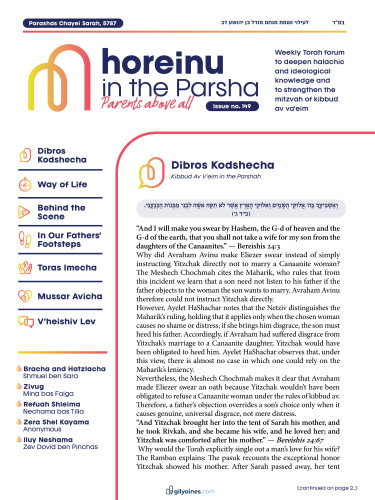
Dibros Kodshecha
Kibbud Av V’eim in the Parshah
Way of Life
.אֹלוֵקי ָהָָאֶָרֶ ץ ֲֲא ֶׁׁשר ֹלא ִִת ַּּקח ִִא ָּׁׁשה ִלִ ְְבִנִ י ִִמ ְּּבנֹות ַַה ְּּכַנַ ֲֲעִנִ י
ֵ ֵֹלוֵקי ַַה ָּׁׁש ַַמִיִ ם ֵו
ֵ יֲעָך ַּבּה’ ֱֱא
ֲ ְּוְַאְׁשִּׁב
ַ
Behind the
)’(כ”ד ג
Scene
“And I will make you swear by Hashem, the G-d of heaven and the
In Our Fathers’ G-d of the earth, that you shall not take a wife for my son from the
Footsteps daughters of the Canaanites.” — Bereishis 24:3
Why did Avraham Avinu make Eliezer swear instead of simply
instructing Yitzchak directly not to marry a Canaanite woman?
Toras Imecha
The Meshech Chochmah cites the Maharik, who rules that from
this incident we learn that a son need not listen to his father if the
father objects to the woman the son wants to marry. Avraham Avinu
Mussar Avicha therefore could not instruct Yitzchak directly.
However, Ayelet HaShachar notes that the Netziv distinguishes the
Maharik’s ruling, holding that it applies only when the chosen woman
V’heishiv Lev causes no shame or distress; if she brings him disgrace, the son must
heed his father. Accordingly, if Avraham had suffered disgrace from
Yitzchak’s marriage to a Canaanite daughter, Yitzchak would have
been obligated to heed him. Ayelet HaShachar observes that, under
this view, there is almost no case in which one could rely on the
Bracha and Hatzlacha Maharik’s leniency.
Shmuel ben Sara Nevertheless, the Meshech Chochmah makes it clear that Avraham
Zivug made Eliezer swear an oath because Yitzchak wouldn’t have been
Mina bas Faiga obligated to refuse a Canaanite woman under the rules of kibbud av.
Refuah Shleima Therefore, a father’s objection overrides a son’s choice only when it
Nechama bas Tilla causes genuine, universal disgrace, not mere distress.
Zera Shel Kayama “And Yitzchak brought her into the tent of Sarah his mother, and
Anonymous he took Rivkah, and she became his wife, and he loved her; and
Iluy Neshama Yitzchak was comforted after his mother.” — Bereishis 24:67
Zev Dovid ben Pinchas Why would the Torah explicitly single out a man’s love for his wife?
The Ramban explains: The pasuk recounts the exceptional honor
Yitzchak showed his mother. After Sarah passed away, her tent
(continued on page 2..)
remained standing, with the understanding that no loved her, and Yitzchak was comforted”: it alludes
other woman was allowed to enter the esteemed to the deep, lingering grief he felt for his mother, a
matriarch’s domain. When Yitzchak saw Rivkah, sorrow from which he could find no solace—until
he brought her directly into that tent, an act of he found comfort in his wife through his love for
profound respect for his mother, and married her her.
there. This is the true meaning of the words, “and he
Just as it is the duty of every Jew to learn the halachos applicable to
Way of Life everyday life, from berachos and Shabbos to shemiras halashon, so
is he obligated to learn and review the laws of kibbud av va’eim, a
Kibbud Av Va’eim in
constant and very serious mitzvah. Neglecting this study is liable to
Halachah and Minhag lead the person to unwittingly violate many halachos.
Based on the sefer Vayevarech David, by the illustrious Rabbi Yisrael David Harfenes, moreh
tzedek and rabbi of the Yisrael VeHazmanim Synagogue and Community, Williamsburg
Sitting in One’s Parents’ Place When They Are father’s place. One of those present whispered, “
Absent — Part II
honors him in his lifetime and honors him after
A father often buys a seat for his son right next to his his passing,” questioning whether R. Chaim was
own; therefore, it’s commendable for a son to sit beside allowed to sit in his father’s chair. Upon hearing
his father in the shul. Fathers feel true nachas when this, R’ Chaim immediately responded with the
their sons stand right beside them during davening. pasuk: “ — ”ושלמה ישב על כסא דודAnd Shlomo sat
When a father is in mourning and temporarily upon the throne of David — proving that this
changes his place in shul for that year, the son constitutes honoring one’s father. The questioner
may not sit in his father’s usual seat during that further asked whether this is also permitted in a
time. Even though the father is currently sitting shul—for example, whether a rabbi’s son or a Rosh
elsewhere, the seat remains his designated place. yeshivah may sit in his father’s place. Rabbi Chaim
A son may sit in his father’s designated chair when Kanievsky replied that even in shul, it’s an honor
it’s for the father’s benefit—for example, to ensure to fill his father’s place after his passing.
no one else takes the seat or to help manage his A father’s designated place isn’t limited to his own
father’s affairs in his absence. Whenever possible, home; it also includes any other home where he
it’s preferable to reserve the father’s seat by placing regularly eats, such as his grandfather’s home.
an object on the chair, such as a coat or hat. If a Wherever a father or mother has a fixed seat, a child
father gives a shiur in a yeshivah and his son is is forbidden to sit there.
called upon to teach in his place, the son may not sit
in his father’s seat. Instead, he should sit elsewhere
or move the table and chair slightly to the side.
The prohibition against sitting in a place designated In a letter to his sons, the Tur writes that
for one’s father or mother applies only during their the mitzvah of parental honor requires one
lifetime; after their passing, it is permitted. The “ — ”להיות מזומן לכל מצוותוto always be ready to
sefer Derech Sichah (Vol. I, p. 282) reports that fulfill whatever his father instructs him to do.
when Rabbi Chaim Kanievsky sat shivah for his (Moriah journal, issue 262.)
father, the Steipler, people saw him sitting in his
Parashas Chayei Sarah, 5787 // Issue no.149 // pg 2
On a Personal Note
Honor, ’ללמוד ולכבדReflections written
with a heavy heart and deep concern
by a teacher who does the Horeinu
‘Learn and program with her class.
I teach seventh-graders, and at the start of the school year,
we began implementing the “Learn and Honor, ”ללמוד ולכבד
program. The program is exceptional. It features everyday
dilemmas, halachic nuances we had never considered, and
deeply moving stories. The students were fascinated—all of
them, except for one!
She is a very nice girl and, in many respects, one of the class’s
top students. Yet when I started the program, she would disrupt
class, talk, distract everyone, or argue with every word. I couldn’t
fathom what was going on. Why was this otherwise excellent Behind the Scene
student acting out like that?
After a few weeks of this behavior, I took a moment to speak A maamar Chazal or
with her alone. After much hesitation, she finally opened up halachah related to
kibbud av va’eim is
and told me that her parents had been estranged from her
concealed in the picture. Send in
grandparents for many years.
the solution, and you’ll be entered
“How am I supposed to learn to honor my parents?” she asked,
to win a prize!
her voice trembling with pain. “When I know that if these
halachos are true, it means my parents have it all wrong? I don’t
want to hear about it. I don’t want to hear that they transgress Email solutions to: Riddle@horeinu.org
halacha. As far as I’m concerned, kibbud av va’eim just doesn’t
apply in real life.”
I validated her feelings and acknowledged that this is a very
difficult situation to be in—at any age! I then explained that
“Kibbud Av Va’eim” is a direct mitzvah from the Torah—one
of the —עשרת הדברותwith its own halachos that everyone must
learn, just as with the halachos of Shabbos, Brachos, and
Kashrus. It is inappropriate—and contrary to halacha—for a
child to judge his parents.
I then asked her a simple question: If a parent makes a mistake,
does that mean the child is exempt from the mitzvah of Kibbud Solution to Behind the Scenes –
The prohibition against contradicting one’s father
av va’eim? Does that mean one doesn’t have to honor them? As does not extend to discussing questions and answers
with him to reach a practical halachic conclusion.
long as parents aren’t telling their child to transgress halacha, the (Pischei Teshuvah)
child is obligated to honor them. I emphasized that her personal
obligation of kibbud av va’eim is completely independent of how Winners win be informed by email.
her parents handle their relationship with the grandparents.
My heart aches for this child and for all those parents who,
without realizing it, convey to their children that the mitzvah
of kibbud av va’eim is negotiable.
Dear parents, pause for a moment and consider: Where does
this lead? How will your children treat you when they grow up?
You are their role model! It is never too late to change direction.
Please step back and reflect while there is still time.
To share your story, email:
office@horeinu.org
’ תנחומא האזינו סי’ ד.2 ירושלמי חגיגה פ”ב ה”א.1
Parashas Chayei Sarah, 5787 // Issue no.149 // pg 3
In Our Fathers’
Footsteps
True Stories of Kibbud Horim
“We Do What Mother Wants” permitted to travel without concern. Yet once
When the father of the family—a very respected again, he repeated the refrain that had guided
and beloved man—passed away, the children him throughout his life: “We do what Mommy
gathered at their parents’ home to sit shivah. wants.” He canceled the trip, and they remained
When the days of mourning ended and the house in Eretz Yisrael.
grew unaccustomedly quiet, the siblings decided In Mumbai, on Rosh Chodesh Kislev 5769, the
their widowed mother should not spend Shabbos very day on which his meeting was meant to take
alone. They set up a rotation: each week, a different place, the devastating terrorist attack shook the
family would come to stay with their mother, world.
bringing her joy and filling the home once more One Never Loses Out by Honoring
with the voices of children and grandchildren. One’s Father
This arrangement continued for years. As time A Jewish man in the United States lost the work
passed, the logistical challenges grew. Organizing phone his employer had provided. Management
an entire Shabbos was complicated and time- viewed the loss as a serious breach and issued
consuming. It meant packing clothes for every an ultimatum: find it within six hours or be
family member, preparing and transporting food, fired immediately. For more than five hours, he
riding crowded buses with suitcases and small searched every conceivable place and pursued
children, and then making the journey back home. every possible avenue to locate the device, but to
As time went on, the siblings grew exhausted. no avail. With only ten minutes left, his personal
They came up with an idea. Why not reverse the phone suddenly rang. The screen displayed a
arrangement? Instead of the entire family traveling single word: “Abba.”
each week, she could rotate as a guest in a different It was an immense test. It would have been so easy
child’s home each Shabbos. It would be easier and to ignore the call and call his father back later. He
more convenient for everyone and give her a nice knew his father would understand he was busy. But
change of scenery. he answered right away, even amid the pressure
Most families would have embraced the idea and panic. He was astonished by what his father
without a second thought. But one of the sons told him: they had found the phone! The person
disagreed. He was determined: “We will not base who found it scrolled through the contacts, tapped
our decision on what is convenient for us. We will “Abba,” and called him. Just imagine what would
do what our Mother wants, not what we want.” have happened if he had delayed answering. You
They turned to their mother and asked her. She truly never lose by honoring your father. (Maagal
gently asked them to keep coming to her—and Shel Kavod)
to be in her own home, within its familiar walls,
on Shabbos, when it comes alive. To this day, the
children continue to go to her. Get Horeinu
That same son, who had stood firm then, was later Delivered to
tested by the very principle he had established. Your Inbox!
He earned his livelihood through Torah-related
work. One day, he and his wife were offered a trip Horeinu’s weekly newsletter is
to Mumbai. The opportunity seemed worthwhile, available by email in English,
and all the arrangements were already in place. Hebrew, and Yiddish.
But when he told his mother, he saw she was
To join our mailing list
uncomfortable with the idea and preferred that
email: Office @horeinu.org
he not go. From a halachic standpoint, there (Please specify English, Hebrew or Yiddish).
was no prohibition whatsoever, and he was fully
Parashas Chayei Sarah, 5787 // Issue no.149 // pg 4
V’heishiv Lev
Questions and Answers from the
Desk of Rabbanim and Therapists
?
Is it permissible to ask one’s parents for it myself.”
assistance with household needs? For Such requests are permitted but require even
example, you are cleaning up, and the greater sensitivity and respect.
kitchen garbage is overflowing. Your mother The third category involves tasks that require
is heading out. May you ask her to take out heavy exertion or are beneath a parent’s dignity.
the garbage? Or, if you are making supper and This includes chores requiring significant
realize you are missing ingredients, may you physical effort, such as lifting heavy items,
ask your mother to go to the grocery store while shoveling snow, or preparing substantial meals,
she is out? In other words: are we permitted to as well as degrading tasks like taking out the
ask for things that serve the general household garbage. It makes no difference whether the
needs, as opposed to our own personal needs? task benefits the whole household or just the
What about asking for things for our personal individual child, such as cleaning or taking
needs? out the trash. Even if a mother is already in
the middle of a thorough house cleaning, it’s
prohibited to ask, “If you don’t mind, could you
>
This topic breaks down into three clean the sink in the room as well?”
categories: It is strictly prohibited to ask a parent to
The first category involves tasks that are perform tasks that diminish their dignity or
simple, effortless, and genuinely enjoyable for that are physically or emotionally hard for
parents to do for their children. For instance, them.
if one’s mother is already at the store, one may Imagine you lived door-to-door with a
respectfully ask her to pick something up. prominent Rav, your boss or your principal—
“Mommy, since you’re already at the grocery and you saw him leaving the house. Would
store, would you mind grabbing a bar of dark you ask him to take out the garbage? This is
chocolate? I was planning to bake a cake for the guiding principle articulated by the Chayei
the family.” If everyone is at the table, one may Adam: “
say, “Mommy, could you please pass the salad?” ‘ — ”יהיו בעיניכם כנכבדי ארץLet them be regarded
phrased respectfully rather than as a blunt in your eyes as the dignitaries of the land ‘ .
command. This is permitted lechatchilah. This is a fundamental rule: The way you
The second category involves tasks a parent approach a public figure for a favor sets the
expects the child to request but that require standard for what you may ask of your parents.
more effort. For example, if you don’t have an
ironed shirt for tomorrow and your mother is
already ironing, you can gently ask if she would
mind including your shirt as well. Your mother Have a question? Need guidance?
would much rather iron it now than discover Horeinu’s Rabbanim and advisers
in the morning that you are left without an are here to help.
ironed shirt. “If you don’t mind ironing this Contact us at office@horeinu.org.
shirt as well, it would be a tremendous help, Confidentiality guaranteed.
and I would really appreciate it. But if it’s too
much right now, please don’t worry—I will do
Parashas Chayei Sarah, 5787 // Issue no.149 // pg 5
written by Y. Binyamin
Mendy shares a story about Tatty and Mommy
and the mitzvah of kibbud av va’eim
My Shalom Zachar Test
One of my favorite things about winter is the long We also review Mishnayos and Halacha, and Abba
Friday nights. In the summer, by the time we get is always happy when I know the material well. Of
home from shul, make Kiddush, eat our Shabbos course, I like getting good marks on my tests in
Seuda, and sing zemiros, it’s already super late. But cheder tests—especially when they’re so good that
in the winter? We’re done eating by eight o’clock! I can show off at home without explaining that
In our family, we have a special schedule on the test was very hard or that the one question I
winter Friday nights. missed was taught when
Abba, Roni, and I go to I was exhausted from a
shul to learn for at least wedding the week before.
an hour, and afterward we Obviously, it’s never
make the rounds to a few my fault! But there’s
Shalom Zachars in the something even better
neighborhood. I love this than a high mark.
routine so much. We always Sometimes, as I explain
sit in the same place in a Gemara, I see Abba’s
shul, open our Gemaras, eyes light up. He smiles,
and I review with Abba asks another question,
what we learned that week and if I answer it correctly,
in Cheder. Sometimes he says, “Very nice, Mendi.
Abba asks me a hard It’s a real nachas to
question; sometimes I learn with you.” In those
explain the sugya to Abba; moments, I feel like I just
and sometimes I find that got a 120 on a test!
what seemed totally clear Once, when I was already
to me in class gets a little in bed, I heard Abba tell
confusing. Ima how beautifully I
when Abba asks me to explain it in my own words had learned with him and how I was beginning to
It’s actually pretty funny. In cheder, I can just say, understand the sugyos really well. I think he spoke
“I understood,” and move on. But with Abba? If I quietly so I wouldn’t start thinking too highly of
say, “I understood,” he immediately wants me to myself, but it didn’t matter—I heard every single
explain what I understood. Apparently, fathers don’t word!
just take your word for it. After learning comes the second part of the
(continued on page 7..)
Parashas Chayei Sarah, 5787 // Issue no.149 // pg 6
evening: going to the shalom zachars. Many When we walk into a neighbor’s house, I’m not
babies are being born in our neighborhood, just Mendi anymore; I’m Abba’s son. People know
bs”d. Sometimes there’s one, sometimes two, him and respect him. If I shove past the grown-
and once we even had three shalom zachars on ups, grab snacks, or stuff my pockets like I’m
one Shabbos! Granted, two of them were in the stocking up for a long trip, it doesn’t exactly make
same building, so it wasn’t exactly an exhausting him look good.
journey, but still, having three shalom zachars is I’m not saying it’s always easy for me. Sometimes
very special! Ima says that’s because there are a there are special cookies, and just as I approach
lot of young couples in our neighborhood. the table to take one, an adult stands nearby and
For anyone who doesn’t know, a whole bunch of starts talking. Some people can carry on an entire
yummy stuff is served at a shalom zachar, like conversation beside a plate of cookies without
candies, cake, and soda. I’m not saying that’s touching them. That’s a level I haven’t reached
why we go—chas v’shalom. We go to celebrate yet. But I try. I wish the baal simcha a mazel tov,
the birth of a baby boy with their family. But once speak politely, and try not to do anything that
we’re already there celebrating, there’s no reason would make Abba wish he’d come alone.
to neglect the chocolate-covered peanuts in their Honoring your father means giving him
bowl. At first, I thought my main responsibility nachas and definitely not causing him pain
at a shalom zachar was to taste everything on or embarrassment. I can give him nachas by
the table. But after a while, I realized I had an knowing my Gemara, make Abba proud, and do
even more important job: not embarrassing Abba. the right thing, even when nobody is watching.
MAKE THIS ZCHUS YOURS!
Partner with us to bring the message of Kibbud Av Va’eim into more homes.
Quickpay/zelle
Email us Donate via our website dedications@horeinu.org.
at newsletter@horeinu.org pay.banquest.com/horeinu Specify “Weekly Newsletter” in the memo.
To receive the weekly newsletter in your inbox, please email *newsletter@horeinu.org
with “Add me” in the subject line.
Created by the Worldwide Horeinu organization. Our goal is to spread
awareness and help Klal Yisroel strengthen the mitzvah of kibbud av va’eim
with the guidance of gedolei Yisroel Registered organization #580780617
We welcome your feedback and personal stories to inspire others. Email newsletter@horeinu.
org to sponsor an issue in memory or in honor of a loved one, or for a zechus for children,
shidduchim, refuah shleimah, and hatzlachah.
www.horeinu.com / REQUIRES GENIZAH /