
The Maharsham Project - English — Chayei Sara (2026-11-02)
W E E K LY T E S H U VA H I N S I G H T S F R O M T H E M A H A R S H A M O F B R E Z H A N
THE
MAHARSHAM שו״ת מהרש״ם
P R O J E C T
Issue No. 33 · Parashas Chayei Sarah 5787 · Shu"t Maharsham III:357
The Whole Tanach on a Watch Chain
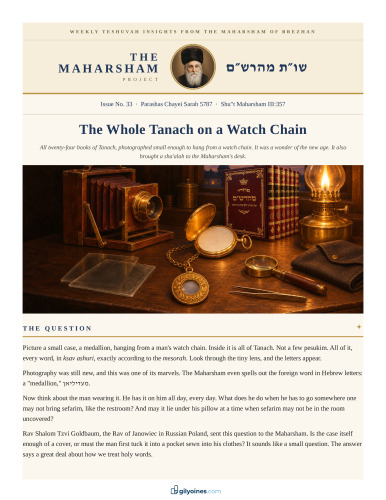
All twenty-four books of Tanach, photographed small enough to hang from a watch chain. It was a wonder of the new age. It also
brought a sha'alah to the Maharsham's desk.
THE QUESTION ✦
Picture a small case, a medallion, hanging from a man's watch chain. Inside it is all of Tanach. Not a few pesukim. All of it,
every word, in ksav ashuri, exactly according to the mesorah. Look through the tiny lens, and the letters appear.
Photography was still new, and this was one of its marvels. The Maharsham even spells out the foreign word in Hebrew letters:
a "medallion," מעדיליאן.
Now think about the man wearing it. He has it on him all day, every day. What does he do when he has to go somewhere one
may not bring sefarim, like the restroom? And may it lie under his pillow at a time when sefarim may not be in the room
uncovered?
Rav Shalom Tzvi Goldbaum, the Rav of Janowiec in Russian Poland, sent this question to the Maharsham. Is the case itself
enough of a cover, or must the man first tuck it into a pocket sewn into his clothes? It sounds like a small question. The answer
says a great deal about how we treat holy words.
A TANACH YOU READ THROUGH A LENS
Tiny photographs were new in the Maharsham's lifetime. John Benjamin Dancer, in England, made the
first microphotographs in 1851, but you needed a microscope to see them. In 1857 René Dagron, in
France, mounted them on a small, powerful lens. His "photomicroscopic jewelry" was a hit: by 1862,
his workshop was turning out twelve thousand pieces a day. The medallion in this letter was the same
idea, put to work for a sefer.
The Maharsham is referring to something
like this: the opening of Bereishis, seen
through a tiny lens. (Hashem's Name is
blurred here.)
T H E M A H A R S H A M ' S A N A LY S I S ✦
Two things have to be settled. First, does the case really cover the words? Second, do words made by a camera, not written
by hand, deserve the same respect? Keep your eye on the second question.
1. A Rav's Hat, and a Sefer in His Pocket
The Maharsham opens with a story about the Radbaz. Someone once asked the Radbaz whether you may walk into a restroom
with papers of divrei Torah on you. He answered from his own life: "I have done this myself, in practice."
Sometimes people would stop him in the street and hand him a written sha'alah. He'd tuck it into his hat and keep walking,
restroom included. "And I am not concerned about it," he wrote. He also carried a small sefer in his pocket at all times, with
hints to the 613 mitzvos, so it would be ready the moment he came out. That went in with him too.
His reasoning was simple. Even tefillin may be brought into a restroom, as long as they're wrapped in a garment and held in
your hand. Other sefarim are less holy than tefillin. So they can surely come in, and a pocket wraps them well.
But the Radbaz drew a line for himself. In principle, he said, even sefarim in ksav ashuri would be fine. In practice, he only did
it with writing in other languages.
Other poskim want more. The Tashbetz says that tefillin and papers with Hashem's Names need a kis b'soch kis, and people
used to buy leather cases for exactly this.
So a pocket can work, at least by the Radbaz. How many layers you need is another matter. And the medallion doesn't fit
neatly into either picture.
2. A Cover You Can See Through
The medallion is a closed case with a glass face. The words are shut in tight, yet anyone can look through the lens and read
them. So are they covered or not?
Rav Goldbaum had looked for an answer in the laws of tumah under one roof. It sounds a world away from a watch chain, but
a Mishnah there deals with a related question: does glass block?
The Mishnah (Ohalos 6:5) speaks of something tamei lodged between the ceiling beams, with a layer as thin as a garlic peel
underneath it. If it "can be seen" from inside, the house is tamei. The Rambam says "seen" means the layer is see-through, like
glass. So in that halacha, glass does not separate. The Kesef Mishneh reads the Mishnah differently, and by his reading, glass
does separate.
What does that mean for sefarim? By the Kesef Mishneh, the glass face would count as a cover. By the Rambam, it may not,
even though glass is enough to let you say Shema facing filth behind it (Berachos 25b). The Maharsham leaves it open: "The
matter still needs further study," he writes. So he won't rely on the Kesef Mishneh's reading to permit it.
3. Who Wrote These Letters?
Now the second question. All of this, the Maharsham points out, is about sefarim written by hand. No one ever wrote the
letters of this copy. A camera made them.
Start with printing. The Rokeach says outright that printing isn't "writing" (though on Shabbos it is still forbidden). But the
Rambam, in a teshuvah, forbade bringing letters embroidered into cloth, the parshah of tzitzis, into a restroom. Nobody wrote
those with a pen either. It was still disrespect. So whether print counts as "writing" is one question. Whether you may treat the
words with disrespect is a different one. And on that, the Maharsham suggests, even the Rokeach would likely agree: not in a
place like that.
A photograph goes a step further. Nobody forms the letters, not even with a press. The Maharsham describes the whole
process. A glass plate, coated with something like a skin of gelatin and kept out of the sun, faces the page through lenses and a
folding bellows. A few minutes in the sunlight, a bath of chemicals, and the image is on the glass. From there it's copied onto
coated paper, by the hundreds and the thousands.
So one could argue, he says, that a photograph isn't a person's act at all. The halacha calls this koach kocho: the person only
started it, and something else did the work. The Maharsham compares it to something a monkey did, and cites the Gemara
(Menachos 7a), where something that falls back into a vessel by itself counts as if a monkey put it there. It isn't counted as the
person's doing. All the more so, the Maharsham adds, if a non-Jew made it.
Then the Maharsham says it makes no difference. Grant every one of those points, he says. These are still the words of Tanach,
and you still may not treat them with disrespect.
ומ"מ אין להקל דאכתי איכא בזיון כתבי קדש
"Even so, we may not permit it, because there is still disrespect to holy writings." (the Maharsham's words)
4. Back to the Watch Chain
One thing works in the medallion's favor. The Tanach is already inside a case, with only one side showing, through glass. On
that alone, there'd be room to permit it. But the Rambam's reading of the Mishnah suggests glass doesn't separate. With that
still open, the Maharsham won't rely on the case by itself.
THE P'SAK
The medallion alone isn't enough. Before he takes it into a restroom, or keeps it under his pillow at such a time, he must
put it into a pocket of his clothing, or something like it.
A SECOND QUESTION IN THE SAME LETTER
Rav Goldbaum also asked a kitchen question. A liver is so full of blood that salting can't draw it all out, so it's roasted over a fire, and the blood
drips away. Rav Goldbaum knew the later poskim's discussion of roasting liver on paper, but he wasn't sure about burning straw.
The Maharsham permits it. You may salt meat on straw, since the blood drains through it the way it drains through a vessel with holes (Yoreh
De'ah 69:16), so you may surely roast a liver on it. The straw burns out under the liver right away, and the fire around it and the heat of the oven
finish the roasting. Either way, the blood has room to drain. Is a straw fire a real fire? If you see the liver is roasted, it worked. Even a parah
adumah burned with straw is kosher (Parah 4:3).
ABOUT THE QUESTIONER
Rav Shalom Tzvi Goldbaum was the author of the sefer Birkas Shalom. A postcard he wrote in 1900, sold at auction in 2022, shows him as Av
Beis Din of Glusk, near Lublin, writing in a tiny, beautiful hand. In it he asks the historian Shaul Pinchas Rabinowitz to send him his book on the
life of the Yaavetz, because, he writes, he is related to him. He also wrote to the Maharsham about watch chains another time (III:369): may a man
go out on Shabbos, where there's no eruv, wearing a watch on a gold or silver chain?
W H Y I T M AT T E R S ✦
A brand-new invention reaches a rav in a small town. The Maharsham takes it seriously. He lays out how a camera works,
plate by plate, and only then asks what the halacha actually cares about.
The answer he finds is worth holding on to. Whether something counts as "writing" is a technical question, and it can matter
for many things. Respect is a different question. The words of Tanach deserve it however they got onto the page: by quill, by
press, or by sunlight on a glass plate. A man who carries them carries Tanach.
KEY TERMS Tumah · טומאהRitual impurity; the tumah of a dead body can spread
through a house under one roof.
Ksav ashuri · כתב אשוריThe square Hebrew letters of a sefer Torah,
tefillin and mezuzos. Koach kocho · " כח כחוThe force of his force": a result a person sets in
motion, but that something else carries out.
COMING NEXT WEEK
The Rav Goes to the Pharmacy. Chicks hatched in a machine, said to live only about three months: are they
kosher? A non-Jew's butter factory to kasher, and the dye that makes butter look better. Oil shipped across the
ocean from America, and a chemist's word on what's inside it. Twice, the Maharsham turned to the pharmacist
himself before he answered.
SOURCES ✦
SOURCE W H AT I T S AY S W H AT I T D O E S H E R E
שו"ת רדב"ז ח"ג תקי"ג Papers in his hat and a small sefer in his pocket may go A pocket can be a covering.
into a restroom; in practice, only for other languages.
בשם,מלבושי יו"ט על הלבוש ס"מ Tefillin and papers with Hashem's Names need a kis Others want more than one cover.
תשב"ץ b'soch kis.
ה; כסף משנה:פיהמ"ש לרמב"ם אהלות ו Whether a see-through layer like glass separates. Is the medallion's glass a cover?
טומאת מת כ"ד; תוי"ט שם
ברכות כה ע"ב Shema may be said facing filth behind glass. Glass covers for that halacha (our reference; the
Maharsham states the rule without citing it).
רוקח ר"פ; אור זרוע תקס"ג Printing, and pressed or carved letters, aren't "writing." Maybe printed Tanach has less kedushah.
תשו' הרמב"ם (מג"א מ"ה סק"ב); גט Embroidered letters may not enter a restroom; printed Disrespect applies anyway.
פשוט קכ"ה סקט"ו letters have kedushah.
מנחות ז ע"א; עירובין לה ע"א A result that happens on its own, and indirect force. A photograph is barely a person's act.
ג:ט"ז; פרה ד:יו"ד ס"ט Salting meat on straw; the parah burned with straw. Roasting liver over straw is permitted.
SOURCE TEXT. Shu"t Maharsham, chelek III, siman 357, to Rav Shalom Tzvi Goldbaum, Av Beis Din of Janowiec in Russian Poland, author of Birkas
Shalom (as the heading of the letter names him). The letter is not dated. The 1900 postcard is Winners Auctions, Auction 133 Part II, item 470 (January
2022). The dates for Dancer and Dagron are from the Wikipedia article "Stanhope (optical bijou)," checked 4 Nov 2026.
W H O WA S T H E M A H A R S H A M ?
Rabbi Shalom Mordechai HaKohen Schwadron, ben HaRav Moshe (1835–1911), served as the Rav of Brezhan in Galicia for thirty
years, from 1881 until his passing. He is best known for his Shu"t Maharsham, thousands of teshuvos on every area of halachah, and
his Da'as Torah commentary on Shulchan Aruch. He was regarded as one of the foremost poskim of his generation, and his piskei
halachah are cited to this day.
R E C E I V E T H E M A H A R S H A M P R O J E C T E V E RY W E E K
Don't miss next week's issue. Scan the QR code or visit kechnia.org/maharsham, and get it free in your inbox every week.
This English adaptation with explanatory commentary is presented for Torah study and enrichment only. It is not intended as halachah l'maaseh. The translator has
made every effort to render the Maharsham's words faithfully, but this English adaptation may contain errors or imprecisions. For any practical halachic question,
consult your own Rav.
The Maharsham Project · kechnia.org/maharsham · · לעילוי נשמת הגה״ק רבי שלום מרדכי בן רבי משה הכהן זצללה״הinfo@kechnia.org