
Clarity for Teens - English — Chayei Sara (2026-11-02)
WEEKLY THOUGHTS • PARSHAS CHAYEI SARAH
PARSHAS CHAYEI SARAH
Reset or Recharge
— ❦ —
The Medrash
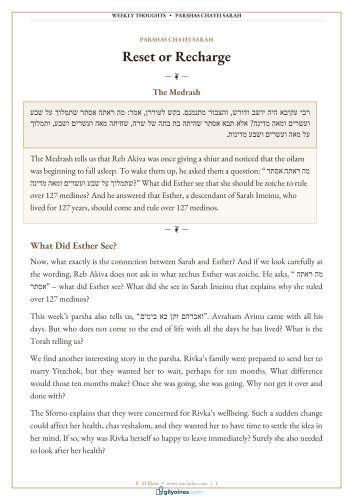
מה ראתה אסתר שתמלוך על שבע: אמר, בקש לעוררן. והצבור מתנמנם,רבי עקיבא היה יושב ודורש
ותמלוך, שחיתה מאה ועשרים ושבע,ועשרים ומאה מדינה? אלא תבא אסתר שהיתה בת בתה של שרה
.על מאה ועשרים ושבע מדינות
The Medrash tells us that Reb Akiva was once giving a shiur and noticed that the oilam
was beginning to fall asleep. To wake them up, he asked them a question: “ מה ראתה אסתר
”?שתמלוך על שבע ועשרים ומאה מדינהWhat did Esther see that she should be zoiche to rule
over 127 medinos? And he answered that Esther, a descendant of Sarah Imeinu, who
lived for 127 years, should come and rule over 127 medinos.
— ❦ —
What Did Esther See?
Now, what exactly is the connection between Sarah and Esther? And if we look carefully at
the wording, Reb Akiva does not ask in what zechus Esther was zoiche. He asks, “ מה ראתה
– ”אסתרwhat did Esther see? What did she see in Sarah Imeinu that explains why she ruled
over 127 medinos?
This week’s parsha also tells us, “”ואברהם זקן בא בימים. Avraham Avinu came with all his
days. But who does not come to the end of life with all the days he has lived? What is the
Torah telling us?
We find another interesting story in the parsha. Rivka’s family were prepared to send her to
marry Yitzchok, but they wanted her to wait, perhaps for ten months. What difference
would those ten months make? Once she was going, she was going. Why not get it over and
done with?
The Sforno explains that they were concerned for Rivka’s wellbeing. Such a sudden change
could affect her health, chas veshalom, and they wanted her to have time to settle the idea in
her mind. If so, why was Rivka herself so happy to leave immediately? Surely she also needed
to look after her health?
R’ M Klein • www.4uclarity.com | 1
WEEKLY THOUGHTS • PARSHAS CHAYEI SARAH
Twelve Years — and Another Twelve
We all know the story of Reb Akiva, who returned home after twelve years of learning. As he
approached his house, he heard someone making fun of his wife for being left alone for so
long. His wife replied that, as far as she was concerned, he could go and learn for another
twelve years. Reb Akiva turned around and went back. We often use this story to explain
why twelve years followed by another twelve years is not the same as 24 continuous years.
But there is something about this story that I could never understand. We are not speaking
about someone like us. We are speaking about Reb Akiva, a Tanna, on a level we cannot
even imagine. What was his plan, and what changed? If he had decided that he needed to
stop learning to visit his wife, why did hearing her say that he could go back suddenly change
that? If going home was the right thing to do, surely he should have gone in!
And just to point out, both stories are about Reb Akiva: the Medrash in which he wakes up
his talmidim, and the story in which he does not even enter his own house. Is there a
connection?
I would like to answer all these questions with a story.
The Fisherman Who Would Not Stop
There was once a fisherman who had a great ambition to cross the ocean in his little fishing
boat. The journey could take three months, but his boat had room for only two weeks’
worth of food. Being a very clever fisherman, he came up with a brilliant plan: he would fill
the boat with food, sail until it ran out, return home to stock up and then set out again. He
was quite pleased with himself.
When he shared his plan with his friends, they were less impressed. “You might spend three
months sailing,” they told him, “but most of that time you’ll be travelling backwards! Take a
bigger boat, carry enough food and actually get somewhere.” For once, our clever fisherman
listened. He bought a bigger boat, filled it with food and set off across the ocean.
A month into the journey, right in the middle of the sea, the engine stopped. He checked
everything he could think of, but the boat refused to move. Eventually, another boat came
along. Its captain took one look and discovered the problem: the fuel tank was empty. “Why
didn’t you stop to refuel?” he asked. The fisherman laughed. “What a foolish question! My
friends already explained that if I keep stopping, I’ll never get anywhere!”
R’ M Klein • www.4uclarity.com | 2
WEEKLY THOUGHTS • PARSHAS CHAYEI SARAH
Now, he sounds like an absolute fool, but he does have a point. His friends did tell him that
stopping and starting would get him nowhere. So why was he now being told to stop? The
answer is simple. There is a world of difference between going back to the beginning every
time and stopping along the way to refuel. One throws away the journey; the other makes it
possible to continue.
Stopping Without Starting Again
I don’t think we realise how often we are that fisherman, only instead of wearing fishermen’s
clothes, we wear a fancy suit.
Life is not supposed to be a collection of 43,800 separate days, or 1,051,200 separate hours,
but one journey of 120 years, iy”h. Each day should take us further towards our goal. That
only happens if today builds on yesterday. If every morning we start all over again, we are no
cleverer than our fisherman. But when a stop is needed in order to continue, it is not a
setback. We can carry on stronger and better than before.
The Mashgiach Reb Yeruchem once told his talmidim that if a person could really live for
just one month in his life, that would already be an enormous achievement. One month of
truly living with purpose, continuously building rather than beginning again each day.
Reb Akiva understood that he needed to go home for his wife’s sake. If that was what she
needed, then going home was not a break from his purpose at all. It was part of it, like
stopping to refuel. But as soon as he heard that she wanted him to continue learning, that
reason was no longer there. In the way I understand the story, entering merely to say hello
and goodbye would now interrupt the continuity he had worked so hard to build. He
wanted to stop only if the stop itself was part of the journey.
Sometimes we feel that we have fallen and are starting all over again. But if we learn
something from the fall, and use it to work out how to avoid falling again, we can turn the
experience into a lesson. Instead of letting it become a reset, we use it to refuel. That does not
make the fall right; it means we do not have to waste what we can learn from it.
A Stop at the Service Station
A good few years ago, just after passing my driving test, I needed to go to London for
Shabbos. I did not yet have a car, so I asked a friend if I could borrow his. He agreed
suspiciously quickly. Only later did I begin to understand why. We made it to London in
one piece, although “a smooth journey” would be a very generous description.
R’ M Klein • www.4uclarity.com | 3
WEEKLY THOUGHTS • PARSHAS CHAYEI SARAH
On Shabbos afternoon, a well-known mohel asked when I was travelling back. When I told
him it was that night, he asked whether I could give him a lift to Manchester for a bris the
following day. It meant squeezing my wife and our two-month-old baby into the small back
seat, but we said yes. Little did we know how much that decision would help us.
Halfway home, the baby needed feeding, so we stopped at a service station. It was the middle
of winter, around midnight. I went to the bathroom, came back and tried to start the car.
Nothing. The battery was dead. I called the friend who had lent it to me. “Oh yes,” he said,
“that happens all the time. That’s why I never really take it on long journeys.” Thank you
very much for sharing that vital piece of information now!
The car was getting freezing, we had a tiny baby, and I did not have AA cover. I had barely
had my driving licence long enough to get used to it. Boruch Hashem, the mohel had AA
Gold membership. He called, and they promised to come within two hours. Two hours
might not sound terrible in a warm house, but at midnight, with a freezing baby in a service-
station car park, it felt rather different.
Two minutes later, a nine-seater minivan pulled into the parking space right next to ours,
out of the whole car park. With bags piled up by the window and a Navcar sticker on the
vehicle, I had a feeling it belonged to a Yid. And sure enough, out stepped a Manchester Yid.
I asked why he had stopped. “The van kept telling me, ‘Take a break,’” he said, “so I got
worried and pulled into the nearest services.”
He had hired a seven-seater, but the rental company had given him a nine-seater, which
meant he had two spare seats. When he heard our situation, he offered to take my wife and
baby home. He also phoned the hire company to find out what was wrong with his van.
Nothing was wrong at all! After a certain amount of driving, the screen automatically
suggests that the driver take a break.
He thought he had stopped for no reason, a pointless interruption to his journey. But that
stop had given him the opportunity to help another Yid. What looked like a nuisance had
turned into something with a real purpose. And, just in case you are wondering, I am not
still sitting in that service station. AA came within the promised two hours – although, I
should add, it was not much less than two hours either.
R’ M Klein • www.4uclarity.com | 4
WEEKLY THOUGHTS • PARSHAS CHAYEI SARAH
There was another lesson there too: you give a lift to someone who needs it, and Hashem can
arrange for someone else to give a lift when you need it. But the point I want to bring out
here is about the stop itself. Sometimes life becomes a bit much and we need a break. We can
use that break in a way that loses our momentum, or we can use it to recharge and continue
the very same journey.
Back to the Medrash
Now let us return to the Medrash and all the questions we started with.
What did Esther see in Sarah Imeinu? She saw a person who lived 127 years as one complete
life, not merely 46,000-odd separate days. Every day had its place in the greater purpose of
her life. That is why the Torah says, “ – ”ויהיו חיי שרהthese were the years of Sarah’s life.
Esther understood that being queen of 127 medinos was not simply an honour or a position.
It was an opportunity with a purpose.
When Mordechai asked Esther to approach Achashverosh, she knew the danger and was
reluctant to go. Mordechai told her, “ – ”ומי יודע אם לעת כזאת הגעת למלכותwho knows
whether it was for this very moment that you came to royalty? In other words, perhaps all
the events that had brought her to the palace had been leading to this moment. If she missed
her tafkid now, what had the whole journey been for? She took the lesson from Sarah: do
not let the journey become disconnected pieces. Use the position you have reached for the
purpose for which you were brought there.
And why was it Reb Akiva who taught this Medrash? Perhaps because few people
understood the value of a continuous journey as deeply as he did. He began learning at forty
and reached extraordinary heights. He knew what it meant to have begun later, and he knew
what could be achieved when every year was allowed to build on the year before. This also
helps us understand why he did not enter his home after those first twelve years. He was not
refusing a necessary stop. He was protecting the continuity of the journey once he knew that
particular stop was not needed.
This also explains “”ואברהם זקן בא בימים. Of course everyone reaches old age with days
behind them. But not everyone comes with those days. Avraham Avinu brought his days
with him because they were not separate, wasted pieces of time. Each one had become part
of the life he had built.
R’ M Klein • www.4uclarity.com | 5
WEEKLY THOUGHTS • PARSHAS CHAYEI SARAH
And Rivka? Her family wanted her to wait so that she could adjust to the change. That
concern was understandable. But Rivka recognised what she was going towards: a life with
Yitzchok, away from the house of resha’im in which she had grown up. For her, waiting
unnecessarily would not be a useful stop to prepare for the next stage. It would simply delay
the beginning of that stage. She therefore chose to go straight away.
So when we think, “What difference will this one small deed make to my whole life?” the
answer is that it may make a very great difference indeed. A life is built by allowing one good
day to lead into the next, and one right decision to lead into another. We all need to stop
sometimes. The question is whether the stop helps us carry on or makes us lose the direction
we were travelling in.
The Clarity
Sarah’s 127 years, Esther’s 127 medinos, Avraham’s “”בא בימים, Rivka’s decision to leave
without delay and both stories of Reb Akiva are all pointing us towards the same yesod. Life
is not a series of separate days; it is one continuous journey. We should not start all over
again every morning, but build on what we achieved yesterday. And when we need a break,
the aim is not to abandon the journey but to recharge so that we can continue it. Even a
mistake can become a step forward if we recognise it as wrong, learn from it and try harder
next time. Every day and every small action can then become part of one fulfilling life.
With Hashem’s help, may we all be zoiche to use our days properly, to keep growing
throughout our lives, and to be zoiche to be mekabel Moshiach b’karov b’yomeinu.
—❦—
R’ M Klein • www.4uclarity.com | 6