
The Rebbe's Table - English - Rav Shmuel Zucker — Chayei Sara (2026-11-02)
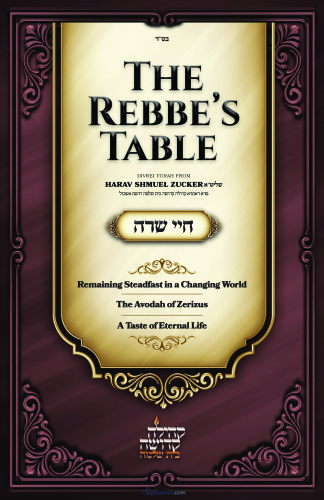
Remaining Steadfast in a Changing World
The Avodah of Zerizus
A Taste of Eternal Life
חודש חשון
thiS month’S SponSoR
Sponsored Anonymously
In Honor of the Rav shlita
שנת תשפ״ז- פרשת חיי שרה
this week’s sponsor
Sponsored Anonymously
dedicated to our dear rav for all that he does
SPONSORSHIPS
$1200 MONTHLY SPONSOR
$300 WEEKLY SPONSOR
To Sponsor:
Call: (513) 888-4172
Email: office@kehillakedosha.com
To listen to the Rav’s shiurim and read previous issues of the Rebbe’s Table, visit KehillaKedosha.com
© 5787/2026 The Rebbe's Table
To join our mailing list and receive a project of Kehilla Kedosha
this Divrei Torah pamphlet by email,
Join our
please email us at
office@kehillakedosha.com WhatsApp
community:
Chayei Sarah
Remaining Steadfast
in a Changing World
P arashas Chayei
Sarah begins with
the words “ויהיו חיי
שרה מאה שנה ועשרים
שנה ושבע שנים שני חיי שרה,” and
years be considered equal?
We find a similar expression
later in the parashah, when
the Torah describes Avraham
Rashi explains the seemingly Avinu with the words “ואברהם
unnecessary repetition of the — ”זקן בא בימיםAvraham was
word “ ”שנהwith the words “כולן old, advanced in days (Bereishis
— ”שוין לטובהall the years of 24:1). The mefarshim explain
Sarah Imeinu’s life were equally that ba bayamim means that
good. Avraham came with all his
days complete and intact. Yet
How can this be understood? Avraham, too, experienced
Sarah Imeinu lived through extraordinary difficulties and
many different periods and nisyonos throughout his life. In
circumstances, each presenting what sense, then, were all his
its own challenges and nisyonos. days complete?
The challenges of a hundred-
year-old woman are not those The sefarim explain that
of a twenty-year-old, and the Sarah Imeinu possessed the
challenges of a twenty-year-old extraordinary middah of השתוות.
are not those of a seven-year- This is the ability to remain
old. How, then, could all her steadfast and consistent in
3
Remaining Steadfast in a Changing World
one’s avodas Hashem, regardless circumstances of their lives.
of the circumstances one By remaining steadfast in
encounters. At every age and their avodas Hashem, they rose
stage of her life, through every above those circumstances and
change, Sarah remained the acquired the ability to influence
same Sarah. Nothing could push the world.
her off course. She followed a
straight and unwavering path, Remaining True in a
and therefore all her years were Changing World
equally good. Chazal refer to this world
as an עלמא דשיקרא, a world of
There is an even deeper falsehood, while Olam Haba
dimension to this middah. When is called עלמא דקשוט, a world
a person allows himself to be of truth. The fundamental
influenced by his surroundings, distinction between truth
those circumstances exercise and falsehood is that truth is
control over him. But when he consistent and unchanging,
remains steadfast, refusing to while falsehood is constantly
allow the changing conditions shifting. A person who speaks
around him to alter his essential the truth has no need to change
identity, the opposite becomes his story, whereas someone
true: he gains the ability to who lies must continually alter
influence his surroundings. his account to maintain the
Instead of being controlled by deception.
the circumstances, he becomes
capable of exercising control Indeed, the Mishnah refers to
over them. a water source that periodically
ceases to flow as “”מים המכזבים
This was the extraordinary — deceitful waters (Parah 8:9).
madreigah of Avraham and Even though the water may
Sarah. They did not merely flow for years at a time, its
withstand the different lack of consistency earns it the
4
Remaining Steadfast in a Changing World
description of falsehood. to the Olam HaEmes was
therefore “ — ”כולן שוין לטובהall
This is why our world is called her years were equally good.
alma d’shikra. The physical
world is constantly changing, It is noteworthy that
from one season to another, immediately after describing
etc. A person’s spiritual Sarah Imeinu’s extraordinary
condition likewise fluctuates, middah of hishtavus, the Torah
with periods of growth and relates Avraham’s negotiations
periods of decline. The task with Efron. Efron initially
of a Yid is to live within this offers to give Avraham the
constantly changing world Me’aras HaMachpela without
while remaining attached to payment, yet ultimately
the unchanging truth of Torah. demands four hundred silver
shekalim. His words and actions
This gives us a deeper are constantly changing.
understanding of the Torah’s
description of Sarah Imeinu’s We often find that when the
passing. Sarah was leaving Torah reveals a particular
alma d’shikra and entering alma madreigah of kedushah, it
d’kushta, the world of truth. also presents its opposite in
Yet even during her lifetime in the realm of kelipah. Sarah
this changing world, she had represents the middah of emes,
already lived according to the remaining steadfast through
reality of emes. every circumstance, while Efron
represents the inconsistency
Her avodas Hashem remained of sheker. The contrast further
steadfast through every stage emphasizes the extraordinary
of life, unaffected by the quality that characterized
changes surrounding her. The Sarah Imeinu’s life.
greatest tribute the Torah could
offer Sarah upon her departure
5
Remaining Steadfast in a Changing World
The Esrog That Never every challenge and every
Changes nisayon. Whatever changes may
This middah of hishtavus is one occur around him, he must
of the fundamental aspects never allow them to alter his
of a Yid’s avodah. The Gemara essential identity or weaken his
teaches that Klal Yisrael is connection to Hashem.
compared to a tapuach, which
Tosafos identifies as an esrog The Arba Minim and the
(Shabbos 88a, Tosafos, ד»ה פריו Secret of Simcha
)קודם לעליו. The esrog possesses a This understanding of the esrog
unique characteristic: “הדר באילנו provides a beautiful insight into
— ”משנה לשנהit remains on its the mitzvah of the arba minim.
tree from one year to the next Whereas the lulav, hadassim,
(Sukkah 35a). and aravos are bound together,
the esrog remains separate.
While the leaves of the tree fall Why does the esrog remain
and new leaves subsequently separate from the rest of the
grow, the esrog remains minim?
attached. Winter arrives with Chazal explain that the four
its rain, cold, and storms, yet species represent different
the esrog remains on the tree. spiritual levels within Klal
Summer follows, bringing Yisrael. The esrog possesses
intense heat and dryness, and both taste and fragrance,
still the esrog remains attached. corresponding to those who
Whatever happens around it, possess both Torah and
the esrog does not budge. mitzvos. The lulav has taste
but no fragrance, the hadas
This is the very definition has fragrance but no taste, and
of hishtavus. A Yid, who is the aravah possesses neither
compared to an esrog, must (Vayikra Rabbah 30:12).
likewise remain steadfast
through every season of life, These different species
6
Remaining Steadfast in a Changing World
represent the various spiritual must never abandon his path.
conditions a person may
experience. At times he may This is why the esrog is brought
be flourishing in Torah and alongside the other three
mitzvos, while at other times he species. It gives strength to a
may feel spiritually diminished. person as he passes through
There are periods of growth all the different conditions
and periods of difficulty, represented by those species,
times of inspiration and times teaching him to remain
when he struggles to find any steadfast through them all.
inspiration at all.
We can now understand why
The three species bound Sukkos is specifically called
together can therefore be “”זמן שמחתנו. The pasuk states,
understood as representing “”אור זרוע לצדיק ולישרי לב שמחה
the changing circumstances of (Tehillim 97:11). The word
a person’s life, much like the “ ”ישריrefers to those who
hundred, twenty, and seven follow a straight path. They do
years of Sarah Imeinu. But how not constantly veer from one
does a person pass through all direction to another, allowing
these different circumstances every change in circumstance to
without losing himself? For alter their course. They possess
this he needs the esrog. the middah of hishtavus. And it
is precisely such a person who
The esrog, which remains experiences genuine simcha.
attached to its tree throughout
the changing seasons, teaches A person who depends upon
him that whatever spiritual constant spiritual excitement
condition he encounters, he will experience tremendous
must preserve his essential fluctuations. One day he
direction. He may experience enjoys an extraordinary aliyah,
tremendous changes, but he and the next day he suffers
7
Remaining Steadfast in a Changing World
a terrible yeridah. He rises and leveling the terrain
and falls repeatedly, without before them. Klal Yisrael’s
making meaningful progress. responsibility was simply to
Such a person cannot attain continue following Hashem.
lasting simcha. True simcha This was an extraordinary
comes from knowing that one expression of hishtavus.
is steadily advancing along Whatever difficulties lay ahead,
the correct path, regardless of Klal Yisrael continued along
the circumstances. This is the the same path, trusting that
message of the arba minim, and Hashem would provide what
the simcha of Sukkos. was necessary.
Following Hashem Through The sukkah represents this same
the Midbar idea. We enter the sukkah and
Sukkos commemorates place ourselves under Hashem’s
the Ananei HaKavod that protection, learning that we
surrounded Klal Yisrael need not be overwhelmed by
during their journey through the uncertainties surrounding
the midbar (Sukkah 11b). us. Our responsibility is to
The midbar was a place of remain on the straight path,
tremendous danger, filled and Hashem will guide us
with snakes, scorpions, and forward.
countless other threats. Klal
Yisrael had no knowledge of For this reason, there is a special
where they were going or what significance to taking the arba
awaited them. They simply minim within the sukkah.
followed Hashem, traveling and Both mitzvos convey the same
encamping according to His message: remain steadfast in
command. your avodas Hashem, regardless
of what is happening around
The Ananei HaKavod cleared you. This is the source of the
their path, removing obstacles simcha of Sukkos.
8
Remaining Steadfast in a Changing World
Yaakov’s Straight Path and On the one hand, he presented
Eisav’s Instability himself as exceptionally
The contrast between hishtavus meticulous in mitzvos, asking
and its opposite is clearly his father how to separate
illustrated by Yaakov and Eisav. ma’aser from salt and straw
Yaakov Avinu is described as (Bereishis Rabbah 63:10). Yet
“( ”איש תם יושב אהליםBereishis he was simultaneously capable
25:27). He represents the of the most terrible aveiros, and
middah of emes, as the pasuk Chazal describe him as having
states, “( ”תתן אמת ליעקבMichah denied techiyas hameisim (Bava
7:20). The word אמתitself Basra 16b).
conveys this quality. Its letters
— ת, מ, — אextend from the How could the same person
beginning of the alef-beis, deny such a fundamental
through its middle, to its end. principle of emunah and yet
Emes represents a straight and later cry bitterly when he lost
consistent path from beginning his father’s berachos? If he
to end. did not believe in the eternal
significance of life and the
Yaakov possessed this middah promises of Hashem, why
because he was a “יושב אהלים,” was he so desperate to receive
immersed in Torah. The Torah Yitzchak’s blessings? The
is called “תורת אמת,” and its answer is that Eisav lacked
teachings are described as “פקודי hishtavus. His beliefs and
( ”ה׳ ישרים משמחי לבTehillim 19:9). behavior were governed by his
The Torah provides a person immediate circumstances. At
with a straight and unwavering one moment he could appear
path, and this yashrus produces deeply religious, and at the next
simcha. he could abandon everything.
Eisav, by contrast, was a person The same instability
of extraordinary inconsistency. characterized Amalek and
9
Remaining Steadfast in a Changing World
other enemies of Klal Yisrael. “ — ”ויבא יעקב שלםYaakov arrived
Pharaoh repeatedly changed complete (Bereishis 33:18). He
his mind about releasing Klal emerged from Lavan’s house
Yisrael. One moment he agreed with his essential identity
to let them leave, and the next intact. He was the same Yaakov
he withdrew his permission. who had entered, as Rashi
Haman could proudly recount interprets the words “אם לבן גרתי
his wealth, his children, and his – תרי״ג מצוות שמרתי.” He remained
extraordinary honor, only to as observant and G-d fearing in
become immediately consumed the house of Lavan as he was
with fury because Mordechai before.
refused to bow before him.
His entire emotional condition The Unchanging Strength of
could be transformed by a single Torah
encounter (Esther 5:9–13). What gives a Yid the strength to
remain steadfast through every
Such a person can never possess circumstance? The answer is
genuine simcha, because his Torah. The Torah is unchanging.
inner world is constantly Its truth is not altered by the
being overturned by external changing conditions of the
circumstances. Yaakov Avinu, world, and therefore a person
however, remained Yaakov who attaches himself to Torah
throughout every challenge. acquires an inner stability that
transcends those conditions.
When he entered the house of
Lavan, he encountered a man This is why the Gemara’s
whose entire character was the comparison of Klal Yisrael to
opposite of his own. Lavan was the esrog appears specifically in
the embodiment of deception, the sugya of Kabbalas HaTorah.
while Yaakov represented At Matan Torah, Klal Yisrael
absolute emes. Yet after all received the very source of
those years, the Torah declares, their hishtavus. By attaching
10
Remaining Steadfast in a Changing World
themselves to the unchanging the context of the parashah. The
Torah, they acquired the lighting of the Menorah follows
strength to remain steadfast the extraordinary inauguration
through every challenge, which of the Mishkan by the Nesi’im.
is why they are compared to an Each Nasi brought his korbanos
esrog. amid tremendous excitement
and inspiration. Aharon, who
The Menorah and Aharon’s had not participated in those
Unchanging Avodah offerings, felt distressed, and
The Menorah, which represents Hashem reassured him, “שלך
the light of Torah, expresses — ”גדולה משלהםyour portion is
this same idea. When the Torah greater than theirs, for you will
describes Aharon Hakohen’s light and prepare the Menorah
lighting of the Menorah, Rashi (Rashi, Bamidbar 8:2; Ramban,
comments, “להגיד שבחו של אהרן ibid.).
— ”שלא שינהto praise Aharon
for not changing (Bamidbar The inauguration of the
8:3). What is so extraordinary Mishkan was an extraordinary
about Aharon’s consistency? moment of spiritual
excitement. Yet excitement
The answer is that Aharon alone does not establish the
possessed the middah of middah of hishtavus. A person
hishtavus. His avodah was not cannot build his avodas Hashem
dependent upon excitement, merely by moving from one
novelty, or changing inspiring experience to the
circumstances. He approached next.
the Menorah with the same
devotion and steadfastness The Menorah represents
every day. something greater: a constant,
daily avodah that continues
This becomes especially regardless of the level of
significant when we consider excitement surrounding it. This
11
Remaining Steadfast in a Changing World
was Aharon’s greatness — “שלא — ”היאHashem, the neshamah
שינה.” You placed within me is pure.
The neshamah remains pure in
Indeed, the entire avodah its essential nature. While the
of the Beis HaMikdash was body is constantly changing,
characterized by consistency. growing, aging, and responding
The korban tamid was offered to the circumstances of the
every morning and afternoon, physical world, the neshamah
day after day, on Shabbos and belongs to a higher reality.
Yom Tov, without interruption.
The Beis HaMikdash thereby The physical world is a world of
taught Klal Yisrael that true constant change. Seasons come
avodas Hashem is built upon and go, circumstances shift,
steadfastness and consistency. and the human body itself is
continually transformed. The
This is also the inner message neshamah, however, possesses
of the Chanukah neiros, which an essential constancy. The
continue the illumination pasuk states, “”נר ה׳ נשמת אדם. The
of the Menorah even during Menorah therefore represents
the darkness of galus. A Yid not only Torah but also the
must carry the quality of “שלא inner light of the Jewish
”שינהinto every circumstance, neshamah.
refusing to allow the
surrounding darkness to alter A person who lives primarily
his essential identity. through his physical existence
will naturally be influenced by
The Neshamah That Never every changing circumstance.
Changes But a person who lives through
There is a deeper reason why a his neshamah can remain
Yid possesses this capacity for steadfast, because his essential
hishtavus. Every morning we identity is rooted in something
declare, “אלקי נשמה שנתת בי טהורה beyond those changes. A person
12
Remaining Steadfast in a Changing World
who possesses hishtavus is the tremendous excitement of
therefore a truly neshamah’dike such an occasion, he did not
person. lose his regular connection to
Hashem. Similarly, during the
Rabban Gamliel’s painful experience of losing
Extraordinary Consistency his wife, he maintained the
The Tiferes Shlomo explains this composure necessary to attend
middah through the conduct of to his personal needs.
Rabban Gamliel. The Mishnah
relates that on the night of This does not mean that he was
his wedding, Rabban Gamliel unaffected by joy or sorrow.
recited Shema, despite the Rather, neither experience
exemption generally granted to caused him to lose his
a chassan. He explained that he essential direction. Whatever
was unwilling to interrupt his circumstances he encountered,
קבלת עול מלכות שמיםeven for a he remained steadfast in his
single moment (Berachos 16a). avodas Hashem.
The Mishnah also relates that The Nisyonos of Avraham
when his wife passed away, Avinu
Rabban Gamliel bathed on We can now gain a deeper
the first night of mourning, understanding of the ten
explaining that he was an nisyonos of Avraham Avinu. The
istenis, a particularly sensitive Mishnah teaches that Avraham
person for whom bathing was a was tested with ten trials
necessity (Berachos 16b). and withstood them all (Avos
5:3). Why was it necessary for
The Tiferes Shlomo explains Avraham Avinu, the first of the
that these two incidents reveal Avos and the foundation of Klal
Rabban Gamliel’s extraordinary Yisrael, to undergo so many
middah of hishtavus. Even on extraordinary challenges?
the night of his wedding, amid
13
Remaining Steadfast in a Changing World
The answer is that nisyonos Avinu’s journey to Eretz Yisrael.
are precisely what develop the Hashem brought him into
middah of hishtavus. When the holy land, where he could
everything proceeds according experience extraordinary
to plan, it is relatively easy to spiritual elevation. Yet almost
remain consistent. A person immediately, a famine forced
wakes up in the morning, him to descend into Mitzrayim,
davens, learns, attends to his a place of tremendous spiritual
responsibilities, and continues impurity. Within a short
through his established period, his entire environment
schedule. There is little to had changed.
disturb him.
Would Avraham be influenced
The real challenge begins by his new surroundings, or
when something unexpected would he remain the same
happens. A difficulty arises, Avraham Avinu? This was the
circumstances change, and essence of the nisayon: to remain
suddenly the person’s entire steadfast in his connection to
routine is threatened. He may Hashem even when everything
become overwhelmed and around him had changed.
abandon the very practices that
previously gave structure to his Avraham Avinu’s ten nisyonos
life. established this middah within
the very foundations of Klal
The purpose of a nisayon Yisrael. Through each successive
is to challenge a person’s challenge, he demonstrated
steadfastness. Will he allow the that a Yid can remain steadfast
difficulty to push him off course, in his relationship with
or will he remain attached to his Hashem regardless of what he
essential path? encounters.
Consider, for example, Avraham
14
Remaining Steadfast in a Changing World
Rivkah Imeinu and the person lacks material resources
Machatzis Hashekel but may be less burdened by
We find this same middah such responsibilities. Just
expressed later in the parashah, as youth and old age each
when Eliezer searches for have their own strengths and
a wife for Yitzchak Avinu. difficulties, so too do wealth
Upon meeting Rivkah, Eliezer and poverty present different
presents her with a gold nose- circumstances in which a
ring weighing a beka, which person must serve Hashem.
Rashi explains was an allusion
to the machatzis hashekel Yet the Torah demands the
that Klal Yisrael would later same contribution from
contribute (Bereishis 24:22). both, teaching that a person’s
What is the connection commitment to Hashem must
between Rivkah Imeinu and remain steadfast regardless of
the machatzis hashekel? his circumstances. Whether
he is wealthy or poor, he must
The Torah commands that possess the same middah of
every Yid contribute precisely hishtavus.
half a shekel, regardless of his
financial circumstances. “העשיר This was the middah that
— ”לא ירבה והדל לא ימעיטthe Eliezer sought in the future
wealthy may not give more, wife of Yitzchak Avinu. Rivkah
and the poor may not give less would become one of the
(Shemos 30:15). Imahos of Klal Yisrael, and
she, too, needed to possess
Wealth and poverty each this extraordinary quality of
present their own challenges. A hishtavus, remaining steadfast
wealthy person enjoys financial in her avodas Hashem through
security but may be constantly every circumstance.
occupied with managing his
possessions, while a poor We can now appreciate the
15
Remaining Steadfast in a Changing World
deeper connection between different from his behavior
the different episodes of the when he is alone. However,
parashah. The Torah begins by a Yid must recognize that he
describing Sarah Imeinu, whose is always standing before the
entire life was characterized King of kings. There is never
by hishtavus. It then relates a moment when he is outside
the marriage of Yitzchak and Hashem’s presence. This is the
Rivkah, who would carry ultimate source of hishtavus.
this middah into the next
generation. And it was from A person who behaves
this marriage that Yaakov differently depending upon
Avinu would ultimately emerge, where he finds himself is
the embodiment of emes, as the allowing his surroundings
pasuk states, “”תתן אמת ליעקב to determine his conduct.
(Michah 7:20). But when he recognizes that
Hashem is always before him,
The entire parashah thus reveals there is no reason for his
the foundation of the middah of essential behavior to change.
emes that would become one of
the defining characteristics of Indeed, the Name of Hashem
Klal Yisrael. expresses His transcendence
of time: — היה הוה ויהיהHe was,
Shema Yisrael — One He is, and He will be. Hashem is
Hashem in Every not subject to the changes that
Circumstance characterize the created world.
There is an even deeper By placing Hashem constantly
foundation to this middah. before him, a Yid attaches
The Rema begins the Shulchan himself to this unchanging
Aruch with the words “שויתי reality.
”ה׳ לנגדי תמיד. He explains that
a person’s behavior in the This is also the meaning of Krias
presence of a king is entirely Shema. We declare, “שמע ישראל
16
Remaining Steadfast in a Changing World
ה׳ אלקינו ה׳ אחד.” Hashem is One, by the Romans, he recited
and our entire existence must Shema. His talmidim were
be governed by that singular astonished that even under
reality. The Torah immediately such circumstances he could
continues, “בשבתך בביתך ובלכתך continue accepting the yoke of
— ”בדרך ובשכבך ובקומךwhen you Heaven. Rabbi Akiva explained
sit in your home, when you that throughout his life he had
travel along the road, when you yearned to fulfill the words “בכל
lie down, and when you arise — ”נפשךto love Hashem even
(Devarim 6:7). if He takes one’s life. Now that
the opportunity had arrived,
These words describe how could he fail to fulfill it? He
the constantly changing prolonged the word “ ”אחדuntil
circumstances of daily life. his neshamah departed — “יצתה
Sometimes a person is at home, ( ”נשמתו באחדBerachos 61b).
sometimes he is traveling,
sometimes he is beginning Rabbi Akiva lived with the
his day, and sometimes he reality of “ ”ה׳ אחדthroughout
is retiring for the night. Yet his entire life. Even in the
throughout all these different most terrible circumstances
circumstances, he remains imaginable, he remained
attached to the same “ה׳ אחד.” attached to that same truth.
His surroundings change, but
his relationship with Hashem There is a profound connection
does not. between Rabbi Akiva and
Yaakov Avinu ( עקיבאcontains
Rabbi Akiva — Until His the letters of )יעקב, both of whom
Final Breath represent this unwavering
The ultimate expression of middah of emes. Yaakov
this idea can be found in Rabbi remained steadfast through
Akiva. Chazal relate that when the trials of his life, while Rabbi
Rabbi Akiva was being tortured Akiva demonstrated the same
17
Remaining Steadfast in a Changing World
quality even at the moment of remained unchanged. This
his death. was the middah of hishtavus
inherited from Yaakov Avinu.
Yosef HaTzaddik — Always
the Same Yosef Yosef is also particularly
This same quality was inherited associated with kedushas ha’bris.
by Yosef HaTzaddik. The Torah The bris represents an enduring
states, “ — ”ויוסף היה במצריםYosef covenant, a relationship that
was in Mitzrayim (Shemos 1:5). remains constant regardless
Rashi explains, “הוא יוסף הרועה of external circumstances.
הוא יוסף שהיה במצרים,את צאן אביו Chazal teach that when
ועומד בצדקו, — ”ונעשה מלךthe Dovid HaMelech entered the
same Yosef who tended his bathhouse, he was sad that he
father’s sheep was the Yosef was in a place and circumstance
who became king in Mitzrayim, where he couldn’t perform
remaining steadfast in his mitzvos. Then he remembered
righteousness. the mitzvah of milah, which
is ingrained in his flesh,
Yosef experienced accompanying him everywhere,
extraordinary changes in even in the bathhouse.
circumstance. He began as
a young boy in his father’s In practical avodah, the
home, was sold into slavery, bathhouse symbolizes a place
endured imprisonment, and or a situation where it becomes
ultimately became the ruler difficult for a person to remain
of Mitzrayim. Yet throughout firm and unyielding in his
every stage, he remained the avodah. The mitzvah of milah
same Yosef. Neither suffering reminds him of and connects
nor success altered his essential him to this middah of hishtavus,
identity. His external position of remaining steadfast in all
changed dramatically, but his possible situations.
inner connection to Hashem
18
Remaining Steadfast in a Changing World
A Straight Path Through the walking on dry land, as though
Sea nothing had changed.
This idea provides a remarkable
insight into Krias Yam Suf. This is a powerful representation
The sea represents a world of of the middah of hishtavus. Even
constant instability. Its waters when the entire world around a
rise and fall, waves crash person is stormy and unstable,
against one another, and the he can continue along a straight
entire surface is continually path in his avodas Hashem.
changing. It is the very opposite
of a straight and stable path. Chazal connect the splitting
Indeed, the pasuk describes of the sea specifically to Yosef
those who travel upon the HaTzaddik. The pasuk states,
sea as being tossed about by “ — ”הים ראה וינסthe sea saw
the storm, rising toward the and fled (Tehillim 114:3). The
heavens and descending into Midrash explains that the sea
the depths (Tehillim 107:23– fled upon seeing the aron of
27). How can a person establish Yosef (Bereishis Rabbah 87:8).
a straight path through such a
place? Yosef possessed the strength
to remain steadfast even in the
Yet when Klal Yisrael reached face of tremendous temptation.
the Yam Suf, Hashem split In his merit, the turbulent sea
the waters and created a path itself gave way to a straight path
through the sea. The Torah for Klal Yisrael. The one who
states, “ויבאו בני ישראל בתוך הים remained steadfast through
— ”ביבשהthe Bnei Yisrael every challenge enabled Klal
entered the sea on dry land Yisrael to pass through the
(Shemos 14:22). Amid the stormiest of places, as calmly as
turbulent waters, a straight and walking on dry land.
dry path appeared, affording
them the ability to continue
19
Remaining Steadfast in a Changing World
The Path Through the Cloud This is the very power of Torah.
An extraordinary parallel It enables a person to follow a
appears in the Gemara’s straight path even when his
discussion of Moshe Rabbeinu surroundings are filled with
ascending Har Sinai. The Torah confusion and uncertainty. The
states, “— ”ויבא משה בתוך הענן path through the cloud at Matan
Moshe entered into the cloud Torah was the same essential
(Shemos 24:18). Yet elsewhere, path that had appeared through
the Torah teaches that Moshe the waters of the Yam Suf.
could not enter the Mishkan Whether surrounded by stormy
when the cloud rested upon it waters or enveloped in a cloud,
(Shemos 40:35). How, then, a Yid who is attached to Torah
was he able to enter the cloud can remain steadfast in his
at Har Sinai? direction. This is the meaning
of “פקודי ה׳ ישרים.” The Torah
The Gemara explains that provides the straight path that
Hashem created a path through enables a person to remain
the cloud for Moshe Rabbeinu, connected to Hashem in every
just as He created a path circumstance.
through the sea for Klal Yisrael.
This is derived through the Preserving Our Avodah
parallel expression “ ”בתוךused Through Every Challenge
in both passages (Yoma 4b). A All these ideas lead to a very
cloud is another place where practical lesson. A person
clarity disappears. Everything must strive to preserve his
is obscured, and a person established avodas Hashem
cannot see the path before him. even when circumstances make
Yet Moshe Rabbeinu entered it difficult to maintain his usual
the cloud to receive the Torah, schedule. Of course, there
and Hashem provided a path are times when he genuinely
through it. cannot accomplish everything
he normally does. The middah
20
Remaining Steadfast in a Changing World
of hishtavus does not mean of her life was equally good
ignoring reality or refusing to because she remained the same
adjust to necessary changes. Sarah throughout them all.
Rather, it means preserving Her external circumstances
something of one’s established changed, but her essential
avodah, even when one cannot relationship with Hashem
maintain it in its entirety. never wavered.
Once a person allows A Yid does not need every
circumstances to uproot his day to be extraordinary or to
regular avodah, it becomes experience constant excitement
increasingly difficult to regain or inspiration. He needs to
his footing. One interruption know that he is following the
leads to another, and before correct path, and that whatever
long he may find that he has happens around him, he will
lost the very consistency that continue along that path to the
previously sustained him. But best of his ability.
when he preserves even a small
part of his established routine, This is the meaning of “אור
he maintains his connection to זרוע לצדיק ולישרי לב שמחה.” True
the straight path. simcha belongs to those who
remain upright, who preserve
The Simcha of a Steadfast their essential direction
Yid through every circumstance.
We can now return to the Their joy does not depend upon
opening words of the parashah. the changing circumstances
“— ”מאה שנה ועשרים שנה ושבע שנים of their lives, but upon the
Sarah Imeinu passed through knowledge that they remain
all the different stages of steadfast in their relationship
life, with all their changing with Hashem. This is the
circumstances and challenges. simcha that comes from living
Yet “כולן שוין לטובה.” Every period with the middah of hishtavus.
21
Remaining Steadfast in a Changing World
May Hashem help us remain pushed off the straight path.
steadfast in our avodas Hashem And through this middah of
through every stage of life. May hishtavus, may we merit the
we be spared difficult nisyonos, true and lasting simcha of “ולישרי
and when challenges do arise, לב שמחה,” with the coming of
may we have the strength Moshiach Tzidkeinu, speedily,
to preserve our connection in our days. Amen!
to Torah and mitzvos, never
allowing ourselves to be
22
Chayei Sarah
The Avodah of Zerizus
P arashas
Sarah
Chayei
begins
with the lengthy
account of Avraham
Avinu’s negotiations with
bound up with eternal life. How,
then, are we to understand the
concept of misah in relation
to them? In describing the
passing of Sarah Imeinu and
Efron over the purchase of her subsequent burial, the
Me’aras HaMachpelah for Torah is revealing a profound
the burial of Sarah Imeinu. understanding of the nature of
The Torah describes their death and the avodah through
entire conversation in which it is ultimately rectified.
great detail, including the
financial negotiations and the Elevating the Dust of Adam
substantial sum that Avraham To understand this, we must
ultimately paid. Why does the return to the creation of Adam
Torah devote so much attention HaRishon. The Torah states,
to this transaction, particularly “וייצר ה׳ אלקים את האדם עפר מן האדמה
to its financial aspects? ( ”ויפח באפיו נשמת חייםBereishis
2:7). The guf of Adam was
More fundamentally, the created from עפר, dust, which
very concept of the passing by its very nature is heavy and
of one of the Imahos requires gravitates downward.
explanation. The Avos and
Imahos were elevated beings The Tanya explains that of the
whose entire existence was four fundamental elements
23
The Avodah of Zerizus
— eish, ruach, mayim, and afar enthusiasm of serving Hashem.
— the element of afar is the
lowest, and it is the source of This explains why the Shulchan
the middah of atzlus, laziness Aruch begins by instructing:
(Tanya, Likkutei Amarim, ch. 1). “יתגבר כארי לעמוד בבוקר לעבודת
Dust is inherently motionless. ”בוראו. The very first halachah
It remains where it is, pulling addresses the avodah of zerizus.
downward toward the earth, Sleep is described by Chazal
ultimately toward misah, as the as a partial form of death, for
pasuk states, “כי עפר אתה ואל עפר during sleep the neshamah
( ”תשובBereishis 3:19). withdraws to a certain degree,
leaving the guf in a state of
However, Hashem did not leave inactivity (Berachos 57b). Upon
Adam as a lifeless body of dust. awakening, when the neshamah
He breathed into him a nishmas returns with renewed vitality,
chaim, a living neshamah, a person’s first task is to
whose purpose was to infuse overcome the heaviness of the
the guf with life, energy, guf and elevate it into zerizus.
and upward movement. The This is the foundation of all
neshamah was to elevate the avodas Hashem.
afar, transforming its natural
heaviness and inactivity into The First Avodah of the Beis
a life of movement and avodas HaMikdash
Hashem. If zerizus is the first avodah
demanded of a Jew each
The essential avodah of uniting morning, we would expect
the neshamah with the guf can to find this same principle
therefore be expressed in one expressed in the first avodah
word: zerizus. The neshamah performed in the Beis
must lift the guf from its natural HaMikdash.
inclination toward atzlus and
infuse it with the vitality and Indeed, the first avodah of
24
The Avodah of Zerizus
the day was תרומת הדשן, the to fall and break his leg (Yoma
removal of a portion of the 22a). How did the avodah of
ashes from the Mizbeiach. Terumas Hadeshen arouse such
The Torah states, “והרים את extraordinary zerizus?
הדשן אשר תאכל האש את העולה על
( ”המזבחVayikra 6:3). The word The answer is that the very
“ ”והריםmeans to lift or elevate. essence of this avodah is the
On a deeper level, this avodah transformation of atzlus into
represents the elevation of the zerizus. The Kohanim were
element of afar. The concepts engaged in Terumas Hadeshen,
of עפרand אפר, dust and ashes, the avodah of elevating the afar,
are closely related, for אפרis and this awakened within them
what remains after matter has an elevation of their own afar,
been consumed by fire. The resulting in a powerful drive
avodah of Terumas Hadeshen is toward zerizus.
therefore an expression of the
fundamental task of man: to In fact, the Torah itself alludes to
lift the element of afar from its this idea at the beginning of the
natural state of heaviness and passage dealing with Terumas
transform it into zerizus. Hadeshen. The parashah begins
with the word “צו,” which Rashi
This explains a remarkable explains as “”אין צו אלא לשון זירוז
phenomenon described by — The expression צוdenotes
Chazal. The Kohanim displayed zerizus (Rashi, Vayikra 6:2).
such extraordinary enthusiasm
for the avodah of Terumas The Torah specifically
Hadeshen that they would race introduces this avodah with a
one another up the ramp of the command of zerizus because its
Mizbeiach to merit performing entire purpose is to elevate the
it. Their zerizus became so element of afar and overcome
intense that one Kohen even its natural inclination toward
pushed another, causing him laziness.
25
The Avodah of Zerizus
Overcoming the Heaviness spiritual pursuits.
of Wealth
Rashi comments further that For this reason, the Torah
this command of zerizus is emphasizes zerizus particularly
particularly necessary “במקום where financial loss is involved.
— ”שיש בו חסרון כיסwhere there The pull of money represents
is a financial loss (Rashi, the downward force of afar, and
Vayikra 6:2). What is the deeper a person must summon an even
connection between financial greater measure of zerizus to
matters and the middah of overcome it.
zerizus?
The pasuk that begins with the
Gold and silver are extracted word צוends with the words,
from beneath the earth. “ — ”ואש המזבח תוקד בוThe fire
They belong to the element of the Mizbeiach shall burn
of afar, which naturally pulls upon it (Vayikra 6:2). Fire is the
downward. Indeed, the Hebrew highest of the four elements.
word for a coin, מטבע, is related Whereas afar naturally
to the word להטביע, meaning descends, fire naturally rises
to sink. Money has the power upward. The Torah is teaching
to pull a person downward, that the avodah of Terumas
immersing him in the heaviness Hadeshen must transform the
of the material world. downward pull of afar into
the upward movement of eish.
As Chazal teach, “מרבה נכסים מרבה The heaviness of the physical
— ”דאגהOne who increases world must be elevated into the
possessions increases worry burning enthusiasm of avodas
(Avos 2:7). The pursuit of wealth Hashem that gravitate upwards.
can weigh a person down,
burdening him with material This also explains why fire
concerns and preventing him occupied such a central place
from rising toward higher in the Beis HaMikdash. There
26
The Avodah of Zerizus
were several fires burning upon The Tikkun of Adam
the Mizbeiach, and there was HaRishon
even a chamber known as the Unfortunately, as a result of
Lishkas Beis Hamoked, where the sin of Adam HaRishon,
a fire was maintained for the the neshamah could no longer
Kohanim. completely elevate the guf
from its natural state of afar.
The entire purpose of the Beis The original harmony between
HaMikdash was to bring man body and soul was disrupted,
to the ultimate perfection of his and death entered the world.
avodah. Indeed, Sefer Vayikra
begins, “”אדם כי יקריב מכם קרבן לה׳ The nachash, which brought
(Vayikra 1:2). The avodah of the about this downfall, was
korbanos is fundamentally the punished by being forced
avodah of Adam, the elevation to crawl upon its belly,
of the physical being through permanently confined to the
the life and energy of the earth (Bereishis 3:14). This
neshamah. represents the ultimate state of
atzlus, a creature whose entire
The fires of the Beis existence is bound to the lowest
HaMikdash represented this element, afar.
transformation. They lifted the
Kohanim from the heaviness of The tikkun of Adam’s sin
afar into the upward movement is therefore to reverse this
of eish, infusing them with process: to lift the afar
the energy and enthusiasm toward eish, transforming the
of avodas Hashem. This is why heaviness and inactivity of the
Chazal declare, “— ”כהנים זריזין הן guf into the energy and vitality
The Kohanim are characterized of zerizus.
by zerizus (Shabbos 20a).
Avraham Avinu, the first of
the Avos, began this great
27
The Avodah of Zerizus
tikkun. Chazal refer to him as with the life of his neshamah.
“( ”האדם הגדול בענקיםYehoshua His physical existence was no
14:15; Bereishis Rabbah 14:6). longer defined by the downward
Avraham was the great אדםwho pull of afar, but by the vitality
began rectifying the failure of of the nishmas chaim. In this
Adam HaRishon. sense, Yaakov completed the
tikkun of afar, achieving a
It is therefore no coincidence state of life that transcended
that Chazal derive the principle ordinary death.
of “ ”זריזין מקדימין למצוותspecifically
from Avraham Avinu, as the This is alluded to in Bilaam’s
Torah states, “”וישכם אברהם בבוקר prophecy: “— ”מי מנה עפר יעקב
(Bereishis 22:3; Pesachim 4a). Who can count the dust of
Yaakov? (Bamidbar 23:10).
Avraham Avinu embodied Rashi explains that this refers
the middah of zerizus. He did to the countless mitzvos that
not allow the heaviness of the Klal Yisrael performs with afar,
physical world to restrain him. such as the ashes of the Parah
Rather, he elevated his entire Adumah and the dust used in
being toward the service of the purification of a sotah.
Hashem, thereby beginning
the rectification of Adam The afar of Yaakov is not the
HaRishon. afar of death, but the afar of life.
It has been transformed into
The ultimate sheleimus of this an instrument of mitzvos and
tikkun was achieved by Yaakov avodas Hashem. For this reason,
Avinu, concerning whom Yaakov Avinu insisted, “אל נא
Chazal teach, “”יעקב אבינו לא מת — ”תקברני במצריםDo not bury me
(Taanis 5b). Yaakov elevated in Mitzrayim (Bereishis 47:29).
the element of afar to such an Yaakov’s afar did not belong in
extraordinary degree that his the impurity of Mitzrayim, for
guf became completely united his entire existence represented
28
The Avodah of Zerizus
the elevation of afar into life reading the written text, the
and kedushah. acquisition of Torah Sheba’al
Peh demands extraordinary
Torah Sheba’al Peh: yegiah and ameilus. Its depths
Transforming Afar into Life can only be attained through
Chazal and the sefarim reveal sustained effort, toil, and self-
a profound connection sacrifice. Laziness and Torah
between Yaakov Avinu and Sheba’al Peh are fundamentally
Torah Sheba’al Peh. There are incompatible.
eighty-five pesukim in Parashas
Vayechi, corresponding to the The Midrash Tanchuma
numerical value of the word describes the extraordinary
“פה,” mouth, alluding to Torah demands of Torah She’baal
Sheba’al Peh. Peh, emphasizing that it can
only be acquired through great
Furthermore, the two great toil, diminished sleep, and the
Tannaim who stand at the willingness to sacrifice physical
foundation of Torah Sheba’al comforts for the sake of Torah
Peh, Rabbi Akiva and Rabbi (Tanchuma, Noach 3).
Yehudah Hanasi, are associated
with the neshamah of Yaakov Through this yegiah, a person
Avinu. The letters of עקיבא elevates the afar of his guf.
contain the letters of יעקב, Instead of allowing the body’s
while the word ( נשיאof Yehudah natural desire for rest and
Hanasi) is understood as an comfort to dictate his existence,
acronym for “נשמתו של יעקב he infuses it with the energy of
אבינו.” What is the connection the neshamah. He transforms
between Yaakov Avinu and atzlus into zerizus, and the
Torah Sheba’al Peh? physical body itself becomes an
instrument for acquiring Torah.
Unlike Torah Shebichsav,
which can be studied through This also explains why Torah
29
The Avodah of Zerizus
Sheba’al Peh begins with Seder Efron represented the very
Zeraim, which deals primarily opposite of this tikkun. His
with the מצוות התלויות בארץ, the entire essence was bound up
mitzvos associated with the with the downward pull of afar.
earth. The very foundation A person’s name reveals his
of Torah Sheba’al Peh is the inner essence. The name “”עפרון
rectification of afar. Just as the can be divided into “ ”עפרand
mitzvos of Seder Zeraim elevate the letter “ן.” Chazal associate
the physical earth into an the letter nun with nefilah,
instrument of kedushah, so too falling, as indicated by its
does the toil of Torah Sheba’al omission from the alphabetical
Peh elevate the physical body sequence of Ashrei (Berachos
into a vessel for the neshamah. 4b). The final nun, which
extends downward beneath the
Avraham Avinu and the line, represents an even deeper
Elevation of Efron descent.
We can now return to the
opening of Parashas Chayei Efron thus embodied the klipah
Sarah and understand the of afar, the force that pulls a
deeper significance of Avraham person downward toward the
Avinu’s negotiations with material world and ultimately
Efron. The passing of Sarah toward death. This explains
Imeinu revealed that the tikkun Efron’s extraordinary desire for
of afar had not yet been fully money. Although he initially
completed. Her neshamah presented himself as willing
had departed, leaving behind to give Avraham the field,
the physical guf, which now he ultimately demanded the
required burial in the earth. enormous sum of four hundred
Avraham Avinu therefore set silver shekels. His attachment
out to accomplish a further to money was an expression
rectification of the element of of the very yesod ha’afar that
afar. defined his existence.
30
The Avodah of Zerizus
As explained earlier, money of Efron, whose heaviness
has the power to pull a person pulls downward, was elevated
downward, binding him to the through Avraham Avinu
heaviness of the material world. upward. What had previously
Efron was completely under the been bound to the forces of
influence of this force. Avraham materialism and death was now
Avinu, however, demonstrated transformed into a place of
precisely the opposite. He eternal life and kedushah.
was willing to part with an
enormous sum of money This is the deeper significance
without hesitation, showing of Avraham Avinu’s purchase of
that he was not enslaved to Me’aras HaMachpelah. Through
wealth or to the downward pull his complete detachment from
of afar. money and his elevation of
the field of Efron, Avraham
Through this transaction, accomplished a profound
Avraham sought to extract tikkun of the element of afar.
the element of afar from the The very earth that ordinarily
domain of Efron and elevate represents death became the
it into kedushah. The very field resting place of those whose
that had belonged to Efron, lives transcended death.
the embodiment of the kelipah
of afar, would now become the From the Dust of Death to
eternal resting place of the Avos Eternal Life
and Imahos. In truth, the ordinary concept
of misah does not apply to the
Indeed, the Torah describes Avos and Imahos in the same
the completion of the purchase way that it applies to others.
with the words “”ויקם שדה עפרון, Their physical passing was
and Rashi explains, “תקומה היתה not an ultimate descent into
— ”לוThe field experienced the earth, but a temporary
an elevation. The very afar state of rest in anticipation
31
The Avodah of Zerizus
of techiyas hameisim. Indeed, challenge that faced Adam
in Shemoneh Esrei we praise HaRishon. Will we allow the
Hashem as “ומקיים אמונתו לישני heaviness of the afar to pull
— ”עפרHe fulfills His promise us downward into laziness and
to those who sleep in the dust inactivity, or will we allow our
(referring to the Avos). They neshamah to elevate us with the
are not described as dead, but fire and enthusiasm of zerizus?
as sleeping, for their eventual
awakening is assured, since A person may be tempted to
their entire lives were devoted remain in bed a little longer, to
to elevating the afar of the delay his learning, to postpone
physical world into the eternal a mitzvah, or to approach his
life of the neshamah. avodas Hashem without energy.
These are all expressions of
We can now appreciate why the yesod ha’afar, the natural
the Torah devotes such heaviness of the physical body.
extraordinary attention Our task is to overcome that
to the purchase of Me’aras heaviness, to rise with zerizus,
HaMachpelah, including the and to infuse every aspect of
financial negotiations with our lives with the vitality of the
Efron. The entire transaction neshamah.
was part of Avraham Avinu’s
great avodah of transforming This is the lesson of Avraham
the afar of death into the afar Avinu, who arose early in the
of life. morning to fulfill the will of
Hashem. It is the lesson of the
Practical Avodah Kohanim, whose zerizus filled
This is the avodah that remains the Beis HaMikdash with life
with every Yid. Each morning, and energy. And it is the lesson
when the neshamah returns of Yaakov Avinu, who elevated
to the guf, we are presented the afar to such a degree that
with the same fundamental Chazal declared, “יעקב אבינו לא
32
The Avodah of Zerizus
מת.” The more we cultivate the rebuilding of the Beis
zerizus in our avodas Hashem, HaMikdash, where the fires
the more we participate in the of the Mizbeiach will once
great tikkun begun by the Avos, again burn and the Kohanim
transforming the heaviness of will perform their avodah
the physical world into the fire with zerizus. May we merit
of kedushah. the fulfillment of Hashem’s
promise to those who sleep
May we be zocheh to overcome in the dust, with techiyas
the pull of atzlus, to serve hameisim, speedily, in our days.
Hashem with genuine zerizus Amen!
and enthusiasm, and to
witness the ultimate tikkun (Leil Shabbos 5786)
of the physical world with
33
Chayei Sarah
A Taste of Eternal Life
R ashi connects the episode
of the Akeidah at the
end of Parashas Vayeira
with the petirah of Sarah
Imeinu at the beginning of
request?
Yitzchak Avinu and the
Meaning of True Life
The answer lies in
Parashas Chayei Sarah. Perhaps understanding what genuine
we can suggest an additional chayim really means. There
connection between these two is an eternal חייםthat is, in
events. essence, true life, and there is
a transient חיים, the physical
Let us begin with a question existence of this world that
regarding the nusach of Birkas eventually comes to an end. A
HaChodesh. In the Yehi Ratzon person can become so absorbed
we recite before announcing in the pleasures and pursuits
the new month, we repeatedly of this world that he mistakes
ask Hashem for chayim: “חיים this temporary existence for
חיים של, חיים של טובה,של שלום genuine life. Yet, in truth, life
חיים של פרנסה,ברכה,” and so on. that is limited by death cannot
Seemingly, the repetition of be considered the ultimate חיים.
the word חייםis unnecessary.
We could simply request a life The Tiferes Shlomo reveals
of peace, goodness, blessing, a remarkable insight into
and livelihood. Why must we the name Yitzchak ()יצחק,
repeat the word חייםwith every explaining that its letters can
35
A Taste of Eternal Life
be rearranged to spell קץ חי. This was the profound
Yitzchak Avinu viewed the revelation of the Akeidah.
transient life of this world Yitzchak Avinu was prepared to
with a sense of disgust and surrender his physical existence
revulsion. He recognized that because he had already tasted
the pleasures of this world, the pleasure of genuine, eternal
when pursued as ends in chayim. His enthusiasm and
themselves, are not genuine life willingness to proceed with
at all. the Akeidah (Bereishis Rabba
56:4) reflected his recognition
Yitzchak Avinu was an עולה that the life of this world is
תמימה, a perfect offering insignificant when compared
to Hashem. As we have to the ultimate life of closeness
explained previously, Yitzchak to Hashem. Once a person has
represents techiyas hameisim, tasted the sweetness of true
the resurrection of the dead, chayim, the fleeting pleasures
and the revelation of eternal of this world lose their appeal.
life. Having reached such an
extraordinary connection to Choosing Life on Rosh
genuine chayim, he could no Hashanah
longer tolerate the superficial This may explain why the
existence of this world. Akeidah occupies such a central
place in our avodah on Rosh
The Tiferes Shlomo explains Hashanah. Chazal teach that
that this is also the deeper on Rosh Hashanah, the ספרי חיים
significance of Yitzchak Avinu’s and ספרי מתיםare opened before
blindness. Having become so Hashem (Rosh Hashanah 16b).
attuned to the reality of eternal Perhaps, on a deeper level,
life, he could no longer bear these two sefarim also represent
to look upon the transient the two different forms of life
existence of Olam Hazeh. to which a person can attach
himself.
36
A Taste of Eternal Life
There is the life of the yetzer of Yitzchak Avinu’s madreigah
hara, which entices a person of קץ חי.
with the pleasures of this
transient world. Although Entering Shabbos with the
these pleasures may appear to Ko’ach of Yitzchak
offer genuine satisfaction, they This idea may also explain a
ultimately belong to a world remarkable teaching of the
of death, for they have no Arizal regarding Shabbos.
lasting existence. This is the life The Arizal reveals that the
represented by the ספרי מתים. three tefillos and three seudos
Then there is the life of eternity, of Shabbos correspond to
the pleasure of connecting the three Avos. Interestingly,
to Hashem and experiencing the Friday night seudah
a reality that transcends the corresponds to Yitzchak Avinu
limitations of this world. This is rather than Avraham Avinu.
the genuine chayim represented Why does the order begin with
by the ספרי חיים. Yitzchak instead of following
the chronological order of the
On Rosh Hashanah, we read Avos?
the parashah of the Akeidah
and draw strength from The answer is that we must
Yitzchak Avinu, who was so enter Shabbos with the ko’ach
deeply connected to eternal life of Yitzchak. Throughout
that the temporary existence the six days of the week,
of this world held no attraction we are occupied with the
for him. We daven that we, transient world. We pursue
too, should merit to taste the our livelihoods, attend to our
sweetness of genuine chayim, physical needs, and become
ultimately to the degree that immersed in the affairs of olam
the superficial pleasures of this hazeh. Then Shabbos arrives,
world become distasteful to us. bringing us into an entirely
We yearn to attain something different existence, mei’ein
37
A Taste of Eternal Life
Olam Haba, a taste of the World and Imahos were attached to
to Come (Berachos 57b). eternal life even while living
in this physical world. Their
The transition from the existence was not defined by
weekdays into Shabbos is the limitations of Olam Hazeh.
therefore a transition from one Rather, every moment of their
experience of life to another. lives was connected to a higher,
When we enter Shabbos and eternal reality.
experience its extraordinary
עונג, we are given a taste of This is why the parashah begins
eternal life. The sweetness of with the words “”ויהיו חיי שרה,
Shabbos should awaken within emphasizing Sarah Imeinu’s
us a sense of disdain toward chayim, before subsequently
the superficial pleasures that stating: ““ — ”ותמת שרהAnd
occupied us throughout the Sarah died” (Bereishis 23:1–2).
week. For Sarah Imeinu, petirah did
not mean that one life had
Having experienced the ended and an entirely different
pleasure of genuine chayim, life was beginning. She had
we begin to recognize how been living a life of eternity
insignificant the pleasures of all along. Her petirah simply
the transient world really are. meant that she ascended from
This is precisely the ko’ach of this physical world to continue
Yitzchak Avinu, the madreigah that very same eternal life in
of קץ חי. And it is with this ko’ach the World of Eternity.
that we must enter Shabbos.
The Akeidah revealed Yitzchak
Sarah Imeinu’s Eternal Life Avinu’s extraordinary
We can now understand a connection to genuine chayim,
deeper connection between and the petirah of Sarah Imeinu
the Akeidah and the petirah demonstrated that this was the
of Sarah Imeinu. Our Avos very existence of our Avos and
38
A Taste of Eternal Life
Imahos. Even while living in in this world.
this world, they were already
living the life of eternity. This is the question we must
constantly ask ourselves:
Bringing Eternity into Our Where is the eternity in what I
Daily Lives am doing right now? Even while
We can now return to the living in this transient world,
repeated requests for chayim in we have the ability to connect
Birkas HaChodesh. When we every aspect of our lives to the
ask Hashem for “,חיים של שלום world of eternity. Our physical
חיים, חיים של ברכה,חיים של טובה activities need not remain
של פרנסה,” we are not merely confined to the temporary
requesting peace, goodness, existence of olam hazeh. When
blessing, and livelihood. We directed toward Hashem, they
are asking that every aspect of themselves become part of
our existence should be infused genuine chayim.
with genuine, eternal chayim.
May we be zocheh to taste the
Even our parnasah must be sweetness of true and eternal
“חיים של פרנסה.” We do not life, to bring that eternity
want to pursue a livelihood into everything we do, and
merely to increase our material ultimately to merit the day that
possessions and enhance our is entirely Shabbos and eternal
transient existence. Rather, rest, speedily, in our days.
we want our parnasah itself to Amen!
become a means of attaining
eternal life, enabling us to serve (Kiddush 5786)
Hashem and fulfill our purpose
39
HaRa v Shmuel Zucker
HaRav Shmuel Zucker is currently the Mara D’Asra of Kehilla
Kedosha Beis Shlomo and Rosh Yeshiva of Yeshivas Keser
Torah Zichron Dovid in Ramat Eshkol, Yerushalayim.
The author of numerous seforim, Rabbi Zucker’s Torah is
marked by extraordinary depth and breadth—penetrating the
most intricate sugyos with clarity, weaving together lomdus,
machshava, and chassidus, and revealing the inner light of the
Torah in a way that speaks to both heart and mind.
A rebbe to hundreds of talmidim across the globe, Rabbi
Zucker is renowned for his rare ability to connect authentically
with every type of Jew. His warmth, depth, and sincerity uplift
all who encounter him, and many talmidim consider him their
rebbe for life.
To subscribe to receive these booklets by email
please visit KehillaKedosha.com or email us
office@kehillakedosha.com
JOIN OUR WHATSAPP COMMUNITY
KEHILLA
KEDOSHA