
זוטשקא בלעטיל - אידיש · Zhutshka Bletil - Yiddish — חיי שרה (2026-11-02)
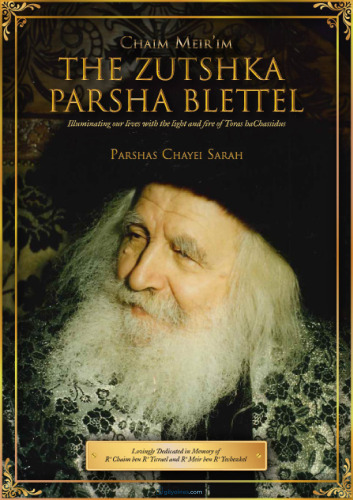
Dedicated in loving memory of Rav Nachum Moskowitz ben Rav Shlomo
in honor of his yahrzeit on 29 Cheshvan
Dedicated by his grandson our esteemed Menahel of Mosdos Zutshka Rav Shmiel Yehuda Moskowitz shlita
Dedicated in loving memory of Rav Yissocher Beirish ben Chaim Roisman zl
who passed away on 17 Cheshvan תשפ”א
Dedicated by our dear friend, his son Reb Moshe shlita of Monsey NY
Dedicated in loving memory of HaKadosh Rav Nachum Ephraim Teitelbaum of Volova
son in law of the Sulitza Rebbe and a descendant of Rav Issamar of Nadvorna
he was martyred in a terrorist attack in Chabad of Mumbai 29 Cheshvan תשס”ט
Dedicated in loving memory of Rav Yissocher Ber of Zhalin ben Rav Yaakov of Nadvorna Debrictzin
who passed away on 29 Cheshvan תשס”טDedicated by his son Rav Issamar Leifer shlita of Boro Park
Equanimity in the Face of Hard Times and Darkness in Our Lives
The Rebbe begins with the pasuk in our parshah “The years of the life of Sarah,” and with
Rashi’s explanation that the pasuk teaches us that all the years of her life were equally good.
However, asks the Zutshka rebbe, how can that be? We know that Sarah Imenu suffered
through many difficult years during her lifetime, in fact most of her adult life was spent bar-
ren and childless, how then can Rashi testify that all the 127 years of her life were equally good
and positive?
There was the time when she said to Avraham (Bereishis 16:5) “my anger is directed towards
you,” and the time when she saw Yishmael hurting Yitzchok, and other trails and suffering
she endured.
The answer is, says the rebbe, that in the end it was revealed to Sarah that all of these things
were equally, all truly positive, even the pain and suffering endured were for the best. Because
all the trials she went through were all done for her sake and for her betterment in the end.
Another perspective that the rebbe shares is the concept of hishtavus - learning to equally
accept with love all that Hashem sends our way, no matter what shape or form it comes in.
This is what Sarah Imenu did, she accepted all her tests and trials with love as Chazal teach us
“A person is obligated to recite a berachah over bad news just as he says a blessing over good
news.” (Berachos 54a) This is hinted at in our pasuk in “the years of Sarah’s life,” the Hebrew
word for years is Shnei which also means two. We can therefoe read “Shnei Chayei Sarah,” as
the two lifetimes of Sarah. This hints at two time periods in Sarah’s life: good times and bad
times, times of light and times of darkness, but to her, accepted with love, they were equally
accepted with the self composure and calm that is a hallmark of hishtavus - equanimity.
In essence this is what Hashem was teaching Avraham Avinu by saying (21:11) ‘do not feel bad
about the lad and your maid [Yishmael and his mother Hagar] being sent away’ even though
surely Avraham would feel bad about having to throw out his wife and son, however a tzadik
accepts it all calmly with equanimity and hishtavus, even such a terrible painful episode as
this was. Because he believes and accepts that whatever Hashem does is for the best, there
must be a hidden motive, some hidden agenda to my good and benefit, even when I cannot
see it. . .
This was Sarah Imenu’s attribute, that she had hishtavus and accepted her life’s difficulties
with equanimity, serenity, trust and faith and joy. The truth is, explains the rebbe, even what
appears to us in this world as evil will, one day in the future, be revealed as a hidden good with
a false facade. It only looks that way on the outside , inside its true inner essence is all good.
The Zutshka rebbe then shares with us an amazing insight in how to understand one of Chaz-
al’s midrashei aggada. In Avoda Zara (3b) we are taught: Rabbi Shimon ben Lakish says that in
the future there is no Gehinom, rather Hashem removes the sun from its sheath and shines
it’s bright light directly unto the wicked and the righteous. The wicked are judged by that
light, whereas the tzadikim are healed by it.
The Rebbe interprets this Midrash by way of another Chazal in Chagiga (12a) that the original
light of creation was used by Adam to see from one end of the world to the other, and when
Hashem saw that future behavior of the wicked and righteous, He hid that light away from the
wicked so the righteous could enjoy it in the future.
Although, says the rebbe, surely the simple straughtforward meaning is that Adam saw from
one end of the world far off in the distance to the other, we can also understand it to mean that
he saw the future events from end of the world to the other - from the past events of Creation,
all the way to future events when the world as we know it ends. When Hashem saw that this
light would be abused, He concealed it. Rabbi Shimon ben Lakish is telling us what happens
when that hidden light is revealed once more again, when Hashem removes that light of cre-
ation, that was hidden away, each and everyone of us will see the future.
What we will see in our future depends on how we lived our lives and conducted ourselves
during our lifetimes. The wicked are judged because all their notorious crimes will be revealed
for all to see. Everyone will see how they hid their disgusting lowlife activities and acted in
secret like Zimri, while putting on a false show that they were as righteous as Pinchos. They
will be so ashamed that they will want to hide their face and burrow themselves a hole in the
ground to hide from embarressment. Then we will recognize that any rewards they receieved
here in this world was all done to pay them up so that they would have nothing left in the next
world, to bankrupt them. In the future the world will be filled with the Divine knowledge of
Hashem as the waters cover the seabeds, so the shame will be sevenfold as bad. This shame
will sting and burn as badly or even worse than the fires of Gehinom.
That is how the wicked shall be judged. The righteous will be healed, since all the hardships
they endured, all the pain, suffering and shame, asking why do the good die young? why do
the righteous suffer when the wicked seem to prosper? (Berachos 7a) In the future all those
things we do not understand will be understyood, this special light will enlighten us and show
us the truth and reveal how it was all for the best and for our benefit, everything from the time
of Creation until the end.
Then all previously hidden matters will be revealed, all secrets exposed, all mysteries ex-
plained and all questions answered. Everything will be seen in a positive light and will be
understood as good.This heals the tzadikim since it reveals that all the events and happenings
in their life were all positive and good.
However what do we do now? Asks the Rebbe, now when we do not yet understand, now when
we still lack the answers to so many difficult questions? Now we must strengthen ourselves
with faith and emunah. We do so by knowing the one general answer that answers all ques-
tions on matters of faith: there is an answer to every question!
However the human mind is limited, and human intelligence and understanding can only go
so far in understanding the Divine Creator’s reasons and plans. Just as we do not have all the
answers to all the questions when we study Torah. We find difficulties and contradictions and
not always do we know the answer. However we believe with full faith that there is an answer,
there are answers to all the questions. Often, we eventually do find some of these answers,
and over time, some of the questions even fall away on their own and cease to be questions
as well live life, learn its lessons and gain new horizons of understanding over the years. This
lesson itself should strengthen us and give us the chizuk and resolve to know that one day
in the future we are destined to answer all the questions on that day when that light shall be
unsheathed and revealed once more, speedily in our days Amen.
Show Us Your Chessed
When the Zutshka rebbe concluded this teaching he told how his father, Rav Issamar of Na-
dvorna once challenged Hashem, like a child lovingly taunts a parent and said: “Hashem - if
You wish to shower us with Your type of Divine loving kindness - then You have to grant us
Divine intelligence to appreciate and comprehend the goodness of such kindness. However
since You only gave me my own limited human intelligence, its only fair that You also only give
me what humans define as loving kindness - the kind of chessed that we can clearly see and
recognize!” Based on this we say in Tehillim asking Hashem “Show us Hashem Your chessed
and loving kindness, and grant us Your salvation,” (Tehillim 85:8) when You Hashem enlight-
en our mind to recognize Your chessed in every matter and everything, only afterwards, only
then is Your salvation granted to us, once we fully understand the true nature of Divine kind-
ness. However nowadays, when we lack this understanding, we asking for simple straightfor-
ward kindness, the type we can easily recognize and see with our very own eyes.
The Zutshka Rebbe ztzl and his son the Rebbe shlita at
The Zutshka Rebbe ztzl davening at Rebitzen Malka of
their ancestor the Zhviller’s Rebbe’s tzion on the date of his
Nadvorna’s tzion in Tiveria
Yahrzeit 24 Cheshvan