
The Maharsham Project - English — Toledot (2026-11-09)
W E E K LY T E S H U VA H I N S I G H T S F R O M T H E M A H A R S H A M O F B R E Z H A N
THE
MAHARSHAM שו״ת מהרש״ם
P R O J E C T
Issue No. 34 · Parashas Toldos 5787 · Shu"t Maharsham III:269, III:378 and III:215
לעילוי נשמת הרה״צ רבי מאיר ב״ר יעקב גאמבא זצ״ל · נלב״ע ה׳ כסלו
The Maharsham Goes to the Pharmacy
New methods, new questions, and a posek who went and found out
1 2 3
Butter dyed yellow in Chicks hatched in a machine Oil shipped across the
a non-Jew's factory ocean from America
T E S H U VA H 1 O F 3 · C H E L E K I I I , S I M A N 2 6 9
The Butter Factory and the Yellow Dye
Brezhan, Galicia
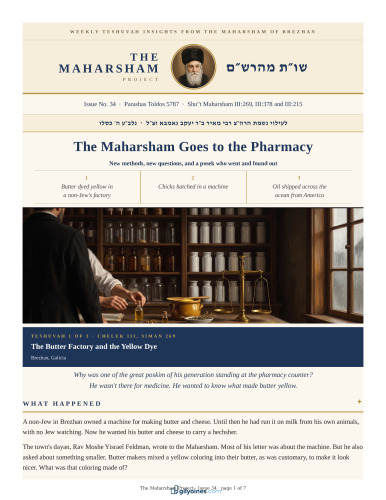
Why was one of the great poskim of his generation standing at the pharmacy counter?
He wasn't there for medicine. He wanted to know what made butter yellow.
W H AT H A P P E N E D ✦
A non-Jew in Brezhan owned a machine for making butter and cheese. Until then he had run it on milk from his own animals,
with no Jew watching. Now he wanted his butter and cheese to carry a hechsher.
The town's dayan, Rav Moshe Yisrael Feldman, wrote to the Maharsham. Most of his letter was about the machine. But he also
asked about something smaller. Butter makers mixed a yellow coloring into their butter, as was customary, to make it look
nicer. What was that coloring made of?
The Maharsham Project · Issue 34 · page 1 of 7
THE QUESTION
Two questions, really. Could this machine be made kosher? And was the yellow dye kosher, and
even kosher for Pesach?
THE KEY IDEA ✦
A yellow coloring doesn't tell you what it's made of, and the Maharsham wasn't going to rule on something he didn't
understand. So he went to find out:
הייתי בעצמי באפטייק לחקור ע״ז
"I went myself to the pharmacy to look into it."
What he found there: the coloring is manufactured in a factory from a plant.
No concern of anything forbidden, and none of chametz.
The question about the machine rested on a different idea. Chazal forbade
chalav akum (milk a non-Jew milked with no Jew watching) out of concern
that he mixed in milk from a non-kosher animal. But milk from a non-kosher
animal doesn't set into cheese. The Shach rules that where we know for
certain the non-Jew meant to make the milk into cheese, it is permitted after
the fact. In this factory, every drop that went into the machine was headed for
The Ringplatz, Brezhan's main square, on an old postcard.
butter or cheese. That is why, in this case, Rav Feldman held that the
machine had never absorbed anything forbidden. Notice what the question
was about: the machine, not drinking the non-Jew's milk.
Rav Feldman's letter walks you onto the factory floor. The milk went into the machine, which turned it into cream. Some went
into one vat to become butter; some went into another vat, warmed by steam, to become cheese. The machine itself only ever
held cold milk, and after each run it was rinsed with boiling water.
So by the letter of the law, Rav Feldman held, the machine needed no kashering at all. Still, since it had been rinsed with
boiling water, he had it filled with hot water now, kashering it the same way it had been used. And the heated cheese vat he
kashered fully, even though most of the later poskim say it wasn't needed, because it's better to be careful with something used
every day. The Maharsham agreed that the machine had never become forbidden, and brought more support.
THE ANSWER
The coloring he investigated was made from a plant: no concern of anything forbidden, and none of chametz. The
machine never became forbidden, because all its milk was meant for butter and cheese; filling it with hot water, the way
it had been used, and fully kashering the heated cheese vat were added care. One limit stands firm: everything here is
about the vessels. The non-Jew's milk itself stays forbidden.
The Maharsham Project · Issue 34 · page 2 of 7
GOING DEEPER
The sources for the machine. The Shach (Yoreh De'ah 115, s.k. 25) permits b'dieved where we know the non-Jew meant to curdle the
milk. The Chut HaShani (33–34) adds that we may assume he meant to make cheese from the start. The Maharit Tzahalon (81) permits
buying milk that has already curdled, since curdled milk can't be from a non-kosher animal.
Milk left in vessels for a full day. What if milk had stood in a vessel for a full day (kavush)? The Taz, citing the Issur V'Heter, treats
that like cooking. But the Mahari Assad shows the Issur V'Heter was unsure, and for metal vessels the Issur V'Heter itself holds that
soaking doesn't make them absorb; the Chut HaShani rules leniently too. The Emek She'elah adds that according to the Rif and the
Rambam, copper absorbs only with fire under it. None of this helps a vessel that was actually used for boiling.
Old vessels nobody can kasher. The Maharsham goes further than he was asked. May a non-Jew's milk vessels that haven't been used
in a day (eino ben yomo), and that cannot be kashered, be used? The Mahari Bruna says yes, even l'chatchila; the Rashba says no. The
Maharsham leans to permit in "our lands," where no non-kosher milk is found, following the Tashbetz (citing the Kaftor VaFerach,
where camel's milk cost more than cow's milk) and the Radvaz (where no non-kosher animal is kept in the yard).
The limit of the leniency. He cites the Shiltei Giborim, who lists reasons to be lenient on the vessels and still ends strict because of
the minhag. Then come these words: וחלילה ח״ו להקל בגוף החלב של עכו״ם שנאסר עפ״י דברי חז״ל, "heaven forbid that we be
meikel with the non-Jew's milk itself, which Chazal forbade."
To say at the table: Before he ruled on an ingredient, the Maharsham found out what it actually was. Even the color of butter got a
careful look.
T E S H U VA H 2 O F 3 · C H E L E K I I I , S I M A N 3 7 8
Chicks from a Machine
Chmeliev, Hungary
A machine could keep an egg warm.
But was the chick that came out of it a kosher chicken?
W H AT H A P P E N E D ✦
Usually a hen sits on her eggs. In a district in Hungary, people had started
putting eggs into machines instead. The machine kept the eggs warm until the
chicks hatched.
But according to the report sent to the Maharsham, these chicks were different. They
were weak. They didn't reproduce. And they lived only about three months.
Rav Yehuda Yerushalmi, the dayan of Chmeliev, wrote to the Maharsham. The An egg incubator of that era: a wooden
cabinet with trays of eggs, kept warm
answer was late, and the Maharsham explains why, with a glimpse of his own desk: by a small oil lamp. (Illustration.)
he had been buried in the indexes and glosses for a sefer of his that was going to
print. "Today they were finished. I looked for your letter, and here is my answer."
THE QUESTION
Did the chicks' weakness and short lives make them treifos, forbidden to eat?
The Maharsham Project · Issue 34 · page 3 of 7
THE KEY IDEA ✦
Two different things can make a bird unlikely to live. One is a treifah: something in its body is damaged or missing, and the
Torah forbids it even with shechitah. The other is a bird that is simply weak and close to death, with no defect that makes it a
treifah. The Gemara calls that a mesukenes. Its weakness alone doesn't forbid it, and it may be eaten when the special
requirements for shechting it are met.
How do we know? The Gemara (Chullin 37a) reasons from the Torah itself. The Torah forbids neveilah, an animal that died
without shechitah. If an animal that was about to die were already forbidden, why would the Torah need to forbid the dead
one? So the dying animal must be permitted. Not everything that won't live is a treifah.
No defect that makes a bird a treifah was reported in these chicks. The Maharsham attributes their weakness to inadequate
incubation, not to damage in their bodies. And they were still chickens. Their species reproduces; these particular birds didn't,
the way some people or animals can't have children and are still the same kind of creature.
THE ANSWER
In his words, הדבר ברור שהעופות מותרין, "the matter is clear: the birds are permitted." These chicks, weak and
short-lived as they were described to him, were still chickens. No treifah defect was reported in them, so their halacha
is that of any other bird.
GOING DEEPER
Birds that grow on trees. Rav Yerushalmi had compared these chicks to birds said to grow on trees, which several poskim say need no
shechitah because they don't reproduce. The Maharsham answers that there the whole species doesn't reproduce. Here the species does;
only these birds are weak.
The proof from Tosafos. A rav had argued from Tosafos (Niddah 23a), which treats a creature in an animal's form, born to a woman,
as a treifah because it won't live a year. The Maharsham answers that such a creature was unfit to live from the moment it was formed.
Our chick would have lived had a hen sat on the egg. And a second answer: "a treifah won't live a year" means it will die from damage
to an organ. Where nothing is damaged, it's a mesukenes, not a treifah.
No "nefel" for birds. An animal born before its full term, or in its first seven days, may still count as a nefel, a birth that isn't viable,
and is forbidden like neveilah. Birds have no such status: once a chick hatches, it is no longer a nefel (Chullin 22b; Tosafos, Menachos
25a). So proofs about animals that won't survive don't carry over to chicks.
What a treifah is. A treifah is "missing" something; even an extra limb counts, as if it were removed. Some treifos, like a hole in the
membrane of the brain, have no missing part, but there is still a change in the body (Temurah 17a, with Rashi). A mesukenes has no
change at all.
A mesukenes and its shechitah. Special rules make sure the animal was still alive when the shechitah was completed. They include
pirkus, a qualifying movement that shows life, and the required movement differs between animals and birds (Shulchan Aruch, Yoreh
De'ah 17). That is the "special requirement" mentioned above.
Where he would not permit. The same letter asked a question about salting. Meat left three full days without salting can no longer be
made fit for cooking by salting (it may still be roasted), and soaking it in water within those three days gives it more time (Yoreh De'ah
69:12–13). But if a whole head was soaked, did the soaking also count for the brain sealed inside the skull? There he said no. If the
head lay nose-down, the water couldn't rise into it; and even nose-up, the water might not get in, or might not spread through the whole
brain. "And who knows the secrets of nature?"
To say at the table: A short life alone doesn't make a bird treif. What matters is whether it has a defect that halacha classifies as
a treifah.
The Maharsham Project · Issue 34 · page 4 of 7
T E S H U VA H 3 O F 3 · C H E L E K I I I , S I M A N 2 1 5
Oil from America
Kolomaya, Galicia
Oil had arrived from America.
Nobody could tell by looking whether it came from cottonseed or from treif fat.
W H AT H A P P E N E D ✦
Oil was coming into Galicia from America. The rav of New York had written that most of these oils were made from the fat of
neveilos and treifos. Only one factory made its oil from cottonseed, and it had no supervision, so even that oil might be mixed.
Rav Yaakov Teomim, head of the beis din of Kolomaya, asked the Maharsham whether a chemist's test could settle it. Rav
Teomim himself thought not.
THE QUESTION
Can we rely on a chemist who tests the oil and reports that it contains no animal fat?
THE KEY IDEA ✦
Why do you trust your mechanic? Partly because he has a name to protect. If he cheats you, the next mechanic may tell you,
and word gets around. Halacha uses a similar idea. In many cases a professional, an uman, is believed about his own work,
because one lie could cost him his name.
But that only works if somebody can catch him. A cook who says the soup tastes fine can be checked by anyone with a spoon.
A chemist who says the oil has no animal fat can be checked only by another chemist. You'd have to find one, and pay him.
And if the two disagree, you're stuck: one expert against another, and no way to know who's right. If he can't be caught, his
reputation alone isn't enough reason to rely on his report.
So in this case the Maharsham builds the check back in. Tell the chemist at the start that two other chemists will test the same
oil. Now a false report would come out, and his name is on the line again. And then, he adds, really do ask at least one more.
That answered the question of reliability. But one practical question was left: can a chemist really tell plant oil from animal fat?
The Maharsham didn't assume. He asked:
ששאלתי היום להאפטעקיר דפה
"Today I asked the pharmacist here."
Yes, the pharmacist told him, it can be tested. But not by just any chemist. Only by a chemist who specializes in testing food.
And, he was told, there wasn't one in all of Galicia, not even in Lemberg; only in Vienna and places like it.
The Maharsham Project · Issue 34 · page 5 of 7
THE ANSWER
A chemist's report on the oil can be relied on only if he knows two other chemists will check him, and at least one more
is actually asked. And it must be a specialist in testing food; there was none in Galicia, not even in Lemberg, only in
Vienna and places like it. "So you'll know what to do," he ends, and leaves the next step to Rav Teomim.
GOING DEEPER
Is an expert believed at all? The classic case is tzitzis: you may buy techeiles from a craftsman without fearing a cheap imitation. The
Magen Avraham (20:1) limits this to things non-Jews also care about. The Ran (Chullin perek 1) seems to disagree, trusting a
craftsman even about hemp thread in a garment, a shatnez question. The Tiferes Tzvi (Rav Tzvi Hirsch of Zamoshch, d. 1807) resolves
it: the Ran wrote that in theory, but in practice, about a fish brine, he was strict. And the Noda BiYehuda, followed by the Chasam
Sofer, holds that a craftsman is trusted not to do something crooked, not for what he only says. The question is whether we can rely on
his report, not on something he made.
The taster. Halacha relies on a kefila, a non-Jewish cook who tastes a mixture and says whether the forbidden taste comes through.
The Rashba holds his word alone is enough, even for a Torah prohibition; the Rosh requires that he speak innocently, without knowing
why he is being asked; the Beis Yosef rules like the Rashba. The Tiferes Tzvi explains why: tasting is his whole livelihood. That would
suggest trusting a chemist too, until the Maharsham points out the difference: anyone can check a taster.
"It will come out." The Rivash explains that halacha trusts one person about something that is bound to come to light, a milsa d'avida
l'igluyei. A translation from Persian can always be checked, because many people read Persian. A man's death in a far-off place may
never be confirmed, which is why a single witness to it is believed only because the Rabbanan made it so. And the Tashbetz writes
that a lone expert isn't "bound to come out," since another expert can contradict him, one against one. "That's exactly our case," says
the Maharsham.
The Shoel uMeishiv. Rav Teomim noted that the Shoel uMeishiv (Rav Yosef Shaul Nathanson of Lemberg) once relied on a chemist,
but only together with other reasons, and where the forbidden part was batel b'shishim (outweighed sixty to one). Here the worry was
that the whole oil was forbidden.
To say at the table: Two separate questions: does this expert know how to find the answer, and can we rely on what he tells us? The
Maharsham checked both.
W H Y I T M AT T E R S ✦
These teshuvos show how carefully the Maharsham separated established facts, reported circumstances, and open questions.
He investigated the butter coloring himself. He judged the chicks as they were described in the letter. Before relying on a test
of the oil, he looked at both the expert's qualifications and the grounds for trusting his report. And when he could not establish
whether water reached the brain inside a whole skull, he would not permit it. Knowing the facts, and knowing where they ran
out, was part of answering the sha'alah.
KEY TERMS Uman · אומןA craftsman or expert, trusted about his own work
because he won't ruin his reputation.
Mesukenes · מסוכנתAn animal close to death. That alone doesn't
make it a treifah; special requirements govern its shechitah. Kefila · קפילאA non-Jewish cook who tastes a mixture and says
whether the forbidden taste comes through.
Chalav akum · חלב עכו״םMilk a non-Jew milked with no Jew
watching, forbidden by Chazal. Milsa d'avida l'igluyei · מילתא דעבידא לאגלוייSomething that will
come to light, so a person won't lie about it.
The Maharsham Project · Issue 34 · page 6 of 7
COMING NEXT WEEK
A district opens a savings-and-credit fund. Every member is Jewish but one. Does that one
non-Jew make the interest permitted, or is it ribbis? And the fix the Maharsham himself
set up in Brezhan, when the directors signed in beis din that every loan is a heter iska.
SOURCES ✦
SOURCE W H AT I T S AY S W H AT I T D O E S H E R E
חולין ל״ז ע״אA dying animal is not forbidden for that reason alone; the Teshuvah 2: a short life doesn't make the chick a
Torah forbids neveilah and treifah, not "an animal that treifah.
won't live."
תוס׳ נדה כ״ג ע״א; תמורה י״ז ע״אA creature unfit to live from its formation; treifos without The chick was fit to live and has no change.
ורש״יa missing part still have a change in the body.
–כ״ה; חוט השני ל״ג: ש״ך יו״ד קט״וMilk meant for curdling is permitted b'dieved; curdled Teshuvah 1: the machine never became
ל״ד; מהרי״ט צהלון פ״אmilk carries no worry of non-kosher milk. forbidden.
; מהר״י ברונא ע״ח; רשב״א ח״א קמ״גOld vessels of a non-Jew's milk: dispute; permitted where Under the conditions he discusses, vessels not
תשב״ץ ח״ד; רדב״ז ח״ד ע״הno non-kosher milk is found. used in a day may be used when kashering is
impossible.
א׳; ר״ן חולין פ״א; שו״ת: מג״א כ׳How far a craftsman is believed; not in what he only says. Teshuvah 3: a chemist's report isn't enough on its
תפארת צבי או״ח י״ט; נו״ב תנינא own.
או״ח ס״ב; חת״ס או״ח קל״ה
יו״ד רס״י צ״ח (רשב״א ורא״ש); ריב״שA kefila; something that will come to light; one expert He's believed only if he knows he'll be checked.
קנ״ה; תשב״ץ ח״א פ״ג–פ״הagainst another.
W H O WA S T H E M A H A R S H A M ?
Rabbi Shalom Mordechai HaKohen Schwadron, ben HaRav Moshe (1835–1911), served as the Rav of Brezhan in Galicia for thirty
years, from 1881 until his passing. He is best known for his Shu"t Maharsham, thousands of teshuvos on every area of halachah, and
his Da'as Torah commentary on Shulchan Aruch. He was regarded as one of the foremost poskim of his generation, and his piskei
halachah are cited to this day.
R E C E I V E T H E M A H A R S H A M P R O J E C T E V E RY W E E K
Don't miss next week's issue. Scan the QR code or visit kechnia.org/maharsham, and get it free in your inbox every week.
This English adaptation with explanatory commentary is presented for Torah study and enrichment only. It is not intended as halachah l'maaseh. The translator has
made every effort to render the Maharsham's words faithfully, but this English adaptation may contain errors or imprecisions. For any practical halachic question,
consult your own Rav.
The Maharsham Project · kechnia.org/maharsham · · לעילוי נשמת הגה״ק רבי שלום מרדכי בן רבי משה הכהן זצללה״הinfo@kechnia.org
The Maharsham Project · Issue 34 · page 7 of 7