
Lamdanim Gilyon - English — Toledot (2026-11-09)
נדבת לז"נ רב גדלי' בן רב שמעון מאקס זצ"ל
HASHK AFAH SPONSOR TEXT 646-598-4703 TO SPONSOR Y E A R LY S P O N S O R דקות בעיון כל יום15 הוא היה רגיל לומר צריך כל אדם ללמוד לכה"פ
Are you a
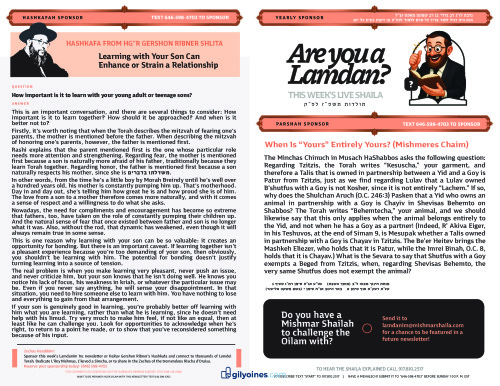
HASHKAFA FROM HG"R GERSHON RIBNER SHLITA
Learning with Your Son Can
Lamdan?
Enhance or Strain a Relationship
QUESTION ?
How important is it to learn with your young adult or teenage sons? THIS WEEK'S LIVE SHAILA
ANSWER תולדות תשפ"ז לפ"ק
This is an important conversation, and there are several things to consider: How
important is it to learn together? How should it be approached? And when is it
better not to? PA R S H A H S P O N S O R TEXT 646-598-4703 TO SPONSOR
Firstly, it's worth noting that when the Torah describes the mitzvah of fearing one's
parents, the mother is mentioned before the father. When describing the mitzvah
of honoring one's parents, however, the father is mentioned first.
When Is “Yours” Entirely Yours? (Mishmeres Chaim)
Rashi explains that the parent mentioned first is the one whose particular role
needs more attention and strengthening. Regarding fear, the mother is mentioned The Minchas Chinuch in Musach HaShabbos asks the following question:
first because a son is naturally more afraid of his father, traditionally because they
learn Torah together. Regarding honor, the father is mentioned first because a son Regarding Tzitzis, the Torah writes “Kesuscha,” your garment, and
naturally respects his mother, since she is משדלתו בדברים. therefore a Talis that is owned in partnership between a Yid and a Goy is
In other words, from the time he's a little boy by Morah Breindy until he's well over Patur from Tzitzis, just as we find regarding Lulav that a Lulav owned
a hundred years old, his mother is constantly pumping him up. That's motherhood. B’shutfus with a Goy is not Kosher, since it is not entirely “Lachem.” If so,
Day in and day out, she's telling him how great he is and how proud she is of him.
The love from a son to a mother therefore comes more naturally, and with it comes why does the Shulchan Aruch (O.C. 246:3) Pasken that a Yid who owns an
a sense of respect and a willingness to do what she asks. animal in partnership with a Goy is Chayiv in Shevisas Behemto on
Nowadays, the need for compliments and encouragement has become so extreme Shabbos? The Torah writes “Behemtecha,” your animal, and we should
that fathers, too, have taken on the role of constantly pumping their children up. likewise say that this only applies when the animal belongs entirely to
And the natural sense of fear that once existed between father and son is no longer
what it was. Also, without the rod, that dynamic has weakened, even though it will the Yid, and not when he has a Goy as a partner! (Indeed, R’ Akiva Eiger,
always remain true in some sense. in his Teshuvos, at the end of Siman 9, is Mesupak whether a Talis owned
This is one reason why learning with your son can be so valuable: it creates an in partnership with a Goy is Chayav in Tzitzis. The Be’er Heitev brings the
opportunity for bonding. But there is an important caveat. If learning together isn't Mashkeh Eliezer, who holds that it is Patur, while the Imrei Binah, O.C. 8,
a pleasant experience because you're too demanding of your son, then obviously,
you shouldn't be learning with him. The potential for bonding doesn't justify holds that it is Chayav.) What is the Sevara to say that Shutfus with a Goy
turning learning into a source of tension. exempts a Beged from Tzitzis, when, regarding Shevisas Behemto, the
The real problem is when you make learning very pleasant, never push an issue, very same Shutfus does not exempt the animal?
and never criticize him, but your son knows that he isn't doing well. He knows you
notice his lack of focus, his weakness in kriah, or whatever the particular issue may מנחת חינוך מצוה ל"ב )מוסך השבת( שו"ע או"ח סימן רמ"ו סעיף ג
be. Even if you never say anything, he will sense your disappointment. In that (שו"ת רעק"א סוף סימן ט באר היטב או"ח סימן י )בשם משקה אליעזר
situation, you need to hire someone else to learn with him. You have nothing to lose
and everything to gain from that arrangement.
If your son is genuinely good in learning, you're probably better off learning with
him what you are learning, rather than what he is learning, since he doesn't need
help with his limud. Try very much to make him feel, if not like an equal, then at Do you have a Send it to
least like he can challenge you. Look for opportunities to acknowledge when he's Mishmar Shailah lamdanim@mishmarshaila.com
right, to return to a point he made, or to show that you've reconsidered something
because of his input. to challenge the for a chance to be featured in a
Oilam with? future newsletter!
Zechus Harabbim!
Sponsor this week’s Lamdanim Inc newsletter or HaRav Gershon Ribner’s Hashkafa and connect to thousands of Lomdei
Torah. Dedicate L’iluy Nishmas, L’kovod a Simcha, or to share in the Zechus of the tremendous Rischa d’Oraisa.
Reserve your sponsorship today! (646) 598-4703
FOR COMMENTS OR QUESTIONS ON THE HASHKAFA MIMEON KODESH, TEXT 848-216-6466
TO HEAR THE SHAILA EXPLAINED CALL 917.810.2517
WANT TO BE MEHANEH YOUR OILAM WITH THIS NEWSLETTER? TEXT 646-598-4703 TO SUBSCRIBE TEXT "START" TO 917.810.2517 | HAVE A MEHALECH? SUBMIT IT TO "646-598-4703" BEFORE SUNDAY 1:30 P. M. EST
SEFER SPONSOR SEFER SHEMOS IS SPONSORED ר' חיים צבי בן ר' משה
Haaros
• Even if we understand Pikuach nefesh as Hutrah, that Heter exists because of
a separate Din of Pikuach nefesh, not because of the Dinim of Shabbos
Recent week's question & answer themselves. Although a non-Jew is prohibited from Retzichah, he does not
necessarily have the same positive Mitzvah of Pikuach nefesh as a Yid.
Therefore, the question should not be whether this is how a Yid properly
“The Pikuach Nefesh Paradox” observes Shabbos. Rather, we should ask: would a Yid be permitted to perform
QUESTION this Melachah if he did not have the separate Chiyuv of Pikuach nefesh? The
The Gemara in Sanhedrin דף נ״ח ע״בstates: “Goy SheShavas Chayav answer is no. Therefore, the Melachah remains an act that contradicts Shevisas
Misah”, a non-Jew may not observe a day of complete rest. At the same Shabbos, and the non-Jew is not considered to have observed Shabbos
time, we know that Pikuach Nefesh is Docheh Shabbos, and a Yid is completely. - Yeshivish Hats Guy
permitted, and obligated when necessary, to perform Melachah in order • I would question the assumption that performing Melachah for Pikuach
to save a life. The question is what happens if a non-Jew decides to nefesh is itself considered keeping Shabbos. L’maaseh, the person performed
observe Shabbos, but during the day a situation of Pikuach Nefesh arises Chillul Shabbos. He was correct and obligated to do so because Pikuach nefesh
and he performs Melachah in order to save a life. On the one hand, he did overrides Shabbos, but that means he observed the Torah properly, not
not remain completely Shoveis, since he actually performed Melachah. necessarily that he was Shoveis. The fact that an act is required by the Torah
On the other hand, performing Melachah for Pikuach Nefesh is itself part does not automatically make it an act of Shevisah. Therefore, a non-Jew who
of how a Yid properly observes Shabbos. If so, is he considered to have performs Melachah to save a life has still broken his rest and would not violate
violated the prohibition of Goy SheShavas, because he kept Shabbos in Goy Sheshavas. Alternatively, perhaps a non-Jew's prohibition of murder does
the same way a Yid would, or does the fact that he actually performed not include the same positive Chiyuv Hatzalah that applies to a Yid. If so, even
Melachah remove him from the category of Shevisah? if saving a life is considered part of a Yid's proper observance of Shabbos, that
ANSWER reasoning does not apply to a non-Jew. - Dovid Shunt, BMG
There are two possible Mehalchim. The first depends on two Chakiros: • Mehalech #1: There is a fundamental difference between a Yid and a non-Jew
whether Pikuach Nefesh Docheh Shabbos works as Dechuyah or Hutrah, regarding the very framework of Shabbos. For a Yid, when a situation of Pikuach
and how to define the prohibition of Goy SheShavas. If the Issur is that a nefesh arises, the restrictions of Shabbos are temporarily overridden as
non-Jew may not observe Shabbos in the manner that a Yid observes it, necessary to stabilize the situation or provide treatment. Once the danger is
then even performing Melachah for Pikuach Nefesh may still be addressed, the ordinary restrictions resume. But for a non-Jew, the obligation of
considered keeping Shabbos, because that is exactly what a Yid is Shmiras Shabbos never existed in the first place. Therefore, it is difficult to
supposed to do in such a case. However, if the Issur is simply Shevisah suggest that the laws of Shabbos were temporarily suspended for him because
from the Lamed-Tes Melachos, then the chiluk between Dechuyah and of Pikuach nefesh. The Yid and non-Jew are operating within two entirely
Hutrah becomes significant. In Dechuyah, the Melachah remains a real different Halachic frameworks, and their actions cannot necessarily be
act of Chillul Shabbos which is merely overridden by Pikuach Nefesh, and equated. Mehalech #2: A Yid has the Mitzvah of "Vachai bahem," which requires
therefore the non-Jew was not actually Shoveis. In Hutrah, however, there preserving life even when doing so necessitates violating Shabbos. There is also
is no operative Issur Melachah in that situation, leaving room to view him the Mitzvah of "Lo saamod al dam rei’echa," which prohibits standing idly by
as having observed Shabbos. A second Mehalech, attributed to HaRav Dov when another person's life can be saved. A non-Jew, however, is obligated in the
Landau Shlita, is that the concept of Pikuach Nefesh Docheh Shabbos Sheva Mitzvos Bnei Noach, including the prohibition of murder, but does not
applies to one who is actually Metzuveh in the Chiyuv of Hatzalas necessarily have the same direct positive Chiyuv Hatzalah. Therefore, he does
Nefashos. A Yid has a Chiyuv to save a life, and that obligation overrides not have the same obligation that overrides Shabbos for a Yid. When he
Shabbos. A non-Jew, however, does not have that same Chiyuv operating performs Melachah to save a life, it is not an expression of his own Shmiras
within the laws of Shabbos. Therefore, when he performs Melachah to Shabbos, but an actual interruption of his Shevisah. - Sh. Y. R., Cedarhurst, NY
save a life, the act remains an ordinary act of Melachah for him. Since he
did not remain Shoveis, he would not fall under Goy SheShavas Chayav Mussar
Moment
THE
Misah.
שו"ע או"ח סימן שכ"ח 'רא"ש יומא פרק ח' סימן יד :יומא פה .שבת קלב :סנהדרין נח This that the Chovos HaLevavos writes about a person having a natural affinity towards a
profession, nowadays we cannot rely on this. Most people are not able to recognize their true
feelings, and it is likely coming from some kind of desire."
Halacha קובץ פסקים צדקה מעשר כספים פרק יג הלכה כז-
Highlights
LOMDUS SPONSOR TEXT 646-598-4703 TO SPONSOR
If someone ate half of a כזיתof a food whose ברכה אחרונהis על המחיהand half
of a כזיתof a food whose ברכה אחרונהis בורא נפשות, they should make a ברכה
Are you a
FOLLOW US
אחרונהof בורא נפשות.
Lamdan?
שו"ע או"ח סימן רי מ"ב ס"ק א- TO SPONSOR A SHAILA LIELUEY NISHMAS
OR REFUAH SHELEIMA TEXT 646.598.4703