
Clarity for Teens - English — Toledot (2026-11-09)
WEEKLY THOUGHTS • PARSHAS TOLDOS
PARSHAS TOLDOS
WHICH CROWD?
—❦—
The Medrash
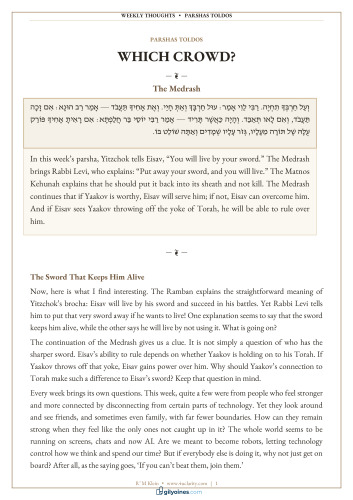
ִאם ָזכָה: וְ ֶאת ָא ִחיָך ַת ֲעבֹד — ָאמַ ר ַרב הּונָא. עּול חַ ְרבָ ְך וְ ַא ְת חָ יֵי: ַרבִ י לֵוִ י ָאמַ ר.וְ עַ ל חַ ְרבְ ָך ִת ְחיֶה
ּפֹורק
ֵ ית ָא ִחיָך
ָ ִאם ָר ִא: וְ הָ יָה כַאֲ שֶ ר ָת ִריד — ָאמַ ר ַרבִ י יֹוסֵ י בַ ר חֲ לַפְ ָתא. וְ ִאם לָאו ְת ַאבֵ ד,ַת ֲעבֹד
. גְ זֹר עָ לָיו ְשמָ ִדים וְ ַא ָתה שֹולֵט בֹו,תֹורה מֵ עָ לָיו
ָ ֻעלָּה שֶ ל
In this week’s parsha, Yitzchok tells Eisav, “You will live by your sword.” The Medrash
brings Rabbi Levi, who explains: “Put away your sword, and you will live.” The Matnos
Kehunah explains that he should put it back into its sheath and not kill. The Medrash
continues that if Yaakov is worthy, Eisav will serve him; if not, Eisav can overcome him.
And if Eisav sees Yaakov throwing off the yoke of Torah, he will be able to rule over
him.
—❦—
The Sword That Keeps Him Alive
Now, here is what I find interesting. The Ramban explains the straightforward meaning of
Yitzchok’s brocha: Eisav will live by his sword and succeed in his battles. Yet Rabbi Levi tells
him to put that very sword away if he wants to live! One explanation seems to say that the sword
keeps him alive, while the other says he will live by not using it. What is going on?
The continuation of the Medrash gives us a clue. It is not simply a question of who has the
sharper sword. Eisav’s ability to rule depends on whether Yaakov is holding on to his Torah. If
Yaakov throws off that yoke, Eisav gains power over him. Why should Yaakov’s connection to
Torah make such a difference to Eisav’s sword? Keep that question in mind.
Every week brings its own questions. This week, quite a few were from people who feel stronger
and more connected by disconnecting from certain parts of technology. Yet they look around
and see friends, and sometimes even family, with far fewer boundaries. How can they remain
strong when they feel like the only ones not caught up in it? The whole world seems to be
running on screens, chats and now AI. Are we meant to become robots, letting technology
control how we think and spend our time? But if everybody else is doing it, why not just get on
board? After all, as the saying goes, ‘If you can’t beat them, join them.’
R’ M Klein • www.4uclarity.com | 1
WEEKLY THOUGHTS • PARSHAS TOLDOS
The Many and the Few
With Chanukah approaching, that question reminds me of the very heart of its story: רבים ביד
מעטים, the many defeated by the few. And there is a most unusual Medrash in Tanchuma
which compares Shevet Levi with Malchus Yavan.
Both names have three letters; Yavan is the third of the four malchiyos, and Levi is the third
shevet. Levi offered parim as korbanos, whereas Yavan forced the Yidden to write on the horns
of their oxen that they had no part in the Elokei Yisroel. Then, after listing all these
comparisons, the Medrash finishes:
ֵאלּו ְמרֻ בִ ין וְ ֵאלּו מֻ עָ ִטין.
Yavan were many, and Levi were few. But hang on! That is not a similarity at all; it is the very
thing that makes them so unequal. Why does the Medrash finish with that point?
In Vezos Haberachah, Moshe Rabbeinu blesses Levi:
ּומשַ נ ְָאיו ִמן יְקּומּון
ְ ְמחַ ץ מָ ְת ַניִם ָקמָ יו, בָ ֵרְך ה׳ חֵ ילֹו ּופֹעַ ל יָדָ יו ִת ְרצֶ ה.
Rashi explains that Moshe Rabbeinu foresaw the Chashmonaim fighting the Yevonim: twelve
sons of Chashmonai and Elazar against many tens of thousands. He therefore benched them
that their strength and their actions in battle should succeed. So, the victory of the few over the
many was already in Moshe’s brocha. But why does he go on to ask Hashem specifically to strike
the enemies in their loins? Surely the main thing is that they should win. Why do we need to
know where the enemy will be struck?
The Strength That Keeps Them Standing
The detail about the loins brings us to a posuk in Tehillim (69:24). Dovid Hamelech describes
his troubles and the enemies surrounding him, and asks Hashem:
ֶת ְחשַ כְ נָה עֵ ינֵיהֶ ם מֵ ְראֹות ּומָ ְתנֵיהֶ ם ָת ִמיד הַ ְמעַ ד.
‘Let their eyes be darkened so that they cannot see, and make their loins continually give way.’
The loins help keep a person standing. Take away that support, and he cannot stand properly. It
is like taking the air out of a tyre: the car may have a wonderful engine, but it will not get very
far. Perhaps the point is to break the very strength upon which the enemy depends.
Earlier in the same Kapitel, Dovid Hamelech describes being trapped in deep mud, with
nowhere to stand, and then being caught in deep, surging waters:
אתי בְ מַ עֲמַ ֵקי מַ יִם וְ ִש ֹבלֶת ְשטָ פ ְָתנִי
ִ ָטָ בַ עְ ִתי בִ יוֵן ְמצּו ָלה וְ ֵאין מָ עֳמָ ד ;ב.
The Midrash Tehillim explains that the mud refers to Bavel, having nowhere to stand to Madai
and Paras, the deep waters to Yavan, and the sweeping current to Edom. So Yavan is pictured as
deep water. The meforshim explain the danger: deep water is frightening even without a
current, and rushing water is frightening even if it is not deep. Put the two together, and a
R’ M Klein • www.4uclarity.com | 2
WEEKLY THOUGHTS • PARSHAS TOLDOS
person is in terrible danger. It is an excellent picture of the way Yavan’s enormous influence
could make a Yid feel overwhelmed. You are not only facing an army; you are surrounded by a
whole way of life that seems much bigger than you.
The Boat and the Fish
This week I came across a random piece of history that fits this rather well. If you find history
and random facts boring, feel free to skip the next couple of paragraphs. I happen to love
history, so too bad! On Sunday, 8 November, the passenger ship Scillonian III made her final
crossing after 49 years sailing between Cornwall and the Isles of Scilly. Since 1977, she had
carried more than five million passengers, travelled over 780,000 miles and made more than
10,000 crossings. She was even nicknamed the ‘Vomit Comet’, because in rough weather she
rocked so much that some passengers had rather unpleasant journeys!
Think about it. Here was a relatively small ship in the enormous Atlantic Ocean. The wind
could howl, the waves could tower around her, and the people onboard could feel as though
everything was turning upside down. Yet her job was not to make the Atlantic disappear. It was
to remain afloat and reach the other side. And after nearly half a century, she completed that
final journey. A boat does not sink simply because water is all around it. It sinks when the water
gets inside. We cannot always change what surrounds us, but we must make sure that what
surrounds us does not become what guides us.
Now imagine somebody on that ship saying, ‘Look how much bigger the sea is than our boat!
Why bother fighting these waves? Let's jump in and join it!’ Would anybody seriously think
that was a good idea? Of course not. The sea being bigger does not make it a better place for a
human being to live.
But somebody might have a clever answer. ‘Look at all the fish! Millions of them live in the sea
without any boat, and they manage perfectly well. Why don’t we become like them?’ There is
just one rather important difference. Fish and humans both need oxygen, but they get it in
different ways. A fish takes oxygen from the water; a human being needs air. What keeps the fish
alive would drown us.
And that is the point. A Yid receives his spiritual oxygen from his connection to Hashem,
through Torah and mitzvas. Other people have different obligations and may seem perfectly
comfortable with a different way of life, but that does not mean it is right for us. Yavan was
enormous and its influence was everywhere, but the strength of Klal Yisroel was never measured
by the number of people on the other side. It was measured by what kept them standing. The
same is true of the technology questions that came in this week. It is not that every device or use
of AI is wrong. But if using it means losing our boundaries, our time, or the things that matter
most, then joining the crowd will not help us breathe. It will take away the very air we need.
R’ M Klein • www.4uclarity.com | 3
WEEKLY THOUGHTS • PARSHAS TOLDOS
Why Specifically Levi?
Now we can understand why the Tanchuma chooses specifically Levi to stand against Yavan. In
Mitzrayim, Shevet Levi lived in the middle of an enormous, powerful nation, yet held on to
Torah and were not subjected to the same avodas perech. They knew how to remain different,
even when almost everybody around them lived another way. Generations later, when Yavan
tried to pull Klal Yisroel away from Hashem, it was the Chashmonaim, from Shevet Levi, who
stood up against them.
Notice also the contrast with the ox. Levi brought parim to the mizbeach to serve Hashem,
while Yavan wanted the Yidden to use the horn of an ox to declare that they had no part in Him.
The battle was not only over soldiers and territory. It was over the very connection that kept us
alive. So when the Medrash finishes, ‘They were many and these were few,’ it is not spoiling the
comparison. It is bringing out the whole point. Yavan had the numbers. Levi knew where their
life came from.
Which Crowd Should We Follow?
But doesn’t this leave us with another problem? We are taught:
ַאל ִתפְ רֹש ִמן הַ צִ בּור.
Don’t separate yourself from the ציבור. But here we are saying that a Yid must sometimes be
prepared to stand against the crowd. So which is it?
The answer is that a ציבורdoes not simply mean whichever group happens to be the biggest. In
our moshol, the ציבורis the boat: the family, friends, Rebbeim and community who help us
stay connected to Hashem. We are not meant to fight these enormous waves completely alone.
A little boat with people holding on together can carry us much further than one person trying
to swim by himself. אל תפרוש מן הציבורis not telling us to jump into the sea. It is telling us not
to abandon the people who are helping us stay afloat.
And there is another important part of the moshol. The Scillonian III was not built to sit in the
harbour, frightened of the sea. She was built to cross it. We, too, are here to live in this world
and use what Hashem has given us for His service, not to run away from everything around us.
But the sides of a boat are there for a reason: they allow it to travel on the water without
becoming part of the water. Our gedarim serve the same purpose. The waves may be bigger,
stronger and noisier, but they do not have to steer our boat. If we throw away what keeps us
afloat simply to fit in, we have already let the waves win. So perhaps we should change the old
saying, ‘If you can’t beat them, join them,’ into something far more accurate: ‘If you join them,
they beat you.’
R’ M Klein • www.4uclarity.com | 4
WEEKLY THOUGHTS • PARSHAS TOLDOS
Back to the Sword
And now we can return to Moshe Rabbeinu’s brocha. The loins keep a person standing, but a
soldier’s sword and armour could also be carried around that part of his body. Perhaps מחץ
מתניםhints not only at the enemy falling, but at Hashem breaking the very weapons and power
on which he relied. That is an additional way to understand the words, not the straightforward
meaning of Rashi.
Eisav thinks his sword will keep him alive. Yavan thinks that its numbers will sweep everybody
along. Yet the continuation of the Midrash about Eisav points us back to Yaakov: what matters
is whether he holds on to his Torah. It is not by becoming Eisav that Yaakov becomes stronger.
And that is exactly what Levi understood. This is not a promise that a Yid who holds on to
Torah will never face hardship. It is a reminder that throwing away what makes us who we are
cannot be the answer to hardship.
The Clarity
The Scillonian III did not need to defeat the Atlantic; she needed to stay afloat and reach her
destination. We do not have to follow every wave around us, either. When the sea seems bigger
than the boat, the answer is not to become a fish. When Eisav raises his sword, the answer is not
to become Eisav. We need to remain Yaakov and hold on to the ציבורthat keeps us afloat. That
is also the answer to someone who feels like the only one with boundaries around technology:
you do not have to follow the crowd, and you do not have to steer the boat alone. רבים ביד
מעטיםteaches us that the question is not how many stand on each side, but what keeps them
standing.
—❦ —
R’ M Klein • www.4uclarity.com | 5