
Olas Shabbos Minkatch - English
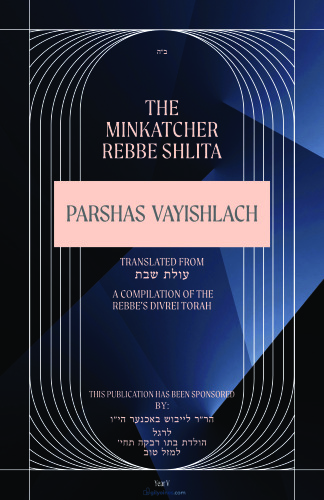
Text of this gilyon
:
ב”ה
THE
MINKATCHER
REBBE SHLITA
PARSHAS VAYISHLACH
TRANSLATED FROM
עולת שבת
A COMPILATION OF THE
REBBE’S DIVREI TORAH
THIS PUBLICATION HAS BEEN SPONSORED
BY:
הר"ר לייבוש באכנער הי"ו
לרגל
'הולדת בתו רבקה תחי
למזל טוב
Year V
PARSHAS VAYISHLACH
ַׁלח ַיַ ֲֲעֹקֹב ַַמ ְְלָאָ ִִכים ְְל ָָפָנָ יו ֶֶאל ֵֵע ָׂׂשו
ַ ַַוִּיּ ְׁש
.ְׂשֵׂדה ֱֱאדֹום ֵ ֵׂשִׂעיר ִ ָאִָחיו ַַא ְְר ָָצה ִ
And Yaakov sent malachim ahead of him to Esav
his brother, to the land of Seir, the field of Edom.
(Bereishis 32:4)
A SHABBOS WITHOUT
BOUNDARIES
Parshas Vayishlach opens with Yaakov dispatching messengers to his
brother Esav “in the land of Seir and the fields of Edom.” Rashi notes that
these messengers were מלאכים ממש, an intriguing lashon that invites further
explanation.
The Midrash expounds upon a subsequent pasuk in the parshah (Bereishis
33:18), “ – ויחן את פני העירAnd he encamped before the city,” and explains
that Yaakov arrived at the city on Friday afternoon, just before the onset of
Shabbos, and while it was still day, established his techumim—the boundaries
within which he would be permitted to walk on Shabbos. In the merit of this
shemiras Shabbos, he was granted an “inheritance without measure,” as the
pasuk states (Bereishis 28:14), והיה זרעך כעפר הארץ ופרצת ימה וקדמה וצפונה
2 The Minkatcher Rebbe on Parshas Vayishlach
“ – ונגבהAnd your offspring shall be like the dust of the earth, and you shall
spread out to the west and to the east, to the north and to the south.”
This Midrash, too, and the correlation it draws between shemiras Shabbos and
the boundless nature of Yaakov’s inheritance, warrants further understanding.
Shabbos is just one of the seven-day week; why should a mitzvah bound to
a single day be rewarded with an inheritance that has no boundaries at all?
The Soul of the Week
A human being is comprised of both a guf and a neshamah, but it is the
neshamah that enlivens the guf and gives it its essential form; without
the neshamah, the body has no existence of its own. A similar relationship
characterizes the seven days of Creation. The six days of work constitute,
as it were, the body of the world. And with the advent of the seventh day,
creation was brought to completion, and the world was endowed with its
neshamah—the kedushah of Shabbos. My grandfather, the Bnei Yissaschar
(see Maamarei HaShabbosos 6:7), elaborates upon this concept at length.
It follows, then, that although Shabbos is but one day of seven, the radiance of
its kedushah is by no means confined to that day. Just as a person’s neshamah
is not confined to any one limb but infuses every part of his being with life, so
does the light of Shabbos permeate each of the six days of the week. Indeed,
it is through its koach that the world derives its continued existence.
With this understanding, it is clear why Yaakov’s shemiras Shabbos endowed
him with a boundless inheritance. Shabbos, being the very soul of the world,
radiates a kedushah that transcends the defined parameters of time and
place, and embraces the entire expanse of Creation. Therefore, the nachalah
granted to Yaakov in merit of his Shabbos observance reflects that same
unbounded nature. Rather than being confined to the limitations of time or
the geographical boundaries of any particular place, his inheritance would
embody the brachah, “And you shall spread out to the west and to the east, to
the north and to the south.”
Moreover, this extraordinary nachalah is not exclusive to Yaakov Avinu. Every
Yid, through his own oneg Shabbos, can merit a share of that very boundless
Translated and Published ( פרשת וישלח תשפ"זYear V) 3
inheritance. As Chazal (Shabbos 118a) have promised, המענג את השבת נותנין
“ – לו נחלה בלי מצריםOne who delights in Shabbos is granted a nachalah
without boundaries,” as the pasuk states (Yeshayahu 58:14), אז תתענג על ד׳
“ – וגו׳ והאכלתיך נחלת יעקב אביךThen you shall delight in Hashem…and I will
feed you the nachalah of Yaakov, your father.”
This is perhaps what Rashi alludes to in his lashon of מלאכים ממש. The letters
of ממשare the roshei teivos of מצות שבת מלכתא—the mitzvah of the Shabbos
Queen, for it was precisely by virtue of the kedushah of Shabbos, through
which Yaakov Avinu had merited a nachalah without boundaries, that he was
empowered to dispatch these malachim even to “the land of Seir, the field
of Edom.” Indeed, so far-reaching is the radiance of Shabbos that it extends
even into the domain of Esav, where it has the koach to nullify the spiritual
dominion of Edom and render that very place part of nachalas Yaakov.
Two Camps or One
The significance of this boundless nachalah becomes even more apparent
in the episode immediately preceding Yaakov’s dispatch of these malachim.
The Torah relates (Bereishis 32:2–3), .ויעקב הלך לדרכו ויפגעו בו מלאכי אלקים
“ – ויאמר יעקב כאשר ראם מחנה אלקים זה ויקרא שם המקום ההוא מחניםAnd
Yaakov went on his way, and malachim of G-d met him. And Yaakov said
when he saw them, ‘This is the camp of G-d,’ and he called the name of that
place Machanayim.”
Rashi explains that מחניםrefers to two camps: “one consisting of malachim
ministering in chutz la’aretz who had accompanied him thus far, and the other
of those ministering in Eretz Yisrael who had come to greet him.”
However, the juxtaposition of these two expressions is somewhat perplexing.
If, upon beholding the malachim, Yaakov declared מחנה אלקים זה, referring
to them collectively as a single מחנה, why did he proceed to name the place
מחנים, a term that denotes the presence of two distinct camps?
Because for Yaakov Avinu, having merited a nachalah without boundaries, the
entire world was an extension of Eretz Yisrael, akin to the reality Chazal (Yalkut
4 The Minkatcher Rebbe on Parshas Vayishlach
Shimoni, Yeshayahu 503) describe, עתידה ארץ ישראל להיות ככל העולם כולו
– “Eretz Yisrael is destined to be like the entire world.”
Thus, although there were indeed two distinct camps of malachim—from
chutz la’aretz and Eretz Yisrael—the distinction between them no longer
held any significance from the perspective of Yaakov’s exalted madreigah.
His spiritual perception of the world transcended the very boundaries that
differentiated one camp from the other, and as such, he beheld them as a
single entity, declaring מחנה אלקים זה.
However, within the present order of Creation in which the distinction between
Eretz Yisrael and chutz la’aretz remains a palpable reality, these malachim still
constituted two separate camps. Therefore, Yaakov named the place מחנים,
acknowledging how they are perceived by the world at large.
To Guard You in All Your Ways
The truth is that even this madreigah does not belong to Yaakov Avinu alone;
it can be attained by every Yid as he ushers in the Shabbos HaMalkah. Each
Friday night, when we sing Shalom Aleichem, we welcome into our homes the
two malachei hashareis who, as Chazal teach (Shabbos 119b), accompany a
person from the beis knesses to his home.
Just as Yaakov Avinu was accompanied by both the malachim of chutz la’aretz
and Eretz Yisrael, so, too, as we are mekabel Shabbos, we find ourselves in the
presence of two camps of malachim—those associated with the six days of
work, who have accompanied us throughout the week, and those of Shabbos
Kodesh, who now arrive to greet us.
A Yid who strives to draw the light of kedushas haShabbos—the very
neshamah of the weekdays—into his daily pursuits, conducting his affairs
and seeking his livelihood with sincere emunah, effectively transforms the
very nature of his weekdays, imbuing them with the sanctity of Shabbos itself.
Thus, the distinction between these two camps of malachim dissipates for
him too, just as it did for Yaakov Avinu.
This reveals yet another dimension of מלאכים ממש. As the two camps of
malachim become one, they bring together the unique virtues of both: The
malachim of Shabbos impart a sublime kedushah, while the malachim of the
Translated and Published ( פרשת וישלח תשפ"זYear V) 5
weekdays provide the koach through which that very brachah can assume an
expression even in the “mamashus”—the tangible, physical reality of this world.
Thus, the presence of these malachim in the life of a Yid is no longer confined
to Shabbos. Having drawn the light of Shabbos into his weekday pursuits, he
merits their companionship along all the paths of his life. They safeguard him
in his endeavors and clear the path before him, even as he traverses the dark
terrain of galus—the “land of Seir, the field of Edom.”
This is perhaps the significance of the pasuk we recite each Friday night upon
concluding Shalom Aleichem (Tehillim 91:11), כי מלאכיו יצוה לך לשמרך בכל
“ – דרכיךFor He will command His malachim on your behalf, to guard you in all
your ways.” By welcoming the malachim into our homes on Friday night, we
invite their protection not only into the sacred hours of Shabbos, but into every
facet of our lives throughout the coming week.
Moreover, since the union of these two camps enables the kedushah of
Shabbos to find expression within the physical world, the brachos that flow
through these malachim are not confined to the realm of ruchniyus. They
become manifest in the most tangible aspects of a person’s life—in his
parnassah, in his home, and in all his material needs, allowing him to perceive
the kindness of Hashem even with his physical eyes
And although a person may not merit to behold the malachim themselves, as did
Yaakov Avinu, of whom the pasuk states, “And Yaakov said when he saw them,”
he can nevertheless merit to behold the brachos they bring into his life. A beautiful
remez to this is also found in the word ממש, whose numerical value is equivalent
to that of “ – הראנו הוי״ה חסדךShow us Your kindness, Hashem” (Tehillim 85:8).
A Gift, a Tefillah, and a Battle
A further dimension of this idea appears in how Yaakov Avinu prepared for his
encounter with Esav. The pasuk (Bereishis 32:9) states, “And the remaining
camp shall escape,” and Rashi explains, “He prepared himself for three things:
for a gift, for tefillah, and for battle.” What is particularly striking is that each of
these three forms of preparation can be understood as an expression of the
koach of kedushas haShabbos, through which Yaakov Avinu was empowered
to emerge victorious against Esav.
6 The Minkatcher Rebbe on Parshas Vayishlach
In expounding upon the pasuk (Iyov 5:7), “ – ובני רשף יגביהו עוףAnd the sons
of reshef fly upward,” Chazal (Brachos 5a) associate the word רשףwith
both mazikin (destructive forces) and yissurin (suffering). Yaakov’s decision
to present Esav with a gift consisting specifically of five hundred and eighty
animals, corresponding to the numerical value of רשף, was thus intended to
subdue the mazikin to which this word alludes.
My grandfather, the Bnei Yissaschar (Maamarei HaShabbosos 1:5; 2:3),
extensively explains that shemiras Shabbos possesses the unique koach to
nullify the mazikin alluded to in the word רשף. We can thus conclude that the
spiritual efficacy of the very gift Yaakov prepared for Esav was derived from
the kedushah of Shabbos, whose radiance extends even into the nachalah of
Esav and nullifies the dominion of the kelipah therein.
Likewise, the efficacy of Yaakov’s tefillah can be traced to the unique virtue of
tefillos offered on Shabbos, which the seforim hakedoshim explain is alluded
to in the words of R’ Chanina ben Dosa (Brachos 34b), אם שגורה תפלתי בפי
“ – יודע אני שהוא מקובלIf my tefillah flows fluently in my mouth, I know that
it is accepted.” The roshei teivos of שגורה תפלתי בפיare the letters of שבת,
suggesting that among the special segulos of this holy day is the favor with
which our tefillos are received by Hashem.
And as for Yaakov’s preparation for battle, its connection to Shabbos can be
understood in light of the extraordinary kedushah inherent in the Shabbos
seudos. When a Yid sets his table and partakes of his seudos in honor of
Shabbos kodesh, thereby permeating the physical act of eating with the
sanctity of the day, his very table becomes a source of strength through
which he can withstand and subdue his adversaries. This is alluded to in the
words of the pasuk that we recite at each of the three seudos (Tehillim 23:5),
“ – תערך לפני שלחן נגד צרריYou set a table before me against my adversaries.”
Indeed, all three forms of Yaakov’s preparations—his gift, his tefillah, and
his readiness for battle—were encompassed within those מלאכים ממש, the
malachim engendered by the kedushah of the Shabbos haMalkah, through
whose koach Yaakov prevailed against Esav.
Translated and Published ( פרשת וישלח תשפ"זYear V) 7
This very koach remains inherent in every Shabbos and is available to
every Yid. The malachim whom a Yid welcomes with the singing of Shalom
Aleichem on Friday night are the very ones who will accompany him into the
week ahead. Through the kedushah of Shabbos, the tefillos and the seudos he
partakes of in honor of the day, he, too, prepares himself to confront the Esav’s
in his own life with a gift, a tefillah, and a readiness for battle. His own journey
through the land of Seir and the field of Edom may take the form of a trying
day at home, uncertainties surrounding parnassah, or an unforeseen struggle
that initially seems insurmountable. Yet he can confront these challenges with
the fortitude that comes from knowing that he is not traversing that terrain
alone—there are מלאכים ממשlighting his way.
May it be the will of Hashem that we merit to welcome the Shabbos Queen
with an abundance of simchah, and to draw the radiance of her kedushah
into each of the seemingly ordinary days of our week. May מלאכים ממש
accompany us along all our paths, safeguarding us in ruchniyus and in
gashmiyus as we journey through the land of Seir and the field of Edom, until
we merit the fulfillment of Yaakov Avinu’s tefillah, “And I will return in peace to
my father’s house, and Hashem will be my G-d,” when “The glory of Hashem
shall be revealed, and all flesh together shall see that the mouth of Hashem
has spoken,” with the arrival of ben Dovid, speedily in our days, through His
abundant mercy and kindness.
To receive our translations of Olas Shabbos directly to your inbox,
please email ‘Munkatch’ to: torah.subscribers@gmail.com
For sponsorship opportunities or to dedicate this publicationin honor of a
loved one, celebration, or Yahrtzeit, etc. please click on the link below.
https://tapcube.co/TORAH
8 The Minkatcher Rebbe on Parshas Vayishlach