
The Maharsham Project - English
Text of this gilyon
W E E K LY T E S H U VA H I N S I G H T S F R O M T H E M A H A R S H A M O F B R E Z H A N
THE
MAHARSHAM שו״ת מהרש״ם
P R O J E C T
Issue No. 36 · Parashas Vayishlach 5787 · Shu"t Maharsham III:198, III:181, II:122
The Governor Comes on Shabbos
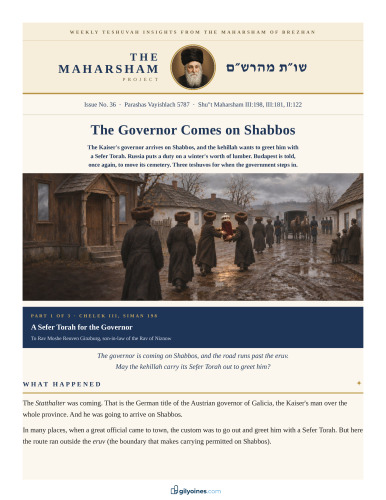
The Kaiser's governor arrives on Shabbos, and the kehillah wants to greet him with
a Sefer Torah. Russia puts a duty on a winter's worth of lumber. Budapest is told,
once again, to move its cemetery. Three teshuvos for when the government steps in.
PA RT 1 O F 3 · C H E L E K I I I , S I M A N 1 9 8
A Sefer Torah for the Governor
To Rav Moshe Reuven Ginzburg, son-in-law of the Rav of Niznow
The governor is coming on Shabbos, and the road runs past the eruv.
May the kehillah carry its Sefer Torah out to greet him?
W H AT H A P P E N E D ✦
The Statthalter was coming. That is the German title of the Austrian governor of Galicia, the Kaiser's man over the
whole province. And he was going to arrive on Shabbos.
In many places, when a great official came to town, the custom was to go out and greet him with a Sefer Torah. But here
the route ran outside the eruv (the boundary that makes carrying permitted on Shabbos).
Rav Moshe Reuven Ginzburg, son-in-law of the Rav of Niznow, had already built an argument. Our streets today, he
wrote, are only a karmelis (an area where carrying is forbidden only by the Rabbis, not by the Torah). If so, the
prohibition is only rabbinic, and Chazal tell that kohanim would leap over coffins to greet kings, out of honor for the
king (Berachos 19b). He added that the Magen Avraham (Orach Chaim 658) permits even a lo sa'aseh out of fear of
the government.
THE QUESTION
May the kehillah carry a Sefer Torah outside the eruv on Shabbos, to greet the governor?
THE KEY IDEA ✦
Asked before. The Maharsham accepts the karmelis point: poskim before him settled at length that today there is no
true reshus harabim (a public domain by Torah law). But he does not rest the psak on the coffins or on fear of the
government. He opens with earlier answers. The Radbaz was asked about places where the custom was to bring out a
Sefer Torah to greet the local ruler. He lists better options side by side: put the matter off, or pay so it need not be
brought out on Shabbos, or carry it less than four amos at a time, or have many people carry it, each handing it to the
next. If none of that works, he says, let a non-Jew carry it, and not a Jew:
שאין כבודו של ספר תורה שיחללו עליו השבת
"For it is not the honor of a Sefer Torah that Shabbos be broken for its sake."
The Kesav Sofer (Orach Chaim 37) saw it differently. He permitted carrying out a Sefer Torah to greet the king, since
the custom was already set, and held that a non-Jew carrying it would itself disgrace the Torah. If a child can carry it, all
the better. So the two disagree at the last step.
Does a governor count? The Kesav Sofer spoke of a king. The Radbaz may have meant a ruler in his own right. A
Statthalter is neither: he is an appointee. The Maharsham answers that the Shulchan Aruch (Orach Chaim 325) leaves
room to be lenient even with a non-Jew who is only somewhat menacing.
Hand to hand. But there is a simpler way. The Taz (Orach Chaim 349) writes that an object may be moved through
several people, each carrying it less than four amos. The prohibition is moving an object four amos in the street. If each
person hands it on before four amos, no one has done the forbidden act. The Taz adds that even so, one may not bring it
out of the private domain, here the shul, into the street. For that step, the Maharsham points to the Even HaOzer,1 who
worked out several ways to do it.
ועכ״פ ע״י כמה אנשים ודאי דשרי ולכן יעשו כן בנ״ד
"At any rate, through several people it is certainly permitted, and so they should do in our case."
1 Even HaOzer ( )אבן העוזרis a commentary on Shulchan Aruch. It is not the Even HaEzer section of Shulchan Aruch.
THE ANSWER
The Sefer Torah may be carried out to greet the governor, passed through several people so that no one carries it
four amos. For bringing it out of the shul and back in, they follow the methods of the Even HaOzer.
GOING DEEPER
The custom. Galician Jews really did go out to greet their rulers with a Sefer Torah. A photograph survives of the Jews of Kolomea
greeting Emperor Karl I this way, a few years after the Maharsham's petirah.
A shvus d'shvus. On the menacing non-Jew, the Maharsham adds that according to the Pri Megadim, a person may then even do a
shvus d'shvus himself (a rabbinic prohibition built on another one). He does not rest the case there.
A challenge from Yom Kippur. The Tashbetz brought a proof that even short carrying is not allowed for the Torah's honor: in Yoma
(70a), as Rashi explains, the Yom Kippur Sefer Torah was brought in the day before. Why not carry it on the day, a little at a time? The
Maharsham is surprised. It could still have been passed through several people. And according to the Taz, who forbids bringing it out
of the private domain this way in any case, there is no question at all. Besides, since it could be brought the day before, there was no
reason to carry it on Yom Kippur. Our case has no day before. The governor comes when he comes.
To say at the table: When the governor came on Shabbos, the Maharsham said: no one carries the Torah four amos. Hand it from
man to man.
PA RT 2 O F 3 · C H E L E K I I I , S I M A N 1 8 1
The Lumber and the Russian Duty
To Rav Moshe Kasten Brahn of Vizhnitz
The boards were sold in winter. Then Russia put a duty on them.
Who pays the tariff?
W H AT H A P P E N E D ✦
Over the winter, people of the community sold a great many boards to Russian merchants. The merchants planned to
float the lumber home on rafts down the Cheremosh river.
Then Russia put a duty on the boards. It came to nearly a third of the price. The profit was gone, and the merchants
would now lose part of the money they had put in. They wanted to cancel the sale.
The Rav who asked had found an earlier teshuvah about merchants who bought flax on credit. But he saw a difference
himself: there, the goods could not be loaded at all. Here, the merchants could still ship the boards, if they paid the duty.
THE QUESTION
A new tax landed on goods after they were sold. Can the buyers cancel the sale?
THE KEY IDEA ✦
A regional disaster? The halachah knows a makas medinah (a calamity that strikes the whole region). When a man
rents a field and a regional disaster ruins the crop, he may pay less. A Russian tariff hits every merchant on the river.
Does that count? Not for a sale. The Maharsham had already written, citing the Nimukei Yosef, that makas medinah
does not apply to a sale at all. Rent pays for ongoing use. Once something is sold, it is yours, and so is whatever
happens to it.
The king's war. Then he brings a case from the Rivash (426). A man bought from the kehillah the right to collect its tax
on wine and meat for a year. The kehillah signed that if any challenge to the tax came from the king, they would cover
the loss. Later the government ordered everyone who was not a permanent resident to leave the city. Most of the tax
came from exactly those people. The buyer lost his profit and his principal, and he sued the kehillah. The Rivash said
no. This was any loss that comes from the world, and he gave his famous example:
זה לא יעלה על לב אדם... הגע עצמך אם המלך יעיר מלחמה על אויבו ויסגור העיר
"Consider: if the king starts a war against his enemy and closes the city... would the buyer say the kehillah must pay him? That would never
occur to anyone."
The Maharsham draws the lesson. There, with a signed guarantee, the buyer still lost. Without it, no one would even
think of canceling. It is nistachfa sadeihu, "his field was flooded": bad luck that falls on whoever owns the thing when it
strikes. When the duty came, the boards belonged to the Russian merchants.
One exception. If someone bought after the decree was already issued, before it was public, and he did not know, the
sale is surely void. That is a hidden defect in what he bought, and overcharging. A buyer takes on what happens after the
sale, not a loss that already existed when he paid.
THE ANSWER
הדין עם המוכרים: the sellers are right. The duty came after the sale, so it is the buyers' loss, and they cannot
cancel. Only one who bought after the decree was issued, without knowing of it, may undo the sale.
GOING DEEPER
The riverbank. The same letter had a second question. For years, the timber merchants had rented a strip of riverbank each year from
the local landowner, to keep their wood where the water could not carry it off. Now one man had leased the whole estate, riverbank
included, and the merchants cried out that he had cut off their livelihood. The neighbor's right of first refusal does not help them, the
Maharsham says, since the man leased the entire estate. But it seems to him that the takanah of Rabbeinu Gershom applies, and the
Maharam Padua (41) writes that it covers every livelihood, not only a house. And the Bach (60) writes that where the livelihood of
many is at stake, even an individual with an established right gives way. "So too in our case, as it seems to my humble opinion."
To say at the table: The Rivash said: if the king starts a war, does the tax buyer get his money back? That would never occur to
anyone. So a tariff after the sale is the buyer's loss.
PA RT 3 O F 3 · C H E L E K I I , S I M A N 1 2 2
The Stones of the Second Cemetery
To Rav Eliezer Pollak, Rav in Budapest
Forty thousand graves to move, and nowhere to put the stones.
May the Chevra Kadisha sell the old matzevos?
W H AT H A P P E N E D ✦
For more than a hundred years, the government had let Jews live in the city. They began as a few families and grew into
a kehillah. But they were never allowed to buy a cemetery outright. They could have one only on a condition: once it
filled, the dead and the matzevos would be moved, and the ground plowed or built over.
When the first cemetery filled, they turned to a second, on the same terms. About twenty-eight years ago, the second
filled too. The city had grown up to its edge, so the government closed it and ordered that after thirty years everyone
buried there, and every matzevah, be moved. A third cemetery filled and closed as well. The government gave them a
fourth, several parsa'os from the city.
Now the time had come to clear the second cemetery: about forty thousand graves and about 6,200 matzevos. Moving
the remains and the stones would cost 200,000 gulden. There was nowhere to put the old matzevos. The only choice
was to buy a large field, wall it in, and post guards day and night, at a cost of a hundred thousand more. It would
swallow everything the Chevra Kadisha had, and end all its chesed for the living and the dead.
THE QUESTION
May the Chevra Kadisha sell the old matzevos, which can no longer stand on their graves?
THE KEY IDEA ✦
What would be sold. The Maharsham first states how he understands the case. The remains would be reinterred
together, so each stone could not stand over its own grave again. And the Chevra Kadisha wanted to sell them for
other graves.
From one grave to another. Is it a lowering of holiness to give one person's stone to another? Perhaps the first was a
greater tzaddik. The Taz (Orach Chaim 154:8) writes that this rule applies only when an object is still fit for its higher
use. When it is not, it is better to use it for a lower holiness than not at all: worn-out mantles of a Sefer Torah are made
into shrouds for a meis. Not everyone agrees with the Taz, but his view has been defended at length.
Where the money goes. Things that belong to a grave are assur b'hana'ah (forbidden for any benefit). The Kesav Sofer
(Yoreh De'ah 173) wrote that one may bury another meis in a grave, because mitzvos lav lehenos nitnu: using something
for a mitzvah is not counted as benefit. But for a matzevah he leaned toward a chumra, since a matzevah is only a
custom. Here the Maharsham makes his move. Every coin from this sale goes only to mitzvos: visiting the sick,
supporting Torah learning, the poor, and burying the dead. So one can say that according to all views it is not counted as
benefit at all. ושרי למכרם: it is permitted to sell them.
THE ANSWER
The Chevra Kadisha may sell the old matzevos, since all the money goes only to mitzvos. But only if all the
rabbanim of the city agree:
וכל זה באופן שיסכימו כל רבני העיר בזה ואם לאו בטלה דעתי ואין רצוני שיסמכו עליו בדבר גדול כזה
"If not, my opinion is void, and I do not want them to rely on it in so great a matter."
GOING DEEPER
Torah or rabbinic? Rav Pollak had cited the Divrei Shmuel, that selling a grave's things for another meis is only rabbinic. The
Maharsham agrees he learned well: here, too, the stones go to other graves, so at most it is a doubt in a rabbinic matter. What he rejects
is the Maharashdam's broader claim that benefit from a grave is always rabbinic. Rashi (Sanhedrin 47b) and others hold it is from
the Torah.
Temporary from the start? Rav Pollak argued that the kehillah bought each cemetery knowing the dead would be moved, as if a
condition was made from the start. The Maharsham calls it a good point but weighs the other side. Chazal say a decree tends to be
cancelled (Kesubos 3b). A decree that touched only Jews, and was not born of hatred, could well have been lifted. So this is only a
supporting reason, alongside the main one.
To say at the table: The Maharsham permitted selling 6,200 old matzevos, and then wrote: if the rabbanim of the city do not agree,
my opinion is void.
W H Y I T M AT T E R S ✦
This week Yaakov prepares to meet Esav. In these three letters, Jews in Galicia, Bukovina and Hungary are dealing with
the powers of their own day. None of them asks whether to obey the government. The governor will come on Shabbos,
the duty will be charged, the cemetery will be cleared. The question is what halachah asks of a Jew inside a decision
someone else has already made.
Each time, the Maharsham finds the answer in a detail: who carries the Torah how far, who owned the boards when the
duty came, where the money from the stones will go. And in the hardest of the three, with forty thousand graves to
move, he gives his heter and then refuses to let it stand on his word alone.
THE BOTTOM LINE
1. The Sefer Torah 2. The Lumber 3. The Matzevos
It may be carried out to greet the The duty came after the sale, so the loss is They may be sold, since every coin goes
governor, passed from hand to hand so the buyers'. They cannot cancel. to mitzvos, but only if all the rabbanim of
that no one carries it four amos. the city agree. Otherwise, he writes, "my
opinion is void."
KEY TERMS Four amos · ד׳ אמותAbout six to seven feet; Nistachfa sadeihu · " נסתחפה שדהוHis field
carrying that far in the street is the forbidden act. was flooded": a loss falls on whoever owns
Karmelis · כרמליתAn area where carrying is the thing.
Makas medinah · מכת מדינהA calamity
forbidden only by the Rabbis.
striking a whole region. It can reduce a rent, not
undo a sale.
Mitzvos lav lehenos nitnu · מצות לאו ליהנות Assur b'hana'ah · אסור בהנאהForbidden for
ניתנוUsing something for a mitzvah is not any benefit.
counted as benefit.
COMING NEXT WEEK · A CHANUKAH ISSUE
A traveler is on an overnight train when Chanukah comes: may he
light his candles there? The Rav of Chortkov asks about a statue his
community wanted to put at the public water trough. And a beis medrash
bought an iron stove from a Vienna factory with raised crosses on it.
SOURCES ✦
SOURCE W H AT I T S AY S W H AT I T D O E S H E R E
בית לחם יהודה יו״ד סי׳ רפ״ב ס״ק ו׳ Better options first, then a non-Jew; a non-Jew carrying is a disgrace. Part 1: earlier answers.
בשם הרדב״ז; כתב סופר או״ח ל״ז
שו״ע או״ח שכ״ה ופמ״ג; ט״ז או״ח A somewhat menacing non-Jew; hand to hand; leaving the shul. Part 1: the psak.
שמ״ט; אבן העוזר
יומא ע׳ ע״א ורש״י; תשב״ץ ח״ב רפ״א The Yom Kippur Sefer Torah was brought the day before. Part 1: a challenge he answers.
נמוקי יוסף; ריב״ש תכ״ו No makas medinah in a sale; the king's war. Part 2: the loss is the buyers'.
שו״ת מהר״ם פדואה סי׳ מ״א; שו״ת Rabbeinu Gershom's takanah covers every livelihood; the many outweigh Part 2: the riverbank.
ב״ח סי׳ ס׳ one.
ט״ז או״ח קנ״ד ס״ק ח׳; מגילה כו ע״ב Lowering holiness when the higher use is gone. Part 3: one grave's stone for another.
כתב סופר יו״ד קע״ג; רש״י סנהדרין מז A mitzvah is not benefit; a matzevah; a decree tends to be cancelled. Part 3: the main reason and a supporting
one.
ע״ב; כתובות ג ע״ב
W H O WA S T H E M A H A R S H A M ?
Rabbi Shalom Mordechai HaKohen Schwadron, ben HaRav Moshe (1835–1911), served as the Rav of Brezhan in Galicia for thirty
years, from 1881 until his passing. He is best known for his Shu"t Maharsham, thousands of teshuvos on every area of halachah, and
his Da'as Torah commentary on Shulchan Aruch. He was regarded as one of the foremost poskim of his generation, and his piskei
halachah are cited to this day.
R E C E I V E T H E M A H A R S H A M P R O J E C T E V E RY W E E K
Don't miss next week's issue. Scan the QR code or visit kechnia.org/maharsham, and get it free in your inbox every week.
This English adaptation with explanatory commentary is presented for Torah study and enrichment only. It is not intended as halachah l'maaseh. The translator has
made every effort to render the Maharsham's words faithfully, but this English adaptation may contain errors or imprecisions. For any practical halachic question,
consult your own Rav.
The Maharsham Project · kechnia.org/maharsham · · לעילוי נשמת הגה״ק רבי שלום מרדכי בן רבי משה הכהן זצללה״הinfo@kechnia.org