
Clarity for Teens - English
Text of this gilyon
PARSHA CLARITY • PARSHAS VAYISHLACH
PARSHA CLARITY • PARSHAS VAYISHLACH
BURNING DESIRES
— ❦ —
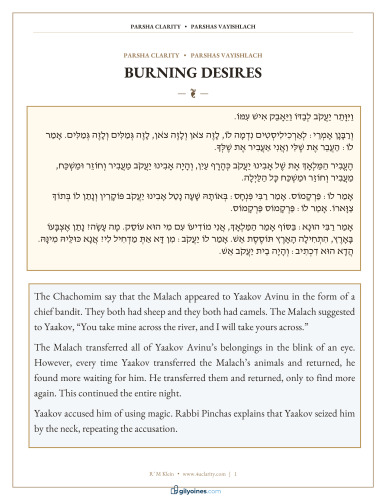
.ַו ִּיו ֵָּתר ַי ֲעקֹב לְבַ ּדֹו ַוי ֵָּאבֵ ק ִּאיׁש עִּ ּמֹו
ָּאמַ ר. ָּלזֶה גְ מַ לִּים וְ ָּלזֶה גְ מַ לִּים, ָּלזֶה צ ֹאן וְ ָּלזֶה צ ֹאן,ִּיס ִּטים נ ְִּדמָּ ה לֹו
ְ ל ְַא ְרכִּ יל:וְ ַרבָּ נָּן ָּא ְמ ֵרי
. הַ עֲבֵ ר ֶאת ׁשֶ לִּי וַאֲ נִּי ַאעֲבִּ יר ֶאת ׁשֶ לְָך:לֹו
, וְ הָּ יָּה ָּאבִּ ינו ַי ֲעקֹב מַ עֲבִּ יר וְ חֹוזֵר ומַ ְׁשכַח,הֶ עֱבִּ יר הַ ּמַ ל ְָּאְך ֶאת ׁשֶ ל ָּאבִּ ינו ַי ֲעקֹב כְ הֶ ֶרף עַ יִּן
.מַ עֲבִּ יר וְ חֹוזֵר ומַ ְׁשכַח כָּל הַ ַל ְילָּה
פֹוק ִּרין וְ נ ַָּתן לֹו בְ תֹוְך
ָּ אֹותּה ׁשָּ עָּ ה נָּטַ ל ָּאבִּ ינו ַי ֲעקֹב
ָּ ְ ב: ָּאמַ ר ַרבִּ י פִּ נְחָּ ס. פ ְַר ָּקמֹוס:ָּאמַ ר לֹו
. פ ְַר ָּקמֹוס פ ְַר ָּקמֹוס: ָּאמַ ר לֹו.צַ וָּארֹו
מֶ ה עָּ שָּ ה? נ ַָּתן ֶאצְ בָּ עֹו.מֹודיעֹו עִּ ם ִּמי הוא עֹוסֵ קִּ אֲ נִּי, בַ ּסֹוף ָּאמַ ר הַ ּמַ ל ְָּאְך:ָּאמַ ר ַרבִּ י הונָּא
. ִּמן ּדָּ א ַא ְּת מַ ְד ִּחיל לִּי? אֲ נָּא כולֵיּה ִּמינָּּה: ָּאמַ ר לֹו ַי ֲעקֹב. ִּה ְת ִּחילָּה הָּ ָּא ֶרץ ּתֹוסֶ סֶ ת ֵאׁש,בָּ ָּא ֶרץ
. וְ הָּ יָּה בֵ ית ַי ֲעקֹב ֵאׁש:הֲ דָּ א הוא ִּדכְ ִּתיב
The Chachomim say that the Malach appeared to Yaakov Avinu in the form of a
chief bandit. They both had sheep and they both had camels. The Malach suggested
to Yaakov, “You take mine across the river, and I will take yours across.”
The Malach transferred all of Yaakov Avinu’s belongings in the blink of an eye.
However, every time Yaakov transferred the Malach’s animals and returned, he
found more waiting for him. He transferred them and returned, only to find more
again. This continued the entire night.
Yaakov accused him of using magic. Rabbi Pinchas explains that Yaakov seized him
by the neck, repeating the accusation.
R’ M Klein • www.4uclarity.com | 1
PARSHA CLARITY • PARSHAS VAYISHLACH
Rabbi Huna says that eventually the Malach said, “I will show him who he is
dealing with.” He placed his finger into the ground, and the ground began to erupt
in fire.
Yaakov replied, “Is this what you are trying to frighten me with? I am made entirely
of that!” As the Posuk says, “The house of Yaakov will be fire”
— ❦ —
There is a fascinating exchange taking place in this Medrash, but the more we look at it, the more
questions we seem to have. Why does the Malach appear specifically as a chief bandit? Why
suggest that each should take the other’s animals across, rather than simply moving his own? Why
does Yaakov keep finding more sheep and camels every time he returns? What exactly is the
“magic” he accuses the Malach of using? And after all that, why does their argument suddenly
become a competition about fire?
Perhaps the biggest question is Yaakov’s answer. The Malach puts his finger into the earth and fire
bursts out. Yaakov is not impressed. “You are trying to frighten me with fire? I am made of fire!”
What does that mean, and how does it answer everything that came before?
To understand the ending, we first need to look at the posuk the Medrash quotes from
:Ovadiah
, וְ ל ֹא י ְִּהיֶה שָּ ִּריד לְבֵ ית עֵ שָּ ו, וְ דָּ לְקו בָּ הֶ ם וַאֲ כָּלום,“וְ הָּ יָּה בֵ ית ַי ֲעקֹב ֵאׁש ובֵ ית יֹוסֵ ף לֶהָּ בָּ ה ובֵ ית עֵ שָּ ו ל ְַקׁש
”.כִּ י ה׳ ִּּדבֵ ר
The house of Yaakov will be fire, the house of Yosef a flame and the house of Esav straw.
The fire will consume the straw until nothing remains.
R’ M Klein • www.4uclarity.com | 2
PARSHA CLARITY • PARSHAS VAYISHLACH
The Malbim explains the picture of the future struggle described by the Novi. Fire burns what is
close to it, whilst a flame can reach farther. Beis Yaakov is described as fire and Beis Yosef as a
flame, reaching even those who are farther away. Esav, by contrast, is compared to straw: once the
fire catches it, the burning spreads from one piece to the next. What looked like a great pile can
disappear remarkably quickly.
Let us go back to the chief bandit. A bandit is not simply another farmer with animals to move.
He is someone who is out to take something from you, even if he appears to be offering a fair deal.
Here the Malach proposes something that sounds wonderfully reasonable: “You help me, and I’ll
help you.” He moves Yaakov’s animals in a moment. But Yaakov’s job is never finished. Each time
he crosses the river, there is more waiting. Then more. And more again, all night long.
Why the strange exchange? Because that is exactly how the trap begins. Yaakov is drawn into
dealing with the Malach’s possessions instead of simply continuing with his own journey.
And why do more and more animals keep appearing? Because that is exactly how the yetzer hora
works. He keeps presenting us with something new, making us feel that there is always more
enjoyment waiting for us.
But in reality, it is all the same fake pleasure, dressed up to look new each time. We think we
are enjoying ourselves again and again, discovering something new and exciting. Yet really, we are
just going round in circles, chasing the same empty pleasure that the trickster keeps putting in
front of us.
And perhaps that is why Yaakov calls it magic. The trick is not that there is really more. The
trick is that he makes us believe there is more. Something that looks so exciting and enjoyable
turns into an endless cycle, where we keep coming back for more, without ever feeling truly
satisfied.
Does that sound familiar? First there is one interesting thing. Then another. A video leads to a
second video; a game leads to one more level; a message needs a reply, which creates another
message. The yetzer hora does not always arrive looking frightening. Sometimes he arrives like
someone offering a very good deal. But soon we discover that our attention has been taken across
the river, again and again, and we still have not finished.
R’ M Klein • www.4uclarity.com | 3
PARSHA CLARITY • PARSHAS VAYISHLACH
Yaakov does not simply continue the arrangement forever. He recognises what is happening and
confronts the Malach. In the Medrash he grabs him by the neck. The struggle has become direct.
Yet even then the Malach has another move. When he sees that Yaakov is fighting back, he puts his
finger into the earth and makes it burst into fire. He is effectively saying, “You think you can fight
me? Let me show you what I can do.”
Here is where I would suggest a deeper meaning. The earth can represent the world of gashmiyus.
The Malach’s fire represents its excitement, its attractions and its power to make a person feel that
something is too interesting to miss. The first tactic was to keep Yaakov busy with more and more.
The last tactic is to make the whole thing look irresistible. “I can make your world light up,” he
seems to be saying. “I can give you excitement you have never experienced.”
There is another point here which, to me, makes the ending of this Medrash even more powerful.
This fight takes place at the very end of Yaakov’s long night. The morning is about to break. And
the Malbim, in explaining the posuk in Ovadiah, is describing the final struggle connected with
the war of Gog uMagog, when the fire of Beis Yaakov and the flame of Beis Yosef will overcome
the straw of Esav. The timing gives us a fascinating way of looking at the Medrash: just before the
morning, just before the final victory, the struggle takes on a different form.
Until now Yaakov has been fighting the Malach directly. He has even grabbed him by the neck, as
though trying to choke the fight out of him. But at the end of the night the Malach changes
tactics. Instead of simply fighting back, he puts his finger into the ground and ignites it. In the
lesson we are drawing from this, that is the final weapon of the yetzer hora: not merely to push us
towards something wrong, but to make it burn with excitement, to make gashmiyus feel so
enjoyable that a person says, “I know it is not good for me, but I want it anyway.”
And that is exactly where Yaakov’s answer changes the whole picture. When the yetzer hora starts
fighting with fire, the answer is not always to try choking that fire out with even more force.
Yaakov answers with a different fire: “I am made of fire.” The way to face a burning desire may be
to ignite an even stronger desire for Torah, for mitzvos and for a real connection with Hashem.
This is what makes the end of the night so important to our message. The final struggle is not only
about resisting what pulls us down; it is about discovering what can lift us higher.
R’ M Klein • www.4uclarity.com | 4
PARSHA CLARITY • PARSHAS VAYISHLACH
This week a boy came to me who had only recently discovered how entertaining MrBeast-style
videos could be. He had been learning properly and had not even known what those videos were.
Then another boy gave him an MP4 player filled with them. Now he told me that, although he
did not really have a way to carry on watching, he could not stop thinking about what he was
missing. The pull itself was disturbing his learning.
What would you tell that boy? Very often a menahel phones and asks me to explain how bad
movies are, how unhealthy endless gaming is, why sleeping with a phone or constantly texting is
dangerous, and why living through a screen takes a person away from the present. Those points
are important, and proper gedorim certainly have their place. But explaining that something is
harmful does not always remove the desire for it.
There is a story told about a professor in the days when the dangers of smoking were becoming
widely understood. He arranged a three-day convention for other professors so they could take the
message back to thousands of students. After spending the first day describing all the harm
cigarettes could do, he went outside with a drink — and took out a cigarette. The other professors
were shocked. “You have just spent the day telling us smoking takes years off a person’s life. Don’t
you believe yourself?”
“Of course I do,” he answered. “But I would rather have seventy years with cigarettes than eighty
without them.” That is the point of the story. He was not arguing about the facts. He was saying
that, in his eyes, the enjoyment was worth the price. And that is why facts alone do not always win
the argument.
A teenager may understand perfectly well that something is bad for him, that it wastes hours,
affects his concentration or leaves him feeling empty afterwards. Yet he may still say, “I know. But
it is fun. I would rather have the fun.” We can explain the dangers until we are blue in the face, but
we have not yet answered the feeling that is pulling him.
Now look at Yaakov’s answer. The Malach produces fire and Yaakov replies, in effect, “Fire? That
is what you are using to frighten me? I have fire as well — and mine is stronger.” The Novi tells us
that Beis Yaakov is fire and Beis Esav is straw. The answer is not that there is no excitement on the
other side. The answer is that there is something deeper and stronger within our own world.
R’ M Klein • www.4uclarity.com | 5
PARSHA CLARITY • PARSHAS VAYISHLACH
That is what I told the boy. “You are right. Those videos can be very entertaining. I am not going
to pretend that you imagined the attraction. But until now you had never really had to choose
between that entertainment and the enjoyment you can get from your learning. Now you have a
new opportunity: to know that there is something exciting out there and still say, ‘I have
something better. I want the fire of my own learning.’”
There is a major difference between the two fires. The excitement of another video, song, game or
message can be real in the moment, but it can also be short-lived. Soon a person needs the next
one. The fire of Torah and a life filled with purpose is not only about the next burst of
stimulation. It builds something inside us. It gives us a deeper kind of enjoyment, one that lasts
beyond the moment.
This does not mean that anyone who enjoys learning will never again feel tempted by a screen, or
that all our struggles disappear in a second. It means that we do not have to fight every single
MrBeast video separately, nor produce a new argument against every movie, game or song.
Alongside the necessary boundaries, we can work on making our own fire stronger. When a
person finds genuine satisfaction in something better, the other attraction often begins to lose
some of its hold.
For a boy, that might mean learning properly, with a bren, until the sugya comes alive. For a girl, it
might mean strengthening her connection to Hashem through davening, mitzvos and doing what
is right with a real feeling of purpose. And for every one of us it can mean putting our heart into a
mitzvah — even one that is difficult. Listening to parents when we would rather do something
else, choosing the right thing when it is not exciting at first, or doing a good deed with enthusiasm:
these are ways of lighting our own fire.
Sometimes the engine is not running. We do not feel inspired. That does not mean we must first
wait until we feel the fire. Very often the action comes first, and the feeling begins to follow. We
make a start, then another. We learn, daven, help, give or do the mitzvah; and little by little we
discover the warmth of something real.
And this week, I saw this very idea in front of my own eyes. On Friday night, as I was davening in
shul, I noticed a boy I had worked with during a very troubled period in his life. I had tried to help
him, but I never felt I had really managed to reach him. Now I saw him davening with such a bren,
R’ M Klein • www.4uclarity.com | 6
PARSHA CLARITY • PARSHAS VAYISHLACH
with genuine enjoyment and passion. He was there before I arrived and was still there after I left.
On Shabbos morning I saw him again, davening with that same fire. I did not approach him or ask
questions. I just watched and wondered what had changed.
Then, on Sunday morning, something remarkable happened. The heads of a yeshiva in Eretz
Yisroel, who were visiting England to recruit bochurim, came to my house for a meeting. We were
discussing various matters, and the conversation turned to the boys in their yeshiva. They
explained that when a bochur arrives with a burning desire for the wrong things, their approach is
not simply to spend the whole day fighting each desire. They work to ignite another fire. They
teach the boy to learn real Torah, to connect to it and to develop a genuine bren. When that fire
begins to burn, there is less room for the other one.
In the middle of the conversation, one of them mentioned a boy he thought I might know. It was
the very same boy I had seen in shul that Shabbos! I told them, ‘What you have just described to
me, I have actually seen with my own eyes.’ A year and a half earlier, I had seen him with his fire
turned towards gashmiyus, towards the excitement and enjoyment of this world. I could still
picture his finger on his smartphone, lighting up its screen — almost like the Malach putting his
finger into the earth and bringing out fire. But this Shabbos, I saw his finger on the siddur, and a
completely different fire was burning: the fire of Torah and tefillah.
I must admit that I felt a little jealous. I would not say I had failed him, but I certainly had not
succeeded in helping him reach that point. And here was a yeshiva that had helped him discover
his own fire. It was not just a nice idea I had been thinking about for a weekly essay. I had watched
it happen in real life. Instead of only trying to choke out the old flame, they had helped him light a
new one. And what a difference it made.
With that Shabbos scene still in my mind, the whole Medrash comes together. Why the bandit?
Because the yetzer hora can appear to offer us something whilst quietly taking away our time and
attention. Why exchange the animals? Because that attractive arrangement is what draws Yaakov
in. Why do more animals keep arriving? Because the demands never finish. Why the accusation of
magic? Because the apparent good deal has become a bewildering cycle. Why the sudden fire from
the earth? Because, when ordinary distraction is no longer enough, the yetzer hora can appeal to
the powerful excitement of gashmiyus itself.
R’ M Klein • www.4uclarity.com | 7
PARSHA CLARITY • PARSHAS VAYISHLACH
And why does Yaakov answer with fire? Because the final answer is not simply “Your fire is
forbidden.” It is “My fire can be stronger.” The Malach is showing how much excitement the
world can offer. Yaakov is showing that a Yid has a different fire, one that can outlast and
overcome that attraction.
The Medrash describes Yaakov’s fight with the Malach coming to its climax at the end of the
night. The Malbim’s explanation of the fire and straw in Ovadiah takes us to the final struggle
surrounding Gog uMagog. Putting these ideas together gives us a lesson for our own struggles:
when the yetzer hora changes tactics and tries to set our desires alight, our answer cannot be only
to keep choking down each new temptation. We need to light a stronger fire of our own. As the
long night draws towards morning, the victory is not just in saying no to the other fire, but in
discovering the fire of Torah and closeness to Hashem that can overcome it.
So the next time you find yourself thinking, “That looks so good. How will I ever manage without
it?” remember the professor with his cigarette. Perhaps you already know all the reasons to say no.
The question is whether you have discovered a stronger reason to say yes — yes to something
meaningful, yes to something that fills you up, yes to the life you really want to live.
When a burning desire comes, you do not always have to choke out the flame.
Sometimes, light your own fire instead. Fill yourself with the fire of Torah, mitzvos and
a real connection to Hashem. A stronger fire of your own can overcome the fire of the
yetzer hora.
R’ M Klein • www.4uclarity.com | 8