
Rav Yaakov on the Parshah
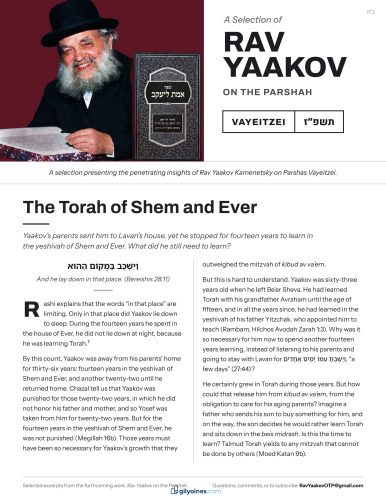
Text of this gilyon
ב״ה
A Selection of
RAV
YAAKOV
ON THE PARSHAH
VAYEITZEI תשפ״ז
A selection presenting the penetrating insights of Rav Yaakov Kamenetsky on Parshas Vayeitzei.
The Torah of Shem and Ever
Yaakov’s parents sent him to Lavan’s house, yet he stopped for fourteen years to learn in
the yeshivah of Shem and Ever. What did he still need to learn?
ַוִּיְׁש ַּכב ַּב ָּמ קֹום ַה הּוא outweighed the mitzvah of kibud av va’em.
And he lay down in that place. (Bereishis 28:11) But this is hard to understand. Yaakov was sixty-three
years old when he left Be’er Sheva. He had learned
R ashi explains that the words “in that place” are Torah with his grandfather Avraham until the age of
limiting. Only in that place did Yaakov lie down fifteen, and in all the years since, he had learned in the
to sleep. During the fourteen years he spent in yeshivah of his father Yitzchak, who appointed him to
the house of Ever, he did not lie down at night, because teach (Rambam, Hilchos Avodah Zarah 1:3). Why was it
he was learning Torah. 1 so necessary for him now to spend another fourteen
years learning, instead of listening to his parents and
By this count, Yaakov was away from his parents’ home going to stay with Lavan for ְוָיַׁש ְב ָּת ִע ּמ ֹו ָיִמ ים ֲא ָח ִד ים, “a
for thirty-six years: fourteen years in the yeshivah of few days” (27:44)?
Shem and Ever, and another twenty-two until he
returned home. Chazal tell us that Yaakov was He certainly grew in Torah during those years. But how
punished for those twenty-two years, in which he did could that release him from kibud av va’em, from the
not honor his father and mother, and so Yosef was obligation to care for his aging parents? Imagine a
taken from him for twenty-two years. But for the father who sends his son to buy something for him, and
fourteen years in the yeshivah of Shem and Ever, he on the way, the son decides he would rather learn Torah
was not punished (Megillah 16b). Those years must and sits down in the beis midrash. Is this the time to
have been so necessary for Yaakov’s growth that they learn? Talmud Torah yields to any mitzvah that cannot
be done by others (Moed Katan 9b).
Selected excerpts from the forthcoming work, Rav Yaakov on the Parshah. Questions, comments, or to subscribe: RavYaakovOTP@gmail.com
RAV YAAKOV ON THE PARSHAH VAYEITZEI תשפ״ז
To understand why Yaakov needed to go to the Now we can understand. Yaakov could not fulfill his
yeshivah of Shem and Ever, we must first understand father’s command to go to Lavan’s house unless he first
the Torah that was taught there. It was a different kind stopped at the yeshivah of Shem and Ever. His parents
of Torah from the Torah of Avraham and Yitzchak. certainly did not want him to go to Lavan if, in the end,
he could not come back and say, ִע ם ָלָב ן ַּגְר ִּת י ְוַת ְר ַי"ג
The Avos sat in their yeshivah (Yoma 28b) and taught
ִמ ְצ ֹות ָׁש ַמ ְר ִּת י, “I lived with Lavan, and I kept the taryag
Torah to all who came to join them. In their beis
mitzvos” (Rashi 32:5).
midrash, Torah was learned at the highest level of
emunah and avodas Hashem, completely sheltered Only that way would he fulfill his father’s command
from the world outside and untouched by it. That is properly. It is not like a son sent to buy something who
why, when Sarah saw Yishmael ְמ ַצ ֵח ק, influencing stops to learn. It is like a father who sends his son to buy
Yitzchak, she said at once ָּגֵר ׁש ָה ָא ָמ ה ַה ֹּזאת ְוֶא ת ְּב ָנּה, a lulav and esrog for Sukkos. On the way, the son
“Send away this maidservant and her son” (21:10). In the realizes that he does not know the halachos of the arba
beis midrash of the Avos, there was no place for a minim well enough, and he stops in the beis midrash to
student who was not worthy, and Hashem agreed with review them. Is he failing to do what his father asked?
her. On the contrary, he is fulfilling it completely and
beautifully. If he did not stop, he would not be fulfilling
The yeshivah of Shem and Ever was different. Shem,
it at all.
the son of Noach, survived dor hamabul. He was saved
not only from the waters of the Mabul but from the This explains another puzzling Rashi. In Parshas
society of that generation and its corruption. That was Vayeishev, the Torah says that Yaakov loved Yosef more
Noach’s strength: he kept his family from being than all his sons, ִּכי ֶב ן ְזֻק ִנים הּוא לֹו, “for he was a son of
influenced by the people around them, and he passed his old age” (37:3). Rashi brings Onkelos, who translates
that Torah on to Shem. Ever was born and lived in the ַּב ר ַח ִּכים, “a wise son,” and explains: everything Yaakov
time of dor haflagah, the people who built a tower had learned from Shem and Ever, he taught to Yosef.
reaching to the heavens to rebel against Hashem. But
Why does Rashi say specifically “what he learned from
he was not swept along with them, and he remained a
Shem and Ever”? Did Yaakov not have the Torah of the
tzaddik.
Avos to teach him? And did he not teach his Torah to
Only Shem and Ever, survivors of corrupt generations his other sons as well?
and corrupt surroundings, could teach Yaakov the
The Avos had a tradition from Avraham that their
Torah he would need to remain a man of integrity in the
descendants would one day be strangers in a land not
house of Lavan. 2 And it was not only Lavan. The people
their own, enslaved and afflicted. Hashem told
of that place were all deceivers. When Lavan gathered
Avraham at the Bris Bein HaBesarim, ָיֹדַע ֵּת ַד ע ִּכי ֵגר ִיְה ֶיה
all the men of the place for a feast before switching ַזְר ֲע ָך, “Know for certain that your descendants will be
Leah for Rachel, not one of them warned Yaakov. The
strangers in a land not theirs” (15:13).
Midrash tells us that they sang Yaakov’s praises,
chanting “הא ליא, הא ליא,” “here is Leah, here is Leah,” Why did Avraham need to know this? So that they
and they all laughed at the deception (Bereishis would prepare themselves for life in galus. Yosef was
Rabbah 70:19). Yaakov needed to absorb an entire the one who would be cast among the wicked, who
Torah of how to live among the wicked and deceitful would have to stand alone against every trial he faced,
while holding fast to honesty and integrity. For that, he and who would carry the burden of preparing the way
needed the special Torah of the beis midrash of Shem for the sons of Yaakov to go down to Mitzrayim. And so
and Ever. it was to him that Yaakov had to teach this special
Selected excerpts from the forthcoming work, Rav Yaakov on the Parshah. Questions, comments, or to subscribe: RavYaakovOTP@gmail.com
RAV YAAKOV ON THE PARSHAH VAYEITZEI תשפ״ז
Torah: the Torah of galus, the Torah of Shem and Ever. 3 Machaneh Yisrael.
The brothers did not know why Yaakov was learning
more with Yosef than with them, and they were jealous 1. Why does the Torah not say outright that Yaakov spent fourteen
of him. They thought that he alone would receive the years without lying down at night? To teach us that one who is
able to learn for fourteen years without lying down, and has the
Torah. But the truth was that for them, the Torah of the strength for it, deserves no special praise for doing so. That is
Avos was enough. Yaakov taught all his sons, and it was what he was created for. A person was created to use all of his
Levi he set apart and appointed to head the yeshivah, abilities, to their fullest, in the service of Hashem.
to teach the way of Hashem and keep the mitzvah of 2. This is why, when the children struggled within Rivkah, she went
to seek guidance from Shem, not from Avraham (Rashi 25:22).
Avraham (Rambam, Hilchos Avodah Zarah 1:3). Only There was a mixture of kedushah and tumah within her, and for
Yosef needed the Torah of Shem and Ever. 4 that she needed the guidance of Shem.
There is a Torah of Eretz Yisrael, the mitzvos that 3. Targum Yonasan translates Yaakov’s berachah to Yosef, ִמ יֵד י
( ֲא ִב יר ַיֲעֹקב49:24), as “he conquered his yetzer through the
depend on the land. In the same way, there is a Torah of strong teaching he received from Yaakov.”
galus, where the nisyonos are different and different 4. This is why, when Yaakov and his sons went down to Mitzrayim,
halachos come into play. So too, the Chofetz Chaim Yaakov sent Yehudah ahead to establish a house of learning
wrote the Mishnah Berurah for all of Klal Yisrael, and a (Rashi 46:28), and did not rely on Yosef to do so. There, Yaakov
wanted a beis midrash built on the tradition of the Avos, not on
separate Shulchan Aruch for Jewish soldiers, the Torah of Shem and Ever.
A Placeholder
Why do we call Hashem “HaMakom” when comforting an avel or asking for a choleh’s
recovery?
ַוִּיְפ ַּגע ַּב ָּמ קֹום ַוָּיֶל ן ָׁש ם ִּכי ָב א ַה ֶּׁש ֶמ ׁש hinting at it in its place. Other explanations of the
name, such as “He is the place of the world,” came later;
He came upon the place and lodged there, for the sun
the simple meaning is that HaMakom stands in place of
had set. (Bereishis 28:11)
the Name. In Aramaic, “Rachmana” was used the same
way. When the Gemara speaks of one who saw a fine
R ashi explains that ַוִּיְפ ַּגעis an expression of
tefillah, and that we learn from here that Yaakov
instituted tefillas maariv (Berachos 26b).
loaf of bread and exclaimed ָּב רּוְך ַה ָּמ קֹום ֶׁש ְּב ָר ָא ּה,
“Blessed is HaMakom Who created it” (Berachos 40b),
it describes a person who was not setting out to make a
formal berachah. He simply spoke from the heart, in
But why does the Torah describe his tefillah with the
everyday speech. 1
word ?ָמ קֹוםAnd why, of the three tefillos the Avos
instituted, was maariv alone reshus, voluntary? That is what happened with Yaakov.
ַה ָּמ קֹוםis a name of Hashem, but it began as the name When Yaakov reached Charan, he realized that he had
people used in everyday speech. When people spoke passed the place where his fathers had davened
informally and did not want to say Hashem’s name, they without davening there himself. He set his mind to go
said “HaMakom,” meaning ִּב ְמ קֹום, “in place of.” It was a back, and the land shrank before him, bringing him at
way of saying: I am not saying the Name itself, only once to Har HaMoriah (Chullin 91b). But Yaakov did not
Selected excerpts from the forthcoming work, Rav Yaakov on the Parshah. Questions, comments, or to subscribe: RavYaakovOTP@gmail.com
RAV YAAKOV ON THE PARSHAH VAYEITZEI תשפ״ז
realize where he was. Only the next morning did he say, The same name has stayed with us in two places.
ָא ֵכן ֵיׁש ה׳ ַּב ָּמ קֹום ַה ֶּזה ְוָא ֹנִכי ֹלא ָיָד ְע ִּת י, “Surely Hashem is When we visit a sick person, we say ַה ָּמ קֹום ְיַר ֵח ם ָע ֶל יָך,
in this place, and I did not know” (28:16). and when we comfort mourners, ַה ָּמ קֹום ְיַנֵח ם ֶא ְת ֶכם.
These words are not said in a place of tefillah. They are
Targum Yonasan explains that only in the morning did
said in the home of the sick person or the mourner,
Yaakov see that this was a beis Elokim, a place set aside
where we have come to share his pain. There, as with
for prayer. The night before, he thought he was in an
Yaakov on the road, Hashem is called HaMakom. 3
ordinary place.
His tefillah that night, then, was not the formal tefillah 1. This also explains the Haggadah’s ָּב רּוְך ַה ָּמ קֹום ָּב רּוְך הּוא. The
of one who stands in a place of prayer. It was the plea of Haggadah is told as a story, not studied as Torah. Accordingly,
a man alone on the road, in what he thought was an Hashem’s name should not be said anywhere in the Haggadah
ordinary place. That is why the Torah uses the word except within a full pasuk, and when the Haggadah wishes to
bless Hashem, it says “HaMakom.”
ָמ קֹום: it is the name used for a request spoken from the
2. The Rambam’s wording reflects this. He writes that Yitzchak
heart, outside a place of tefillah. “added” another tefillah toward evening, but of Yaakov he writes
only that he “davened maariv” (Hilchos Melachim 9:1). Yitzchak
Perhaps this is also why maariv was originally reshus. instituted mincha as a fixed tefillah. Yaakov davened maariv as a
Yaakov had already davened mincha that day. His voluntary one, and since the Torah records it, maariv was
tefillah at night was an additional, voluntary one, and so established as a voluntary tefillah.
maariv began as a voluntary tefillah. 2 3. Such words are often said in a home where the surroundings
may not be clean enough for Hashem’s name, and so the custom
was always to say “HaMakom.”
Had I Known
Yaakov slept and was granted a vision of the Shechinah. Why did he regret having slept?
ַוִּייַק ץ ַיֲעֹקב ִמ ְּׁש ָנתֹו ַוֹּיאֶמ ר ָא ֵכן ֵיׁש ה׳ ַּב ָּמ קֹום revelation of the Shechinah and Hashem’s promise,
ְוִה ֵּנה ָא ֹנִכי ִע ָּמ ְך ּוְׁש ַמ ְר ִּת יָך ְּב ָכל ֲאֶׁש ר ֵּת ֵל ְך, “I am with you,
ַה ֶּזה ְוָא ֹנִכי ֹלא ָיָד ְע ִּת י
and I will guard you wherever you go” (28:15).
Yaakov awoke from his sleep and said, “Surely Hashem
is in this place, and I did not know.” (Bereishis 28:16) Yet Yaakov regretted that he had gone to sleep in such
a holy place. In his eyes, the entire vision of Hashem
R
standing over him was not worth it. He should have
ashi explains: had I known, I would not have guarded the sanctity of that place and not slept there.
slept in such a holy place.
Picture one man who sat and learned Torah all night,
These words should make us stop and think about while his friend went to sleep and was granted a
Yaakov Avinu’s level. For the fourteen years before this, revelation of Eliyahu. The one who slept thinks he is the
he had not lain down at night, because he was learning greater of the two, since he was shown Eliyahu. Yaakov
Torah. Now he slept, and in that sleep he was granted a teaches us that the opposite is true.
Selected excerpts from the forthcoming work, Rav Yaakov on the Parshah. Questions, comments, or to subscribe: RavYaakovOTP@gmail.com
RAV YAAKOV ON THE PARSHAH VAYEITZEI תשפ״ז
Brotherly Rebuke
Before questioning the shepherds’ conduct, Yaakov called them “my brothers.” Why did
his tochachah have to begin there?
ַוֹּיאֶמ ר ָלֶה ם ַיֲעֹקב ַא ַח י ֵמ ַא ִין ַא ֶּת ם The reason for the exemption is now clear. Once the
sinner strikes him or rebukes him in return, it is no
Yaakov said to them, “My brothers, where are you
longer tochachah, because the sinner no longer
from?” (Bereishis 29:4)
believes that he is being rebuked for his own good. We
see from this that the one who rebukes must love the
W e do not find a person calling strangers
“brothers.” Lot called the men of Sedom ַא ַח י
(19:7), but they were people he knew, and it
sinner at the moment he rebukes him. This is also why
Chazal say that one may not rebuke to the point of
embarrassing him (ibid.). It is not only a separate
was common to call acquaintances “brothers.” Here, prohibition. Rebuke that causes shame does not fulfill
Yaakov was speaking to men he had never met. the mitzvah of tochachah at all, because it does not
come from love.
The Gemara discusses how far the obligation of
tochachah extends. Rav says: until the one being Rashi tells us that Yaakov came to rebuke the
rebuked strikes him. Shmuel says: until he curses him. shepherds. If you are hired workers, he said, you have
Rabbi Yochanan says: until he rebukes him in return not completed your day’s work, and if the animals are
(Erachin 16b). yours, it is still too early to gather them in (Rashi 29:7).
Before he could rebuke them, he first had to awaken
This seems strange. Why should a curse from the
love and brotherhood between them. And so he began:
sinner, or a sharp word in return, exempt the other from
“My brothers.”
the mitzvah of tochachah?
This may also explain why Lot called the men of Sedom
The Rambam writes (Hilchos De’os 6:7):
ַא ַח י. He too came to rebuke them, as their answer
ִויַד ֵּב ר לֹו, ָצ ִר יְך ְל הֹוִכיחֹו ֵּב ינֹו ְל ֵב ין ַע ְצ מֹו...ָה רֹוֶא ה ֲח ֵב רֹו ֶׁש ָח ָט א shows: ָה ֶא ָח ד ָּב א ָלגּור ַוִּיְׁש ֹּפט ָׁש פֹוט, “This one came to
ְויֹוִד יעֹו ֶׁש ֵא ינֹו אֹוֵמ ר לֹו ֶא ָּל א ְל טֹוָב תֹו,ְּב ַנַח ת ּוְב ָל ׁש ֹון ַר ָּכה sojourn, and now he judges!” (19:9).
One who sees his friend sin... must rebuke him privately,
A great obligation rests on those who rebuke: love of
speak to him gently and softly, and let him know that he
others must be rooted in their hearts. Without it, they
is saying this only for his good.
cannot rebuke. Perhaps this is what the Gemara means
He continues that a person must rebuke again and when it says, “I wonder whether there is anyone in this
again, until the sinner strikes him and says, “I will not generation who knows how to rebuke” (Erachin 16b). 1
listen.”
1. The second Beis HaMikdash was destroyed because of sinas
chinam (Yoma 9b), and Chazal also say that Yerushalayim was
destroyed because its people did not rebuke one another
(Shabbos 119b). The two go together. Where there is no love,
there can be no tochachah.
Selected excerpts from the forthcoming work, Rav Yaakov on the Parshah. Questions, comments, or to subscribe: RavYaakovOTP@gmail.com
RAV YAAKOV ON THE PARSHAH VAYEITZEI תשפ״ז
Who Took Whose Husband?
Rachel gave Leah the simanim. Why did she remain silent when Leah accused her of
taking her husband?
ַה ְמ ַע ט ַק ְח ֵּת ְך ֶא ת ִא יִׁש י ְוָלַק ַח ת ַּגם ֶא ת ּדּוָד ֵא י It must be that since Yaakov married Leah first, and
lawfully, Leah was his first wife. Rachel, who married
ְּב ִני
him afterward, came as a ָצ ָר ה, a rival wife, to Leah. 1
Is it not enough that you have taken my husband, that
you would also take my son’s dudaim? (Bereishis 30:15) This teaches us something new. By the laws of man,
Leah was Yaakov’s first wife, and Rachel came after her.
L
Rachel knew this, and so she did not answer. Yet by the
eah’s words are hard to understand. Rachel was laws of Heaven, Rachel remained the akeres habayis.
the akeres habayis, the mainstay of Yaakov’s
home (Rashi 46:19). Yaakov had worked for A person’s standing in the eyes of Heaven is not always
Rachel, not for Leah. And it was Rachel who gave Leah the same as his standing by the laws of man. This is a
the signs she had arranged with Yaakov, so that Leah great principle that runs through the Torah’s whole
would not be shamed. Rachel had at least as strong a outlook.
claim to Yaakov as Leah did. How could Leah say to her
that she had taken her husband? 1. The Chizkuni explains Leah’s words the same way: “I was married
to him first, and you became my rival.”
And yet Rachel did not answer, “On the contrary, it was
you who took my husband from me.” She said nothing
of the kind.
The Terms of Berachah
Lavan offered full wages. Why did Yaakov answer, “When will I also provide for my own
household?”
ָנְק ָב ה ְׂש ָכְר ָך ָע ַלי ְוֶא ֵּת ָנה ְוַע ָּת ה ָמ ַת י ֶא ֱעֶׂש ה ַגם ָא ֹנִכי ְל ֵב יִת י,ַוְיָב ֶר ְך ה׳ ֹאְת ָך ְל ַר ְג ִל י
Name your wage, and I will give it. (Bereishis 30:28) Hashem has blessed you on my account; and now,
when will I also provide for my own house?
(Bereishis 30:30)
Y aakov had finished his fourteen years of work for
Rachel and Leah, and he asked Lavan to let him
go home. Lavan wanted him to stay, and offered
His answer is hard to understand. Lavan had just
offered him full wages, any sum he wanted to name.
to pay him whatever he asked. Why did Yaakov answer as if he had no way of providing
for his household?
Yaakov answered:
Lavan was asking what wage he could pay. Yaakov was
Selected excerpts from the forthcoming work, Rav Yaakov on the Parshah. Questions, comments, or to subscribe: RavYaakovOTP@gmail.com
RAV YAAKOV ON THE PARSHAH VAYEITZEI תשפ״ז
answering that he did not want a wage at all. He wanted That is why Yaakov began by saying, “Hashem has
a partnership. blessed you on my account.” He had seen Hashem’s
berachah rest on Lavan’s flocks because of him. Now he
A hired worker receives a fixed wage. His pay stays the
wanted that berachah for his own household too, and
same however much the flock grows, and so, in the
for that he could not be a hired hand. He had to be a
natural way of things, the berachah in that growth rests
partner.
with the owner, not with him. A partner is different. His
share grows with what grows. And so he told Lavan, ֹלא ִת ֶּת ן ִל י ְמ אּוָמ ה, “You shall not
give me anything” (30:31). He asked for no wage.
Instead, he would take as his share the animals born
with the markings they agreed on. What Yaakov
received would depend on Hashem’s berachah.
What Lavan Wanted to Uproot
The Haggadah says that Lavan sought to uproot everything. Where do we see that in
the Torah?
ֱא ֹלֵק י ַא ְב ָר ָה ם ֵואֹלֵה י ָנחֹור ִיְׁש ְּפ טּו ֵב יֵנינּו ֱא ֹלֵה י served the god of Nachor. But since they both came
from one family and one root, Lavan argued, there was
ַוִּיָּׁש ַב ע ַיֲעֹקב ְּב ַפ ַח ד ָא ִב יו ִיְצ ָח ק,ֲא ִב יֶה ם
something they shared that could unite them: ֱא ֹלֵה י
“May the G-d of Avraham and the god of Nachor judge ֲא ִב יֶה ם, the god of their common father.
between us, the god of their father.” And Yaakov swore
by the Fear of his father Yitzchak. (Bereishis 31:53) Lavan sought a complete union between the two
families, built on their shared descent. Had he
I
succeeded, he truly would have uprooted everything.
n the Haggadah we say: Pharaoh’s decree threatened the males of Klal Yisrael.
,ֵצא ּוְל ַמ ד ַמ ה ִּב ֵּק ׁש ָלָב ן ָה ֲא ַר ִּמ י ַל ֲעׂשֹות ְל ַיֲעֹקב ָא ִב ינּו Lavan’s covenant threatened what Klal Yisrael is.
ְוָלָב ן ִּב ֵּק ׁש ַל ֲעקֹור ֶא ת ַה ֹּכל,ֶׁש ַּפ ְר ֹעה ֹלא ָגַזר ֶא ָּל א ַע ל ַה ְּזָכִר ים Yaakov agreed to make a covenant with him, but he
Go and learn what Lavan the Aramean sought to do to made clear on what it stood. He swore ְּב ַפ ַח ד ָא ִב יו ִיְצ ָח ק,
Yaakov Avinu. Pharaoh decreed only against the males, “by the Fear of his father Yitzchak,” a name of Hashem.
but Lavan sought to uproot everything. The covenant would rest on avodas Hashem, and on
The commentators have long noted that the Torah nothing else that Lavan had in mind.
never says outright that Lavan sought to destroy Lavan sought to unite with Yaakov because they were
Yaakov and his entire family. one family, even though Yaakov served Hashem and
It seems that the Haggadah is referring to the covenant Lavan served avodah zarah. That is a nationhood built
Lavan asked Yaakov to make with him. Lavan wanted a on secularism. Yaakov answered him by swearing ְּב ַפ ַח ד
ָא ִב יו ִיְצ ָח ק: there is no Jewish nationhood other than
covenant that would unite them under “the god of their
father.” Yaakov served the G-d of Avraham, and Lavan one built on pure emunah in the Creator of all the
worlds.
Selected excerpts from the forthcoming work, Rav Yaakov on the Parshah. Questions, comments, or to subscribe: RavYaakovOTP@gmail.com