
Chelkeiny Besoirosaicho - English
Text of this gilyon
YEAR III ISSUE 113
Chelkeinu B’Sorasecha
PARSHAS VAYISHLACH • 5787
MAVO
Wholeness in Wealth and Torah
“Save me, please, from the hand of Yaakov davened to be saved from both. Later, on “He touched the socket of
my brother, from the hand of Eisav.” If Eisav came as an open enemy, the his thigh,” the Ramban cites the
Yaakov Avinu asks Hashem to save him danger was “lest he come and strike Midrash (Bereishis Rabbah 77:3):
from his brother. But his words reveal a me.” If he came as a brother, Yaakov Eisav’s angel struck at the tzaddikim
particular fear: he is afraid of Eisav the who would descend from Yaakov, the
had a special concern for “the mother
rasha, and he is also afraid of Eisav the generation that would suffer religious
with the children”: the women, who
brother. persecution. There would be times
might be more readily persuaded, and
when Eisav would gain such power over
the young children could be drawn Yaakov’s children that he would nearly
The Ohr Hachaim Hakadosh explains after him and learn from his ways. uproot them. Indeed, there have been
that Eisav could approach him in either Their bodies might remain unharmed generations in which the nations
of two ways. He could openly display while their Yiddishkeit was lost. This is inflicted such suffering on Klal Yisrael,
his wickedness and try to harm him. Or Rachmana litzlan. Yet, the Ramban
the explanation of the Pardes Yosef.
he could come with an offer of writes, “We endured it all, and it
brotherhood, pretending to have passed over us.” This is alluded to in
Yaakov’s best interests at heart, and the words “Vayavo Yaakov
draw him into a trap. That second shalem”—Yaakov arrived whole.
danger would be even harder for
Yaakov to escape. He needed Hashem’s One of the central lessons running
help against both. through several pesukim in this parshah
concerns the source of the money that
A number of meforshim develop this supports Torah. Torah and chinuch
thought. The Pardes Yosef writes that must be sustained by pure sources,
Klal Yisrael’s lot is bitter when Eisav without depending on funds that bring
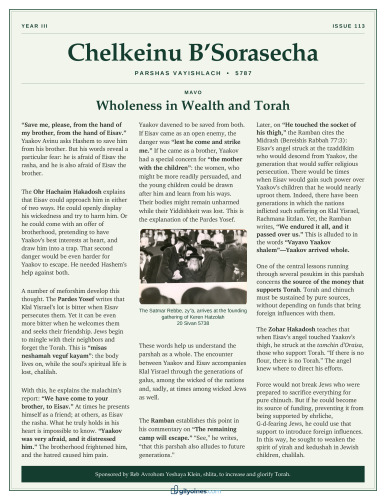
The Satmar Rebbe, zy”a, arrives at the founding
persecutes them. Yet it can be even foreign influences with them.
gathering of Keren Hatzolah
more bitter when he welcomes them 20 Sivan 5738
and seeks their friendship. Jews begin The Zohar Hakadosh teaches that
to mingle with their neighbors and when Eisav’s angel touched Yaakov’s
forget the Torah. This is “misas These words help us understand the thigh, he struck at the tamchin d’Oraisa,
neshamah veguf kayam”: the body parshah as a whole. The encounter those who support Torah. “If there is no
between Yaakov and Eisav accompanies flour, there is no Torah.” The angel
lives on, while the soul’s spiritual life is
Klal Yisrael through the generations of knew where to direct his efforts.
lost, chalilah.
galus, among the wicked of the nations
Force would not break Jews who were
With this, he explains the malachim’s and, sadly, at times among wicked Jews
prepared to sacrifice everything for
report: “We have come to your as well. pure chinuch. But if he could become
brother, to Eisav.” At times he presents its source of funding, preventing it from
himself as a friend; at others, as Eisav being supported by ehrliche,
the rasha. What he truly holds in his The Ramban establishes this point in
G-d-fearing Jews, he could use that
heart is impossible to know. “Yaakov his commentary on “The remaining support to introduce foreign influences.
was very afraid, and it distressed camp will escape.” “See,” he writes, In this way, he sought to weaken the
him.” The brotherhood frightened him, “that this parshah also alludes to future spirit of yirah and kedushah in Jewish
and the hatred caused him pain. generations.” children, chalilah.
Sponsored by Reb Avrohom Yeshaya Klein, shlita, to increase and glorify Torah.
Chelkeinu B’Sorasecha VAYISHLACH 5787 / ISSUE 113
Wholeness in Wealth and Torah CONTINUED
The same idea is alluded to in the The same principle illuminates Yaakov’s My uncle, Reb Yoel Ganz, shlita, who
pachim ketanim, the small jugs for message to Eisav at the beginning of the served the Rebbe, told me what he had
which Yaakov Avinu went back. Chazal parshah: “Im Lavan garti,” on which witnessed himself. The Rebbe sorted
tell us that tzaddikim value their Chazal comment, “Yet I observed the the money into separate piles. He then
possessions more than their own 613 mitzvos,” followed by “I have instructed him to place his hand on the
bodies. In Tiv Levav, the Satmar Rebbe, table with his fingers spread apart, each
acquired oxen and donkeys.”
zy”a, explains that Yaakov’s attachment finger holding a different pile.
to those jugs certainly did not stem
from a desire for wealth. Tzaddikim The Rebbe explains that Yaakov was With the money still separated between
need money from kosher sources in telling Eisav: You need not envy the his fingers, he was to go straight to the
order to uphold Yiddishkeit and sustain great wealth I am bringing from Lavan’s Rebbetzin, a”h. She knew where each
Torah and mitzvos. Such money is home. I have observed the 613 mitzvos, group of bills belonged, and everything
exceedingly precious to them. and therefore I will not benefit from was put in its proper place.
this money. I will send it all to you as a
Who can fathom the ways of kedoshim?
On “Vayavo Yaakov shalem,” Chazal gift. This is not money for me; I must be
teach that Yaakov was whole in body, particular to have money from kosher Above all was the work the Rebbe
whole in wealth, and whole in Torah. In sources. undertook toward the end of his life.
Divrei Yoel, the Rebbe explains that Drawing on his remaining strength, he
these are connected. Because Yaakov gathered funds and exerted himself
was shalem bemamono, refusing money beyond his physical limits to establish
from sources of which the chachamim Keren Hatzolah for the mosdos in
did not approve, he remained shalem Eretz Yisrael.
beToraso: his Torah remained whole,
without any blemish. As we approach fifty years since its
founding, it is heartening to see Keren
Hatzolah continue to grow. From that
This rests on the principle of koach pure flask of oil, more lights are kindled
Thousands gathered for the founding of Keren
hapo’el banifal—the influence of the to strengthen the holy mosdos. Year
Hatzolah.
giver remains in what he gives—a after year, the sums distributed increase
principle the Rebbe impressed upon his substantially.
talmidim with all his heart. In Agra The Rebbe used this principle of koach
D’Kallah (Parshas Shoftim) and Agra hapo’el banifal to explain many other Where does it all come from? From the
D’Pirka, the author relates that he passages in this parshah and in the sincere, heartfelt gifts of Jews for whom
personally knew men who had been surrounding parshiyos. pure chinuch is a burning concern.
sincere ovdei Hashem in their youth. As They acquired that dedication from the
they grew older, their avodah cooled, Rebbe, zy”a, his talmidim, and their
Satmar talmidim and chassidim have talmidim, who continue to draw from
until they lost the spiritual heights they
much to relate on this subject. They saw his Torah and pass it on from one
had attained. The reason was that they
had sustained themselves with money for themselves how careful the Rebbe generation to the next.
that was not ehrlich and kosher. was with money. Even the pidyonos
brought with kvitlach were not mixed Perhaps a remez can be added. At the
together. Each sum was kept separately. beginning of the parshah, the Chasam
This warning was already recorded in Sofer discusses the force of impurity
the earlier sefarim. How often the called לילי״ת, whose numerical value is
Rebbe cried out about it, urging those The meshamshei bakodesh describe the 480, and its 480 camps that seek to
who overlooked the danger to remarkable avodah that took place consume kedushah. Its tikkun comes
recognize that such money could sever every Erev Shabbos, when the Rebbe through the shekalim, שקלי״ם, given to
a person’s connection to the source of sorted the money he had received support kedushah. That word, too, has
kedushah, Rachmana litzlan. during the week. the numerical value of 480.
PARSHAS VAYISHLACH 2
Chelkeinu B’Sorasecha VAYISHLACH 5787 / ISSUE 113
Wholeness in Wealth and Torah CONTINUED
The words קרן הצלה, Keren Hatzolah, Reb Yosef readily agreed. He traveled to The Rebbe replied: “Fun yene gelt ken
also total 480. We may suggest that the Rebbe and told him about his ich dir geben asach mehr”—“Of that
Keren Hatzolah serves this same employer’s situation. The Koloshitzer money, I can give you much more.”
purpose: overcoming the forces of Rav offered a wise piece of advice that But he had not wanted to give this rav
impurity that surround our would allow the man to clear himself of “that money.” For him, the Rebbe had
mechanchim and mechanchos with the charges. Even the attorneys chosen money of a higher spiritual
their 480 camps and seek to harm our handling the case had not thought of it. quality, suited to his madreigah.
precious children through the support
The owner followed the Rebbe’s advice We are now approaching 21 Kislev, the
they offer.
and was vindicated in court. day of the Satmar Rebbe’s rescue and
liberation from the wicked. At this time,
We have been privileged to see the
He wanted to thank the tzaddik who we owe particular gratitude to Hashem
strength of kedushah grow ever greater. for the Rebbe’s mesirus nefesh on
had helped him so much. He gave Reb
May Hashem grant that it continue, to behalf of us and our children: keeping
Yosef five hundred zlotys, an
increase and glorify Torah. us apart from those who had strayed
enormous sum in those days, to bring to
the Rebbe as a gift. and protecting us from foreign
In truth, this was not a new approach influences.
introduced by the Rebbe. Tzaddikim Reb Yosef understood that this was no
throughout the generations paid close small matter. Before bringing money The Rebbe did not stop at opposing
attention to the source of the support from a non-Jew, he needed to know impurity through sur meira, turning
they received, knowing how deeply it away from evil. With his great
whether the Rebbe would accept it at
could affect them, for good or, chalilah, kedushah, he also brought blessing to
all. He called the Rebbe and told him
otherwise. our community, so that more people
about the large gift his employer
committed to kedushah would prosper.
wished to send.
I recently came across an account in the They would be able to support our
The answer was immediate. The Rebbe mosdos generously and wholeheartedly,
new sefer Toldos Chana, about the
without our having to depend on
Koloshitzer Rav, zy”a, Hy”d, that would not take the money—not for his
“matnas basar vadam,” gifts of flesh
brings this point home. household expenses, and not even for
and blood.
tzedakah.
One of his chassidim, Reb Yosef The Rebbe explained that phrase as a
Horowitz, a”h, earned his living in a Reb Yosef was to tell his employer that
gift that comes from the “flesh and
factory owned by a non-Jew. Hashem the Rebbe was a very wealthy man and
blood” within a person, rather than
gave Reb Yosef favor in his employer’s had no need of anyone else’s money.
from his pure neshamah.
eyes. The owner held him in high
Countless such incidents were
regard and enjoyed talking with him For all this, we praise and thank
witnessed with the Satmar Rebbe, zy”a. Hashem: “Through Hashem’s
about all sorts of subjects.
He was prepared to throw great sums kindness we have not perished, for
into the lavatory rather than have any His mercy has not come to an end.”
At one point, the factory owner became
connection with money he did not want
entangled with the government. He had
to accept. May the zechus of this tzaddik and all
not paid his taxes properly, and now he
the tzaddikim before him, whose Torah
could see no way out of his Once, a distinguished rav from the sustains us and whose paths we follow,
predicament. Rebbe’s family came to him as he was stand by us and our children. May we
preparing to make a wedding. The continue to raise generations in purity,
In his distress, he turned to Reb Yosef. Rebbe gave him a generous sum to help in Eretz Yisrael and in galus, and may
“I’ve heard so much from you about with the expenses. we go forth, young and old together, to
your Rebbe, what an extraordinary greet Moshiach Tzidkeinu with radiant
person he is. Could you do me a favor The rav mentioned that he knew of faces, speedily in our days. Amen.
and ask his advice? How can I get out someone else who had received a larger
of this trouble?” amount. Why had he received less? Reb Avrohom Yeshaya Klein, shlita
PARSHAS VAYISHLACH 3
Chelkeinu B’Sorasecha VAYISHLACH 5787 / ISSUE 113
Torasam Keva
The Malachim Yaakov The sefer Aspaklaria Hame’irah A Share in This World
(Parshas Behar) writes that the Name
Chose Elokim governs the entire world. In “He raised his eyes and saw the
Eretz Yisrael, however, the Name women and the children, and said,
“Yaakov sent malachim ahead of
Havayah governs as well. This ‘Who are these to you?’ He
him.”
explains the Gemara’s statement answered, ‘The children whom
The opening letters of (Kesubos 75a), “One of them is like Elokim has graciously given your
—וישלח יעקב מלאכים לפניוvav, yud, mem, two of us”—one of the scholars of servant.’” (Bereishis 33:5)
and lamed—have a combined Eretz Yisrael is like two of those in
chutz la’aretz. In Eretz Yisrael, their Eisav sees Yaakov with his family and
numerical value of 86, the same as
spiritual sustenance comes from both asks, “Mi eileh lach?” Rashi
the Divine Name אלקים, Elokim. We
Names. explains: “Who are these, that they
need to understand the significance
should be yours?”
of this remez. This is the meaning of “At the
command of Havayah they What is Rashi adding? There is
At the end of Parshas Vayeitzei, the another point to consider. Yaakov
encamped.” Wherever the Jewish
Torah tells us, “He called the name answers, “Asher chanan Elokim es
people camped in the midbar, it was
of that place Machanayim.” Rashi as though they were in Eretz Yisrael, avdecha.” Why does he specifically
explains that two camps of malachim drawing from the Name Havayah. use the Name Elokim, which signifies
met there: those of chutz la’aretz, This is the explanation of the Divrei middas hadin? His wording suggests
who had accompanied Yaakov until Yoel. that all this blessing is rightfully his,
that point, and those of Eretz Yisrael, even according to strict justice.
who had come to greet him. The With this, we can also understand the
Sifsei Chachamim adds that Yaakov pasuk in Tehillim (122): “I rejoiced Chazal teach that Yaakov and Eisav
kept the malachim of chutz la’aretz when they said to me, ‘Let us go to divided the two worlds between
with him for the time being because the house of Hashem.’” The reason them. Yaakov took Olam Haba, and
he intended to send them to Eisav. for that joy appears in the next Eisav took Olam Hazeh.
pasuk: “Our feet stood within your
The Chida, in Rosh Dovid (Parshas
Why did he choose those malachim? gates, Yerushalayim.”
Tzav), therefore asks how the Jewish
The Beirach Moshe of Satmar, zt”l, A beis medrash possesses the people may benefit from this world.
explains that Yaakov was concerned kedushah of Eretz Yisrael. As the If it belongs to Eisav, are we not
for the malachim of Eretz Yisrael. Gemara teaches (Megillah 29b), the taking what is his?
They had never been exposed to the shuls and batei medrash of Bavel will
He quotes an answer in the name of
challenge of Eisav’s tumah, and he one day be established in Eretz
Rav Shmuel Primo, z”l. The Gemara
feared that its intensity might affect Yisrael. A beis medrash therefore also
teaches (Shabbos 88a) that Hashem
them. The malachim of chutz la’aretz, receives the influence of the Name
made a condition with Creation: if
however, were already accustomed to Havayah. That is why Dovid
the Jewish people accepted the
moving among Seir and Edom. They Hamelech speaks of going to the
Torah, the world would endure; if
would not be harmed. house of Havayah, not merely of
they did not, it would return to
Elokim.
emptiness and chaos.
In Divrei Yoel (Beha’aloscha, p.
We can now understand the remez in
263), the Rebbe explains the pasuk, By accepting the Torah, the Jewish
וישלח יעקב מלאכים לפניו. Yaakov sent
“At Hashem’s command they people saved all of Creation from
Eisav the malachim of chutz la’aretz,
encamped, and at Hashem’s destruction. They are therefore like
where the spiritual influence comes
command they traveled,” based on someone who rescues property from
through the Name Elokim. The
the Arvei Nachal’s teaching that zuto shel yam, the sea’s
opening letters therefore total 86, the
wherever the Jewish people traveled overwhelming current, where it
numerical value of Elokim.
in the midbar, the kedushah of Eretz would otherwise be irretrievably lost.
Yisrael accompanied them. Reb Yonah Friedman, shlita What he saves belongs to him.
PARSHAS VAYISHLACH 4
Chelkeinu B’Sorasecha VAYISHLACH 5787 / ISSUE 113
Torasam Keva CONTINUED
But the meforshim raise an objection, This sheds light on the words we This is why Yaakov spent fourteen
as cited in Ahavas Olam by Rav recite at Kiddush on Shabbos years immersed in Torah in the beis
Shlomo Algazi. The Jewish people morning: “I will feed you the medrash of Shem and Ever before
accepted the Torah under inheritance of Yaakov your father, going to Lavan. Torah brings reward
compulsion: “He held the mountain for the mouth of Hashem has in this world as well. Eisav would
over them like a barrel.” An act spoken.” We merit the good of this therefore have no claim against his
world, Yaakov Avinu’s inheritance, inheritance.
performed under duress is not
because we saved the world by
considered a person’s voluntary act. Reb Dovid Aryeh Yakob, shlita
accepting the Torah. And through
Shalosh Seudos, Parshas Toldos 5787 • Beis
“The children of Israel shall keep Medrash Menuchah V’Simchah, West Palm
One might answer by invoking the the Shabbos,” which brings reward
rule of “Talyuhu vezavin, zevinei in this world, the objection of
zevini” (Bava Basra 47b): when a compulsion falls away. Yaakov’s Message to Eisav
person is forced to sell something but
Another approach follows from
is paid for it, the sale is valid. The “He instructed them, saying: ‘So
Yitzchok’s brachos to Yaakov.
Jewish people, too, were promised a shall you say to my master, to
Although the brachos concern the
reward for accepting the Torah. Eisav: Thus says your servant
blessings of this world, the Midrash
Yaakov: I lived with Lavan and
(Bereishis Rabbah 66:3) interprets
The reasoning behind that rule, remained there until now. I have
them in terms of Torah: “The dew of
however, is that the pressure of the heaven” refers to Mikra; “the acquired oxen and donkeys, flocks,
coercion, together with the payment, richness of the earth” to Mishnah; servants and maidservants, and I
brings the seller to agree to the and “abundant grain and wine” to have sent to inform my master, to
transaction. This applies when the Gemara. find favor in your eyes.’” (Bereishis
money is actually placed in his hands. 32:5–6)
The Chavos Yair (Or Hashlishi)
The promise of Olam Haba and of explains that the general rule that Rashi explains “garti”: I did not
inheriting Eretz Yisrael was a promise mitzvos are not rewarded in this become a ruler or a person of
of future payment, not money world reflects the possibility that a importance; I remained a stranger.
already received. The argument of person may later sin, for an aveirah You have no reason to hate me
“moda’ah rabbah l’Oraisa”—that can extinguish the merit of a because of our father’s brachah, “Be
the Torah had been accepted under mitzvah. An aveirah cannot, a master over your brothers,” for it
compulsion—would therefore however, extinguish Torah. Torah has not been fulfilled in me.
remain. study therefore earns reward in this
world as well. Rashi offers another explanation: the
numerical value of garti is 613.
There is, however, another detail to Through learning Torah, then, the Although I lived with the wicked
consider. All agree that the Torah reward is received at once. Here, too, Lavan, I kept the 613 mitzvos and did
was given on Shabbos (Shabbos the acceptance is comparable to a not learn from his evil ways.
86b). compelled sale accompanied by
payment, and is valid. On “I have acquired oxen and
The Yetev Lev (Parshas Vayakhel) donkeys,” Rashi comments: My
Eisav’s question now becomes clear.
writes that the mitzvah of Shabbos father blessed me with “the dew of
He sees Yaakov blessed with the
earns reward even in this world. The bounty of this world and asks, “Mi heaven and the richness of the
letters of שבתform the initials of eileh lach?” How can all this be earth,” but what I have is neither
“Beyomo titen secharo”—“Give yours? This is my share! from heaven nor from the earth.
him his wages on that day.” The Yaakov answers, “Asher chanan Why was it so important for Yaakov
Jewish people thus received reward Elokim es avdecha.” It is mine to send Eisav all this information?
that very day. Their acceptance was according to justice. Through my How would telling him that Yaakov
comparable to a compelled sale for Torah, I have saved the world. Like had not become a ruler, or that he
which payment is received, and was someone who rescues property from had kept the 613 mitzvos, soften the
therefore valid. the sea, I have acquired what I saved. hatred Eisav harbored in his heart?
PARSHAS VAYISHLACH 5
Chelkeinu B’Sorasecha VAYISHLACH 5787 / ISSUE 113
Torasam Keva CONTINUED
We can suggest an explanation by This is what he was alluding to in his “I kept the 613 mitzvos” alludes to
way of remez, based on Rashi’s message to Eisav: I am returning the third category, one who marries.
commentary about Eisav’s wife. Our from Lavan’s home with many merits Yaakov married in Lavan’s home,
parshah refers to “Basmas, daughter and without a trace of sin. All three thereby completing his observance of
of Yishmael, sister of Nevayos” circumstances that bring forgiveness all 613 mitzvos.
(36:3). Yet elsewhere she is called have been fulfilled in me.
Machalas. This is stated explicitly in Midrash
“I did not become a ruler or a Seichel Tov (Bereishis 33:17), on the
Rashi cites the Aggadas Midrash person of importance, but words “Im Lavan garti.” Yaakov said
Sefer Shmuel: three people are remained a ger.” The word ger that it was in Lavan’s home that he
granted forgiveness for their sins—a alludes to a convert, whose sins are completed the 613 mitzvos.
convert, a person who rises to a forgiven. Previously, he had observed them all
position of prominence, and a
Yaakov then tells Eisav that he has no except the mitzvah of bringing
person who marries. It is from this
reason to hate him over their father’s children into the world. In Lavan’s
passage that we learn of forgiveness
brachos, because those brachos have home, he fulfilled that mitzvah as
upon marriage. She is called
Machalas because Eisav’s sins were not been fulfilled. His father blessed well, as the pasuk says, “Yisrael
forgiven when he married her. him with “the dew of heaven and the worked for a wife, and for a wife
richness of the earth,” while oxen and he guarded.”
In his tefillah, Yaakov says, “I have
donkeys are neither from heaven nor Yaakov was thus letting Eisav know
become small through all the
from the earth. that he was free of sin. Eisav had no
kindnesses” (32:11). Yet he goes on
to recall Hashem’s promise, “You It follows that the wealth Yaakov power to harm him, and Yaakov had
said, ‘I will surely do good with acquired in Lavan’s home did not no reason to fear him.
you’” (32:13). Rashi explains the come by virtue of those brachos. He
This also explains “heitev eitiv”:
double expression, heitev eitiv: attained wealth and prominence
both in his own merit and in the
“Heitev—in your merit; eitiv—in through his own merits. He therefore
merit of the Avos. Yaakov was
the merit of your fathers.” Yaakov falls within the category of one who
returning with zechuyos, free of sin.
was thus relying on his own zechus rises to prominence, whose sins are
as well. forgiven. Reb Moshe Yehuda Bash, shlita
SIFSOSAV DOVEVOS
When Blessings Humble a The thought breaks his heart. His very elevation becomes his
punishment, an onesh hisnas’us. As Chazal teach, a stirring
Tzaddik of repentance within a person’s heart accomplishes more
than a hundred lashes.
“Thus says your servant Yaakov: I lived with Lavan…”
(Bereishis 32:5) That is what we ask in this tefillah: even when we deserve
Rashi explains: I did not become a ruler or a person of punishment, let it come through kindness, through blessings
importance, but remained a stranger. You have no reason to that will bring us to a broken and humbled heart. This is the
hate me because of our father’s brachah, “Be a master over substance of the Maggid’s teaching.
your brothers,” for it has not been fulfilled in me.
Perhaps this is Rashi’s meaning. Yaakov sent word to Eisav:
This needs explanation. Did Yaakov Avinu not believe that
You have no reason to hate me because of the brachos I
the brachos of his father, Yitzchok, would be fulfilled?
received. For me, that greatness is no cause for celebration.
The Maggid of Mezritch, zy”a, offers a beautiful When I think of those extraordinary brachos, my heart
explanation of the tefillah, “Draw Your kindness upon breaks. Perhaps I have sinned and am not worthy of them?
those who know You, G-d Who is zealous and exacts
retribution.” Yaakov feared that the brachos were an onesh hisnas’us.
When Hashem wishes to punish a tzaddik for a sin, He does What Eisav saw as good fortune and greatness was, for
not afflict him with suffering. Instead, He raises him to Yaakov, a form of punishment. Why should Eisav hate him
prominence and showers him with goodness. The tzaddik for that?
thinks: I have sinned and rebelled against Hashem, and He is
giving me so much! Am I worthy of all these blessings? Reb Moshe Yosef Schwartz, z”l
PARSHAS VAYISHLACH 6
Chelkeinu B’Sorasecha VAYISHLACH 5787 / ISSUE 113
HU MOSIF V’HU MEFAREK
Knowing the Fathers and Every hour, every moment of Avrohom Avinu’s life was
therefore more precious than another person’s entire
Keeping Their Ways lifetime, even were that person to live a thousand years. This
was especially so in his time, when Avrohom stood alone and
To the editors of Chelkeinu B’Sorasecha, no one served Hashem as he did.
With warm greetings, Yitzchok knew and understood this. All his thoughts and all
his conversations centered on Avrohom.
I greatly enjoyed the words of my dear brother-in-law, Rav
Avrohom Yeshaya Klein, shlita, in the introduction to When Avrohom suddenly passed away, Yitzchok could find
Parshas Toldos. He quoted Rabbeinu Bachya’s explanation no rest for his soul. From the creation of the world until
that Yitzchok Avinu reopened his father’s wells and called Avrohom, there had been no one like him, and there would
them “by the names his father had given them.” He would never be another. There were indeed many tzaddikim who
not change even their names. How much more, then, should served Hashem constantly. But there was no one like
a person remain faithful to the path of his parents. Avrohom.
The author described how this was repeated in our own Only one thought could console him: the day of “Those who
generation, when Jewish life was rebuilt after the Churban. sleep in the dust will awaken” would yet come. The dead
Our leaders built anew while holding firmly to the old ways. would rise, and his father would return to him.
He recalled the early founders who insisted that everything Yitzchok held fast to that consolation and instituted the
remain as it had been, without change. A yasher koach for brachah of Mechayei Hameisim: “You are faithful to
these meaningful words. revive the dead.” For this, after all, is Hashem’s delight.
I would like to add a thought based on the Tiferes Shlomo Hashem, too, comforted him with this assurance: the dead
at the end of Parshas Chayei Sarah. His words help us would live again and serve Him forever. Amen.
understand where Yitzchok found the strength to remain so
completely faithful to his father’s path, without deviating The Tiferes Shlomo’s words help us understand the
even slightly. reopening of the wells. The Torah says, “The Pelishtim had
stopped them up after Avrohom’s death” (Bereishis
At the end of Parshas Chayei Sarah, the Torah tells us, “After 26:18), using the same expression as “After Avrohom’s
Avrohom’s passing, Elokim blessed his son Yitzchok.” passing, Elokim blessed his son Yitzchok.”
Rashi explains: “He comforted him as one comforts
mourners.” Hashem Himself consoled Yitzchok. The Pelishtim thought: Avrohom is gone. His era is over.
Now we can fill in the wells and erase his memory.
The Tiferes Shlomo asks why we do not find the same thing
recorded when other tzaddikim passed away: that Hashem But Yitzchok knew who his father had been. His thoughts
Himself came to comfort the mourners, as He did for were bound to Avrohom, and he could not accept the loss.
Yitzchok. Just as he found comfort in techiyas hameisim, he also
reopened his father’s wells and gave them the same names,
He raises another question. Chazal teach (Pirkei D’Rabbi so that Avrohom’s way would continue to live in the world.
Eliezer, ch. 31) that the brachah of Mechayei Hameisim
corresponds to Yitzchok Avinu, who instituted it. What is the He would not change even the names. With different
particular connection between Yitzchok and this brachah? names, they would have become Yitzchok’s wells. He
Why was he the one moved to establish it? wanted them to be Avrohom’s wells, brought back to life.
The Tiferes Shlomo explains that we must consider what We saw this in our own generation. After the terrible
Avrohom’s passing meant to Yitzchok. Such bitter grief had Churban, many thought the old way had been stopped up
never been experienced before, nor would it be afterward. and lost. Here, on new soil, it seemed impossible to continue
Only Yitzchok truly understood his father’s greatness. as people had lived before.
Avrohom was the first individual through whom Hashem’s Our holy Rebbes, led by the Satmar Rebbe, zy”a, arose and
presence became revealed in all the worlds. Those worlds reopened those wells without changing them. They had
depended on his speech and his spirit. From the very known the earlier generations and understood their
beginning of Creation, he had been its purpose. greatness.
Every day, he rose from one madreigah to the next, without This is a lesson for each of us. To truly carry on the path of
limit. Hashem’s delight was entirely in Avrohom, as the earlier generations, we must first know and appreciate
pesukim say, “Avrohom, My beloved” (Yeshayahu 41:8) who they were.
and “Avrohom, My servant” (Bereishis 26:24). Reb Moshe Dovid Gutman, shlita
PARSHAS VAYISHLACH 7
Chelkeinu B’Sorasecha VAYISHLACH 5787 / ISSUE 113
DAVAR B’ITO
The Brachah Yaakov Had Yet to This is the meaning of the Midrash (Bereishis Rabbah
66:3) on Yitzchok’s brachah to Yaakov: “May Elokim
Receive give you of the dew of heaven”—this is Mikra; “the
Divrei Torah from the Satmar Rebbe’s tish in Pest, Shabbos richness of the earth”—this is Mishnah;
Parshas Vayishlach 5704 “grain”—this is Talmud; “wine”—this is Aggadah.
“So shall you say to my master, to Eisav: Thus says Yitzchok blessed Yaakov that he should not have to
your servant Yaakov: I lived with Lavan and pursue his livelihood. In the zechus of learning Mikra,
remained there until now. I have acquired oxen Mishnah, and Talmud, his parnassah would come
and donkeys.” (Bereishis 32:5–6)
from the dew of heaven, generously and abundantly.
Rashi explains: I did not become a ruler or a person of
importance, but remained a stranger. You have no During his years with Lavan, however, Yaakov had not
reason to hate me because of our father’s brachah, yet seen that brachah fulfilled. On the contrary, he
“Be a master over your brothers,” for it has not worked intensely for his livelihood. As he himself said
been fulfilled in me. (Bereishis 31:40), “By day the heat consumed me,
and frost by night, and sleep fled from my eyes.”
He offers another explanation: “I lived with Lavan,
yet I observed the 613 mitzvos.” This was Yaakov’s message to Eisav: “I lived with
On “I have acquired oxen and donkeys,” Rashi Lavan, yet I observed the 613 mitzvos.” I kept all
comments: My father blessed me with “the dew of the mitzvos and learned Torah day and night.
heaven and the richness of the earth,” but these are Nevertheless, “I have acquired oxen and
neither from heaven nor from the earth. donkeys”—what I have came through my own hard
I still remember Shabbos Parshas Vayishlach 5704, work.
when the Rebbe, zy”a, was in Pest. The sword already
My father blessed me with “the dew of heaven and the
hung over the heads of our fellow Jews.
richness of the earth,” but what I possess is neither
Throughout that Shabbos, the Rebbe davened all the from heaven nor from the earth. I have not yet
tefillos in the Chevrah Tehillim Shul, where he also merited the “dew of heaven” that comes in the zechus
conducted his tish. A large crowd gathered. Jews of Mikra, or the “richness of the earth” that comes in
streamed in from every part of the city to hear the
the zechus of Mishnah.
words of Torah from his holy lips.
I remember well the Torah the Rebbe said at the tish. You therefore have no reason to hate me over our
These are his words, as they remain engraved in my father’s brachah, Yaakov tells Eisav. It has not yet
memory: been fulfilled in me.
Chazal teach (Brachos 35b), “When Yisrael does the And the argument is all the stronger: if I, who learn
will of Hashem, their work is performed by Torah and observe its mitzvos, have not yet seen those
others.” When Jews fulfill Hashem’s will, learn Torah, brachos fulfilled, then certainly you, who do not learn
and serve Him wholeheartedly, they need not toil for Torah at all, are not worthy of receiving them. “The
their livelihood themselves. Their parnassah comes to words of a wise man’s mouth find favor.”
them honorably, without their own labor and
exertion. Reb Chaim Yechezkel Stein, shlita
TO RECEIVE THE WEEKLY GILYON OR SUBMIT DIVREI TORAH
Phone 845-210-6668 • Fax 845-314-8486 8
chelkeiny@gmail.com